


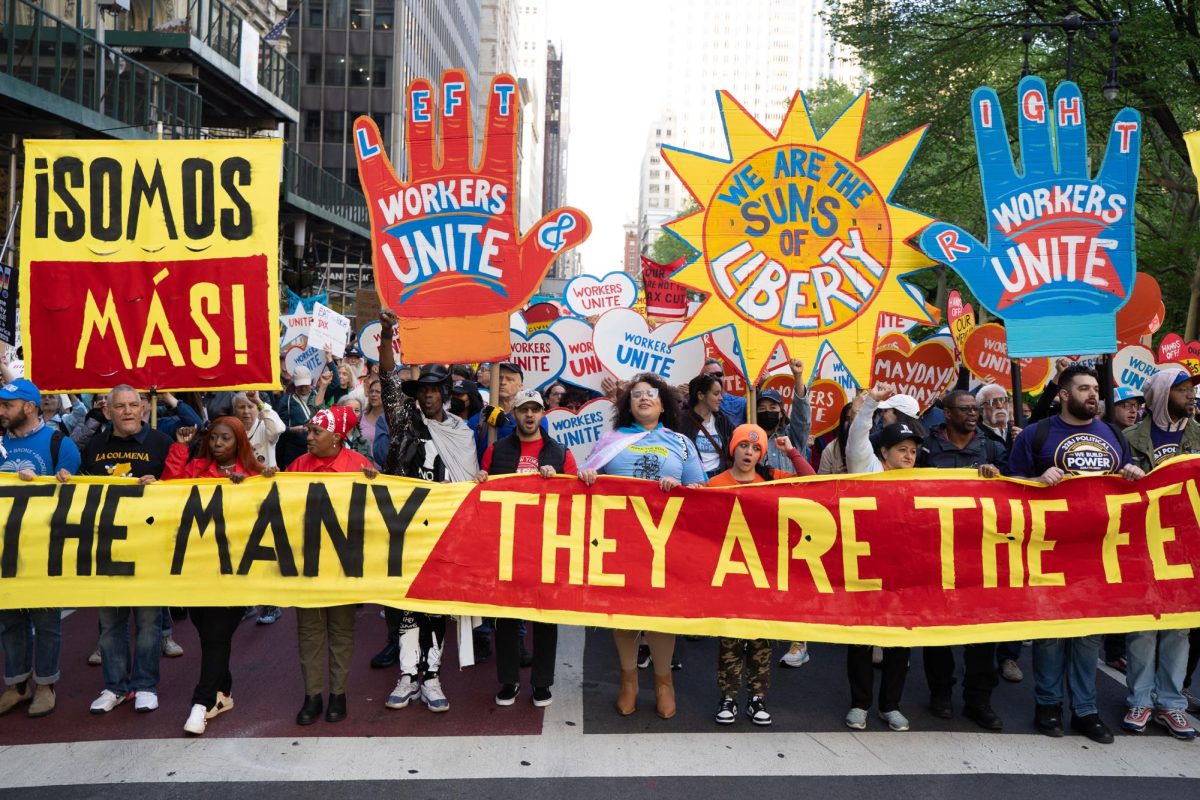





















































































Live BlogSince its start in January, Fast Food Forward movement has organized fast food employees across New York City to push for higher wages and the right to unionize.
The movement began with employees in a number of fast food chains in the city organizing with the help of local economic justice coalition New York Communities for Change.
At the end of last month, the campaign held its biggest demonstration that involved a day-long strike of 200 employees at more than a dozen fast food restaurants. The employees, whose current minimum wage is $7.25 an hour, are demanding a pay of $15 an hour.
“The goal of the workers’ campaign … is to get New York’s economy moving again by putting money back in the pockets of the 50,000 men and women who work hard in the city’s fast food industry but still can’t afford basic necessities like food, clothing and rent,” Fast Food Forward said in a press statement last month.
The group’s online petition has accumulated more than 20,000 signatures so far.
In response, Scott DeFife, executive vice president of the National Restaurant Association, refuted the statements of movements like Fast Food Forward.
“An overwhelming majority of employees describe the restaurant business as an industry of choice,” DeFife said. “The New York City restaurant industry is to be commended for providing jobs through a sluggish economy.”
Jeff Goodwin, a published expert on social movements and a professor of sociology at NYU, said the few efforts in recent history to organize fast-food and other low-paid service workers have mostly failed.
“[They] have met resistance from the large corporations that dominate this sector of the economy,” Goodwin said. “These workers are also easily replaced compared to more highly skilled workers … and they often just fire union organizers.”
None of the 200 workers on strike have been fired.
William Greene, an economics professor at Stern School of Business, was also critical of how much impact Fast Food Forward could have.
“It is premature to call this more than a protest,” Greene said. “Unionization is not something done overnight; it takes a huge organized effort and ultimately, involves government intervention by the [National Labor Relations Board].”
But Simone Goldenberg, 34, of Brooklyn was more sympathetic to the cause and signed Fast Food Forward’s online petition. She said that the $15 an hour salary Fast Food Forward is demanding is more than she earns at her job at a local bookstore.
“The issue of ensuring that people earn a living wage is still critical, and I’m relatively optimistic the movement will achieve something,” Goldenberg said.
However, Alessia, an employee at a McDonald’s in Brooklyn who spoke on the condition of anonymity, was not as optimistic.
“I think it’s a long shot, and it’s probably not gonna happen,” she said.
Even though Alessia is pessimistic of the outlook, she said she would openly welcome such a change.
“Of course I would love for that to happen,” she said. “When people think you’re going nowhere in life they say you’ll be working at McDonalds your whole life, but it’s not as easy as some think. I think we deserve it.”
A version of this article appeared in the Tuesday, Dec.11 print edition. Andrew Karpan is a staff writer. Email him at [email protected].