


















More than just a concrete jungle
Under the Arch
More than a concrete jungle
Residents find community in New York City’s green spaces, but they often pay the price for it in their rent.
Ciara Lang, Deputy Magazine Editor | April 20, 2026
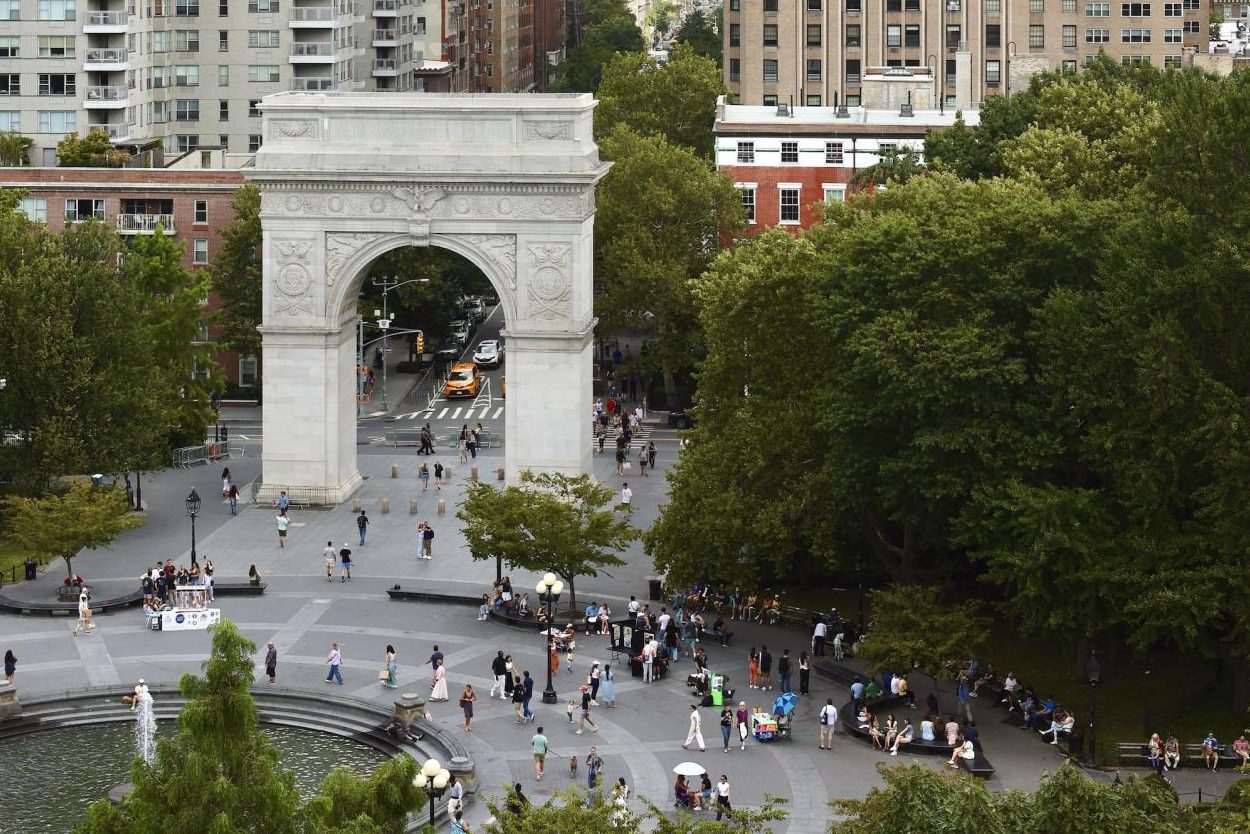
For decades, New York City has been known as the concrete jungle — a moniker that leads outsiders to believe the city is a place devoid of greenery. But those of us who live here know that these stereotypes fail to paint a full picture: In between the sidewalks, on terraces and in publicly planned parks, nature finds ways to emerge, allowing us to flourish alongside it.
At New York City’s founding, parks were maintained by the mayor’s office until the establishment of the Department of Parks and Recreation in 1870. It was instrumental in developing green spaces like Central Park, the High Line and Washington Square Park, all of which have become urban oases for nature. Beyond these larger parks, greenery can also be found throughout the city, from the tree-lined streets of the West Village to the rows of flower bouquets outside of bodegas. Greenery offers a reprieve from a harsh urban environment, providing the space New Yorkers need to have a moment of peace, take a breath of fresh air or simply look at something beautiful.
“Having a place to sit on a bench, see some trees, touch some grass — it’s definitely really important,” Sarah Olcott, who grew up near Elizabeth Street Garden and now volunteers there, said in an interview with WSN. “Something about this place, people are just the best versions of themselves when they’re here.”
Elizabeth Street Garden, one of the few green spaces in the NoHo neighborhood, fosters a strong community for New Yorkers through a number of local events and volunteer opportunities. It was for that community that local activists spent 12 years fighting New York City’s plans to destroy the garden and build affordable housing units, in an effort to counteract rising rents. However, when former Mayor Eric Adams made the garden a public park — while Mayor Zohran Mamdani fought to turn the lot into affordable senior housing — it fueled the debate about the role of public green space amid an affordability crisis.
These communal parks are so crucial to New Yorkers because the concept of having a backyard in most of Manhattan is a joke. As NYU students, we are specifically reliant on the parks around campus, chiefly Washington Square Park — unless you live in one of the few dorms with a courtyard like Carlyle Court, Third Avenue North or Othmer Hall. For the rest of us, there are multiple smaller spaces tucked around campus, like the Sasaki Garden or the Vanderbilt Hall courtyard.
“I feel like people here appreciate it a lot more because there’s a lot less,” Tandon senior Eric Melendez, who lives at Carlyle Court, said in an interview with WSN. “Having the green space that’s just for this set of buildings is very, very special.”
Just as Elizabeth Street Garden can foster community for its neighborhood, communal green space in a housing complex can do the same. These spaces, dedicated to the simple enjoyment of the residents, can feel more intimate and soothing than large New York City parks — which feel forcibly incorporated into the urban landscape. They also let you build relationships with people in your residential community.
“It allows people to kind of have another shared space,” CAS junior Zoya Sawal, who also lives in Carlyle Court, told WSN. “It reminds me that there is a community.”
The ability for green spaces to bring people together is one of their most powerful features. According to NYC Parks, parks and recreation spaces take up 14% of the city and 99% of New Yorkers live within half a mile of one. These spaces are more than just undeveloped areas where you can stop to rest — rather, they boast hundreds of baseball fields, tennis courts and playgrounds, as well as thousands of basketball courts. These existing spaces bring people of varying social classes together, blurring the disparity of living conditions that housing in the city is known for.
The act of developing green spaces directly correlates with increasing housing prices in the area. For instance, the value of housing around the High Line rose 35% after its implementation in 2009. This disparity is unfair, proving the need to prioritize making green space accessible to all community members — despite their housing budgets. Research has long proved nature’s positive impact on mental health, as well as its numerous health benefits by providing people with a space to exercise, minimizing pollution and reducing local temperatures. Efforts to incorporate nature in housing building’s infrastructure, while also prioritizing affordability, is crucial.
If you don’t have a courtyard or rooftop terrace, there are other small ways to incorporate greenery in your apartment and still reap the benefits. Simply adding a few beautiful plants on your windowsill can help you reap some of the psychological benefits that nature provides. New York City is also home to over 550 community gardens, and volunteering at one can be a way for you to incorporate nature into your life without paying the premiums for it to be in your residential community.
“I have some flowers,” Sawal said. “When it was really cold outside, bringing those inside kept me excited for being outside and seeing more green all over.”
The concrete jungle has more to offer beyond the skyscrapers if you know where to look. Whether to grab some fresh air or ground yourself in your community, appreciate the pockets of nature the city provides.
Contact Ciara Lang at [email protected].

Ciara Lang is a sophomore studying journalism and environmental science. She loves going on long walks to explore new neighborhoods and finding cute coffee...

Neil Tawney is a first-year studying business and technology management. When he’s not studying in Bobst, you can find him outside of Palladium getting...