



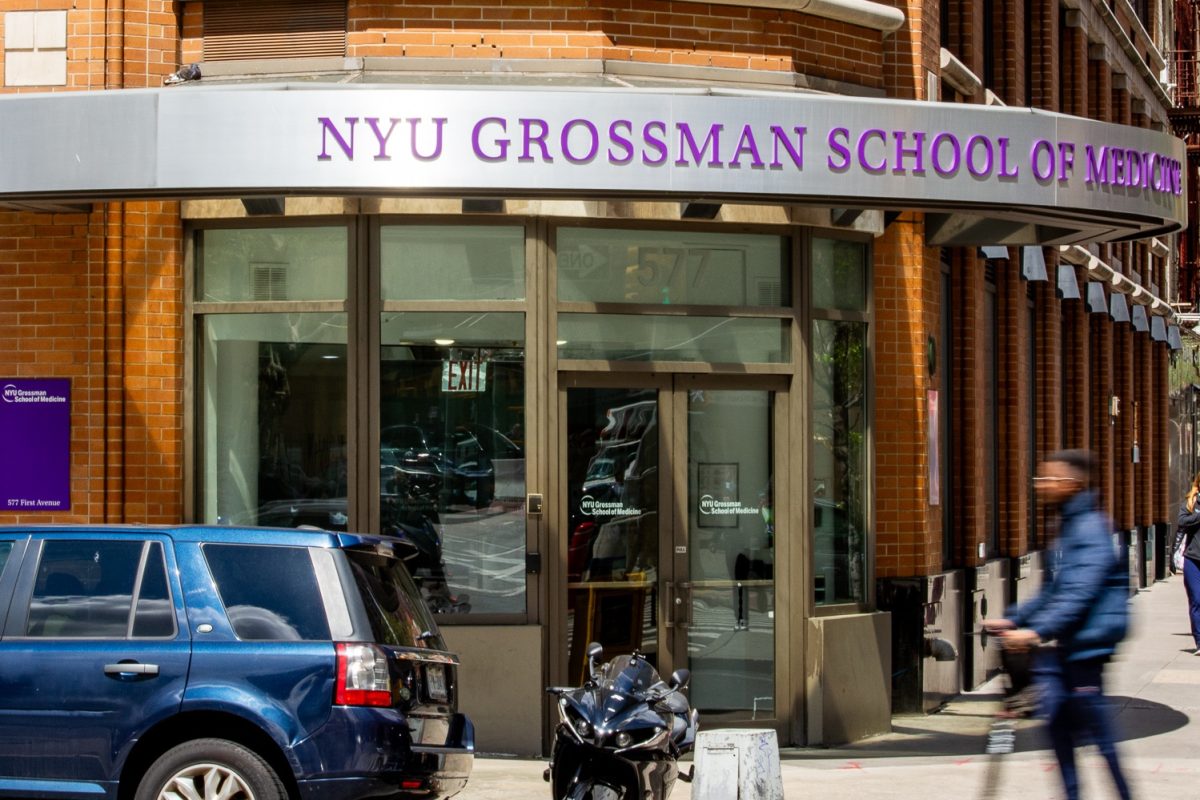


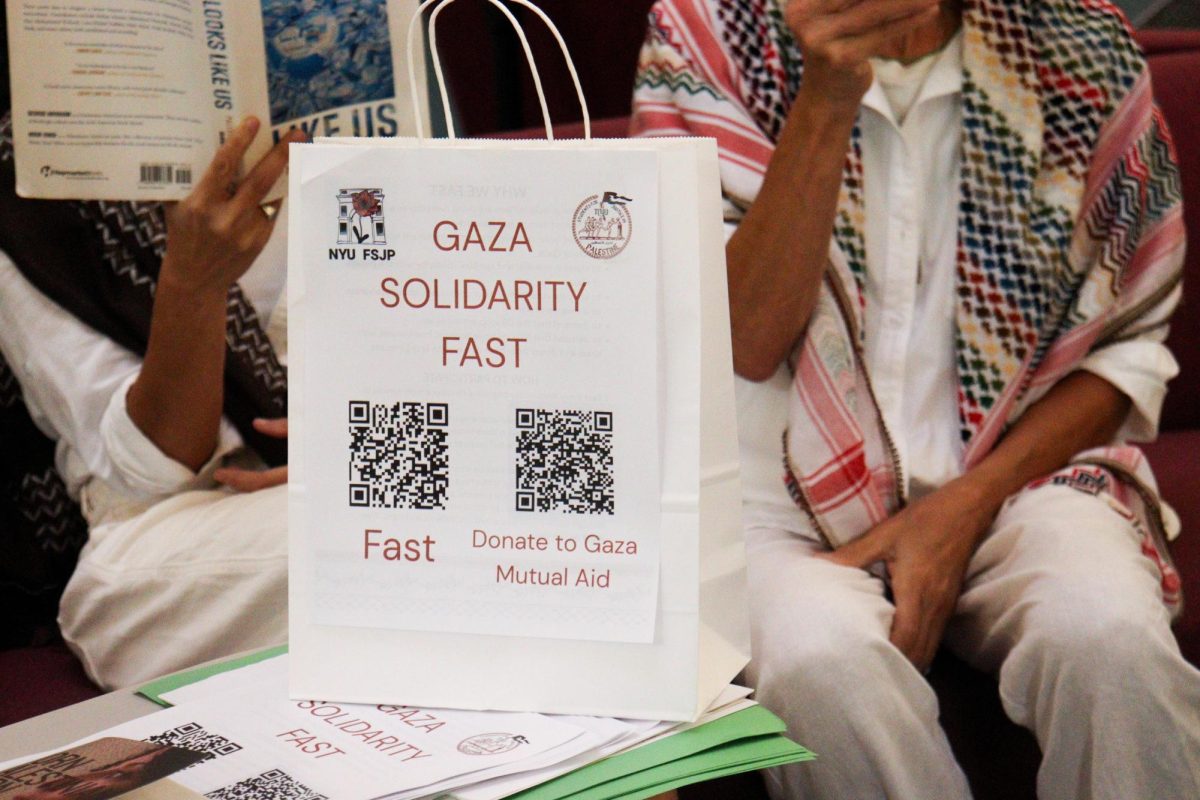

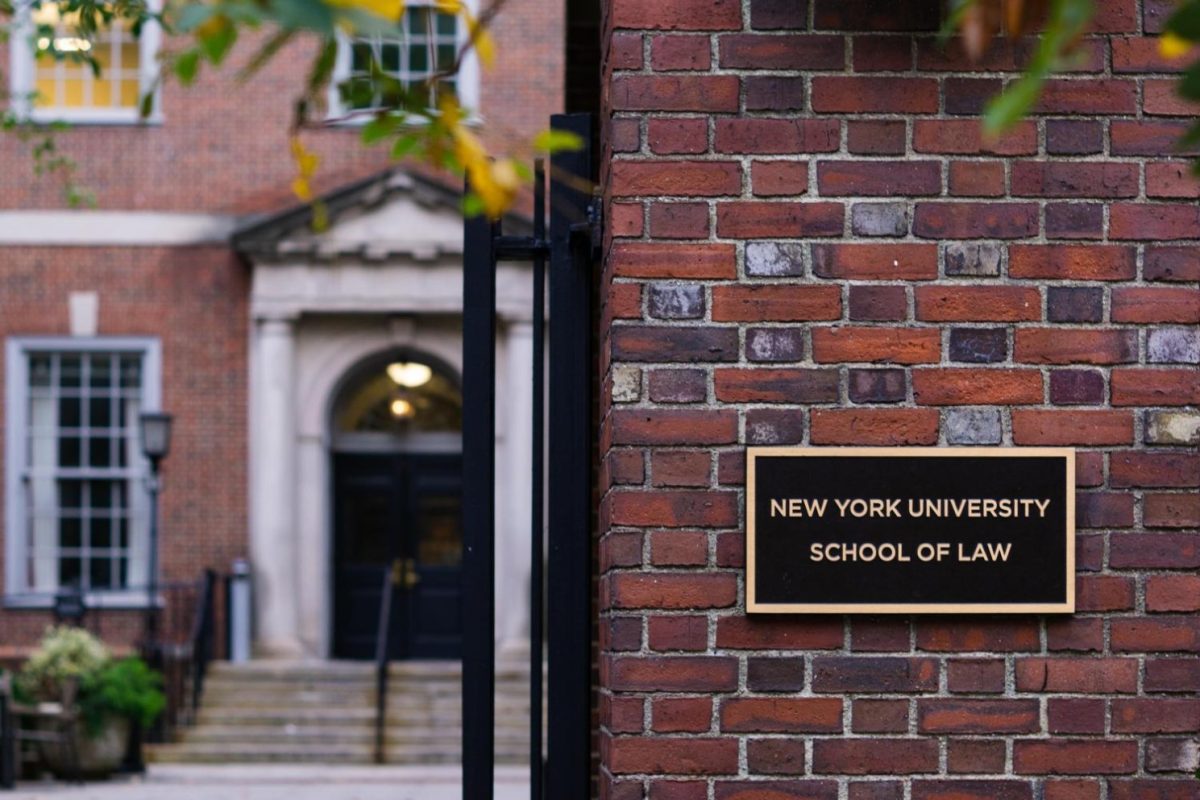


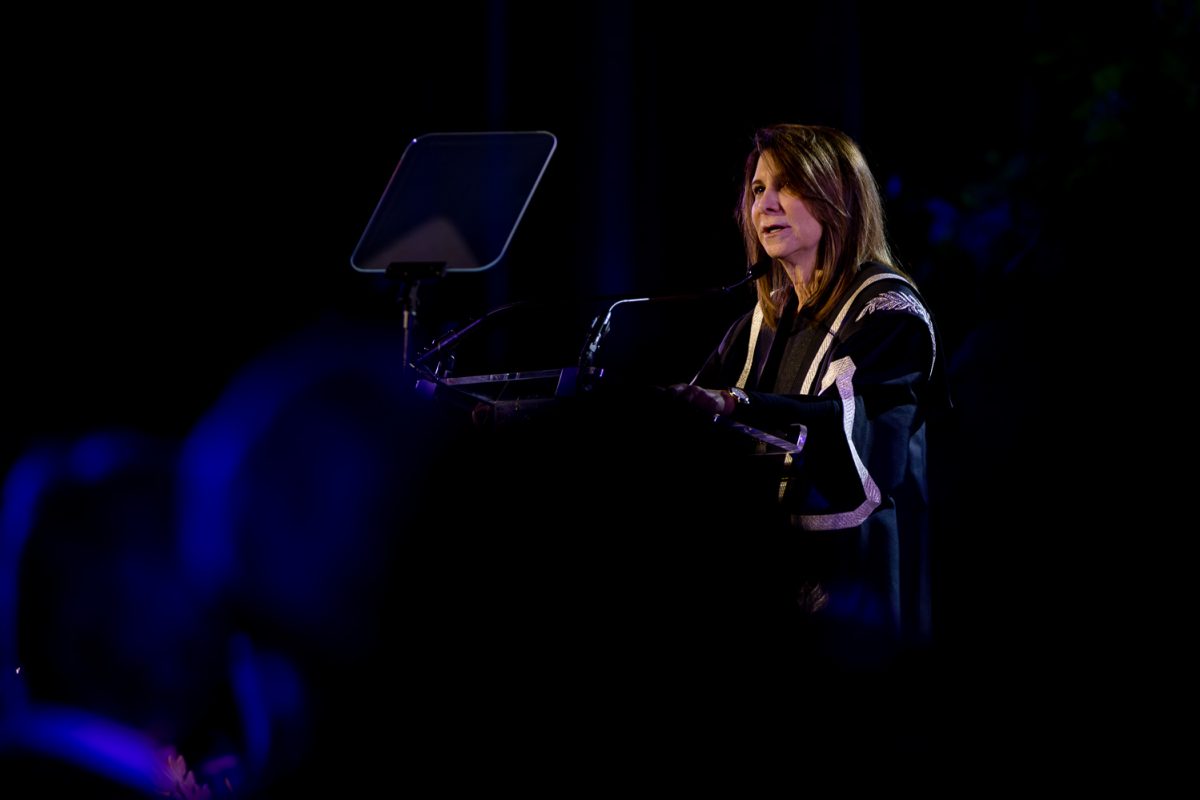










Members of NYU’s Faculty and Staff for Justice in Palestine discussed the group’s investigation into the university’s yearslong crackdown on pro-Palestinian speech with around two dozen students and faculty at a press conference Wednesday morning.
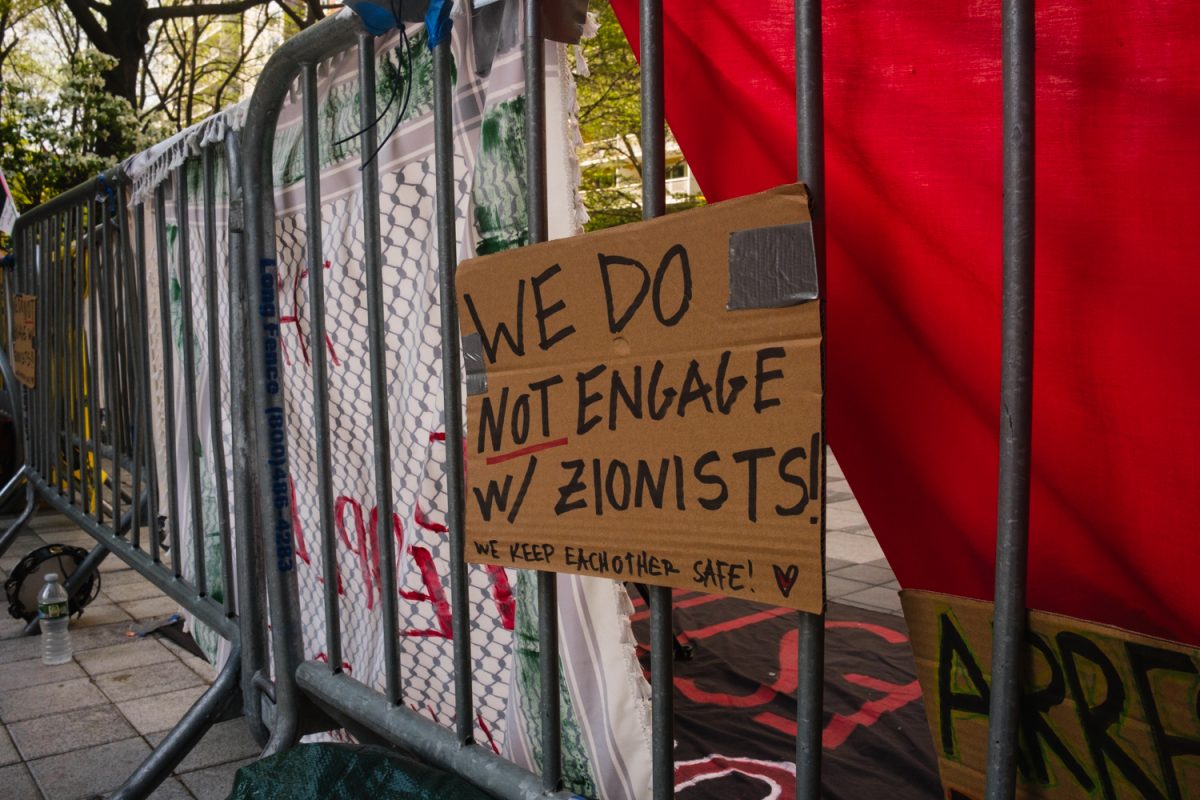
Faculty members took turns sharing testimonies of their experiences with NYU’s disciplinary measures for protesting Israel’s siege in Gaza after October 2023. Professors said the event, held on the corner of West Fourth Street and Mercer Street, was originally scheduled to take place in Gould Plaza — in recognition of two years since police swept NYU’s first Gaza Solidarity Encampment — but was relocated down the street because of the construction wall outside the space.
FSJP announced its investigation on Tuesday, a tribunal consisting of legal experts who will hold a series of hearings probing into how administrators sanctioned students, faculty and staff for pro-Palestinian speech. An NYU spokesperson previously told WSN that the tribunal is of “no service to the cause of free expression on campus” and that “division can’t replace dialogue.” In a speech, CAS professor Sara Pursley challenged the university’s statement, claiming that it has divided campus spaces like Gould Plaza with barriers.
“Our university administrators do not get to decide what counts as free expression,” Pursley said. “NYU’s administration would rather prevent any potentially political gathering of its community members than risk another such public expression of solidarity with Palestinians.”
A university spokesperson did not respond to multiple requests for comment.
Pursley told the crowd that the university’s “longstanding Palestine exception” to freedom of speech and academic freedom “has been institutionalized” — citing NYU’s code of conduct, which lists “code words, like ‘Zionist,’” as examples of speech that could violate its Non-Discrimination and Anti-Harassment policies. She added that one of the tribunal’s goals is to preserve historical memory and hold NYU accountable, “at least publicly.”
Members asked students, faculty and staff affected by university disciplinary measures in the last few years to send FSJP an email providing their testimonies either publicly or anonymously. The tribunal — whose investigation will take place over the 2026-27 academic year — will review individual testimonies before issuing a cumulative report including recommendations.
At the event, which lasted around 30 minutes, CAS professor Sonya Posmentier spoke about her arrest after a protest outside Bobst Library in December 2024 and subsequent persona non grata designation, which barred her from entering multiple university buildings. She told WSN that FSJP has already heard from multiple people who expressed interest in testifying, including alumni who faced disciplinary action for Palestine-related speech before October 2023.
“We’re beginning the process of soliciting testimony,” Posmentier said. “There’s a lot of fear and anxiety about coming forward to speak. Students really were affected far more drastically by the suspensions and disciplinary actions than faculty on the whole, so it’s especially important that we hear from students and alumni.”
Posmentier was one of two faculty members arrested at the Bobst demonstration and among eight designated PNG following a separate sit-in the day prior — a status also issued to multiple students. She said a judge dropped charges of “trespass” and “disorderly conduct” three weeks later, but that “no explanation has ever been given” for the group’s PNG status. CAS professor Andrew Ross, the second arrestee at the protest, told WSN the tribunal aims to “capture” the time period’s events while people’s memories are “relatively fresh.”
Posmentier also demanded that NYU — while evacuating students and faculty from its Abu Dhabi and Tel Aviv campuses, temporary closing the sites, amid the United States and Israel’s war with Iran — acknowledge “the destruction, invasion and scholasticide of universities and schools” in Gaza, the West Bank, Lebanon and Iran. On Wednesday, NYU Abu Dhabi said it is expanding access to brace for students’ gradual return back to campus.
Gallatin professor and FSJP member Vasuki Nesiah, who organized the tribunal, said the investigation’s aim is to affirm academic freedom and the values of “dialogue, critique, community and learning that are central to the university’s mission.” Nesiah said she hopes to hear from administrators responsible for carrying out sanctions following the initiative.
“Indeed, many of the students, staff and faculty who faced sanctions were standing up for precisely these values when they were sanctioned,” Nesiah said. “Against the negative force of repression, a tribunal is a positive and constructive step to remember, to record, to learn lessons for the future and to bring the university together in collectively reflecting on the challenges of the last few years.”
Two years ago, hundreds of students and faculty set up a pro-Palestinian encampment on Gould Plaza and held demonstrations in the area. Following threats from Campus Safety head Fountain Walker to arrest protesters who refused to leave the plaza, NYU authorized police to sweep the encampment. Officers zip-tied and pepper sprayed protesters and arrested over 130 students, faculty, alumni and community members for allegedly blocking traffic and engaging in “disorderly conduct.” Tisch professor Kathy Engel, who was arrested in Gould Plaza, recounted a positive experience of “shared songs, readings, a Passover Seder and more,” before she was “hauled off by the NYPD” that evening. She said she witnessed how her colleagues and students were subject to physical violence by officers.
“We have been and are subject to the Palestine exception,” Engel said. “The tribunal we are launching constitutes necessary action to safeguard against campus repression, fear mongering and to ensure academic freedom.”
At the end of the press conference, retired CAS professor David Ludden — also arrested at Gould Plaza — said that when he participated in the demonstrations as a college student, he was never arrested without any warning.
“Instead of talking to members of their faculty and to their own students, they called the NYPD to drag us out and take us to jail,” Ludden said. “I was zip-tied very tightly behind my back. They wouldn’t loosen the zip ties — it was quite painful.”
Leena Ahmed contributed reporting.
Contact Yezen Saadah at [email protected].
Izzy • Apr 23, 2026 at 10:27 am
Or, hear me out, chanting “globalize the intifada” is despicable and a violation of the university’s anti-harassment and anti-discrimination policy.