




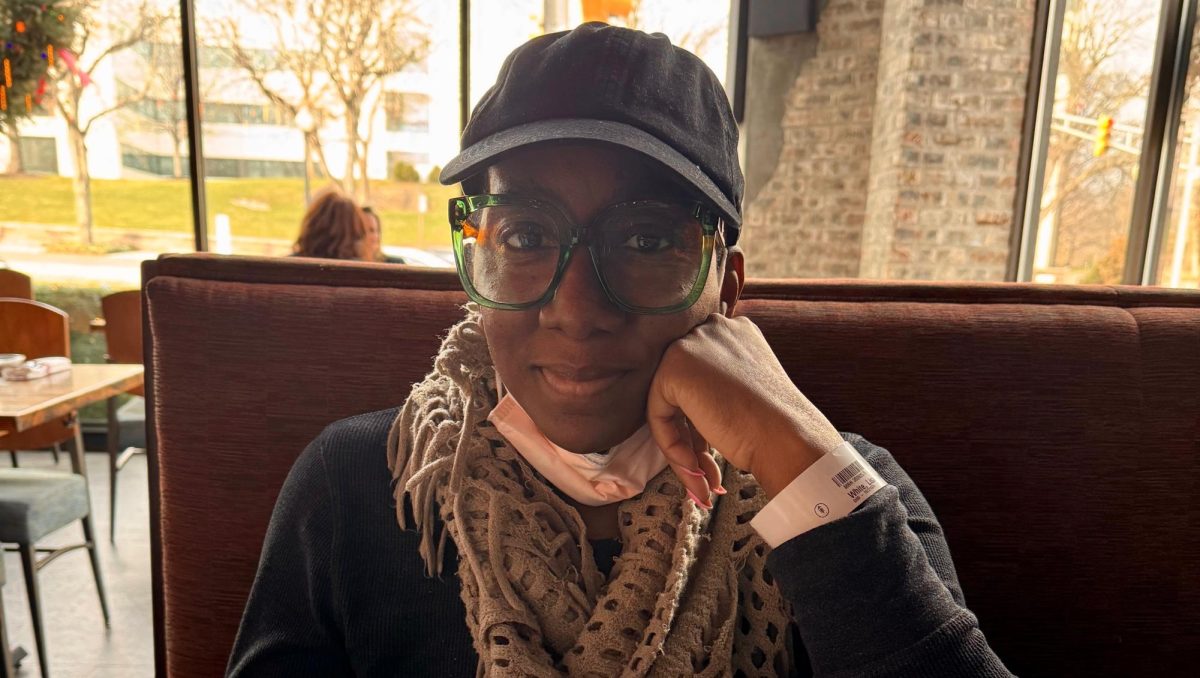























WSN: Welcome back to In the Huddle, a podcast by the Washington Square News. I’m Sayako Ikeda, deputy sports editor at WSN, and joining me today is Emma Grunin, a senior thrower on the women’s track and field team. She competes in javelin, discus and shot put, and recently won the UAA championship in javelin. Thank you so much for joining me, Emma.
Grunin: Yeah, happy to be here.
WSN: So before getting into your career here at NYU, I wanted to ask, how did you get into throwing in track and field?
Grunin: So I was on the track and field team as a shot putter. I kind of got into that just because I knew it was one of those sports where power was a bigger deal rather than speed. I’m not super fast. I’m not super — I don’t have great endurance, you know? But I’ve always been more powerful, like, just naturally strong. So I kind of knew that it would play to my strengths a little bit — shot put. And then my coach saw me throwing the football, and he was like, oh, that would be really good for javelin. And so, I tried javelin, and then that became my main event, ’cause it just very quickly became what I was strongest with in general.
WSN: Yeah, and then what about NYU specifically? Like, back when you were a freshman, what drew you to NYU athletics?
Grunin: I definitely didn’t choose NYU because it had DIII athletics, but it was not, not a factor. I knew that it would be feasible for me to compete at the college level if I went to a DIII school, just based on stats, which I think appealed to me for sure. And so when I realized that NYU fit with what I was looking for academically and just in other ways, I decided, why not throw athletics in there, you know? Because, of course, it’s great for building community, making great friends. You get to travel for free, which is really nice. So I just think there were a lot of good perks. I was like, why not go for it?
WSN: Yeah, and adding on to that idea of community: As someone who’s been a part of the NYU track and field team for four years, could you talk a bit about the team culture and how you feel your role has kind of changed over the years?
Grunin: Oh, so our team culture has changed quite a bit every single year. When I came in, the coach I was emailing with about joining the team was gone by the time I got here, and then we kind of had a new coach starting in the winter when I got here, which was after most teams had already started training. So we started very late ’cause we had a new change, a change in leadership. So our culture has been really, very susceptible to change every single year because we had a coach for a year and a half and then he kind of got fired and then — there’s just been a lot of change of leadership. So the team culture has definitely gone from freshman year, it was not super conducive to top performances because there wasn’t a great culture of being on time and putting full effort and all. But over the years it’s gotten better. And I think that my year, the current seniors, have done some work to switch that around by just holding each other accountable and making sure everyone’s showing up, everyone’s on time, everyone’s putting their best foot forward, you know? So it’s changed quite a bit, but I would say it’s at a better place now.
WSN: That’s good. Yeah, and then, since NYU is kind of unique in the sense that it doesn’t really have a campus, I’ve heard that you guys have to travel quite a bit for training.
Grunin: Definitely.
WSN: But, could you talk a bit about how practice has shaped your schedule as a collegiate athlete?
Grunin: Yeah, I would say it’s been good in general that everything is kind of in the morning for track and field. Like the way the tennis team, they practice at night, at like 8 or 9 p.m. — very different vibe. So we do every morning, so I’ve had to wake up very early. I’m such a night owl, so that’s been a very weird change of pace for me through college. We are currently commuting to New Jersey every morning, so we drive to this place in North Jersey and Bayonne. It takes like 20, 30 minutes to get there, and then it takes sometimes like an hour and a half to get back because of how bad traffic is in the Lincoln Tunnel, getting back to New York. But yeah, the commutes are kind of crazy. And then in the winter, we go to the armory, which is on 168th Street. That commute — where I’m living now, it’s probably 40 to 50 minutes because we live right on the right line to get there, on the ACE — but it used to take like over an hour and we had to do that every morning, there and back. So it’s pretty intense. The travel time alone adds a lot to the time commitment of the sport. But I feel like it’s definitely something that’s brought us together as a team, and now I live with two of my teammates, so it’s nice we could commute together. So, it’s definitely been an obstacle, but not an unwelcome one. I don’t mind it.
WSN: Yeah, and then getting into your recent achievements, obviously you won the UAA title for javelin, and you’ve had a great season, but how do you feel personally about your performance in your final season?
Grunin: I would say so far, I’m very glad I won the UAA; it was kind of always stressed to us that the conference meet was the big one where we all wanted to perform our best. We wanted to put up a good fight and give our team the opportunity to potentially not get last place in the UAA. Our team is very small compared to the other team, so it’s very hard for us to be competitive on the whole team level. But, it’s always been emphasized as this big meet, so to win it, my senior year was really cool. It definitely felt like a nice climax for my senior year. But I definitely, I have one more goal: I really want to get the school record. We’ll see if it happens or not. But yeah, so far I’m happy with my season.
WSN: And then going way back to the beginning, do you remember what your goals were like as a freshman coming into NYU?
Grunin: I definitely think one of my predominant goals was probably to win the UAA, or even maybe just to get on the podium, which I ended up doing sophomore year, which was also a very high point for me for sure, athletically. So I’d say that was one of my goals. So that’s great.
WSN: Yeah that’s really great.
Grunin: And then the other one would probably be the school record, which has yet to happen, but we’ll see. And then from a more abstract way to interpret the question, I feel like just building the deep friendships I’ve been able to make, lifelong friends — one of my roommates who I’m probably gonna be friends with for the rest of my life, Kai [Aravena]. So I think just that alone is also a goal accomplished. You know, it’s something that I’m very happy to be able to walk away from NYU athletics with.
WSN: And then kind of adding onto that, are there specific things you’ve learned from your journey here? How do you feel like you’ve grown as a person throughout your career?
Grunin: I feel like a lot of the lessons it has taught me just have to do with sticking with something, staying committed, even through all the hardship. There’s so much time management involved; you have to wake up even when you really don’t want to. And there’s the commitment to the team, building each other up, contributing in a team environment. There’s some slight leadership in creating a good culture for the underclassmen — we don’t have many underclassmen, but it’s still something you try to do, making it a good experience for them and making sure that they can pass that on to the people under them. So I feel there’s a lot of the classic athletic stuff that you learn: the hard work, the collaboration.
WSN: Just to close off, as you close out your senior year, are there any comments you want to make reflecting on your journey here? Any regrets or anything you’re specifically really grateful for?
Grunin: I would say no regrets. I think I’m very happy with how everything’s gone. I’m definitely most grateful for the friends I made, and the experience I got to have of traveling with my friends and cheering each other on. The vibes that attract me are honestly really incredible, even though it can be a little bit like long, dull, boring, tedious, you know? A good example is the 4 by 4, the last race at most meets; at conferences, for example, everyone’s running across the field to watch their teammates, then they’re all running back, and it’s just this big climactic finish. Just the energy in that space is something really special that I’ll probably never forget. But really it all just comes back to the people. I’ve met some really awesome people. We just have such a good time together. So that’s the biggest takeaway: It showed me what a community can look like, and how much fun you can have with a group of people, you know?
WSN: I think that’s a really nice note to finish on. Thank you so much for joining me today, and congratulations on an incredible career. And I hope you get your record.
Grunin: Thank you. I appreciate it. And thank you for having me.
WSN: Of course.
Grunin: It’s been a pleasure.
Contact Sayako Ikeda at [email protected].