
























Disclaimer: We put “Israel” in quotations so as to not affirm the illegitimate Zionist project claiming statehood.
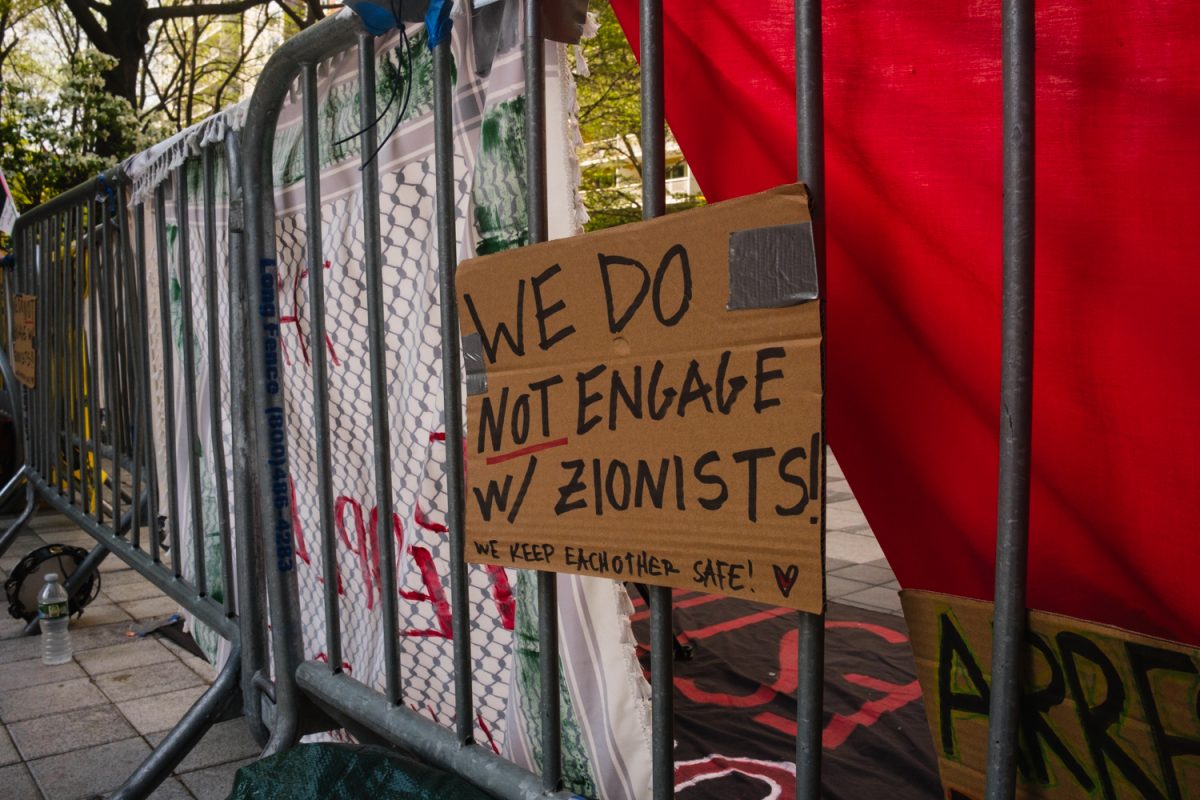
Earlier this week, an op-ed published in WSN argued that anti-Zionism is, and “always has been,” antisemitism. As members of the student collective Jews Against Zionism, we firmly reject such conflation.
First, we feel it is necessary to clarify the definition of antisemitism and Zionism. Antisemitism is prejudice or discrimination toward Jews because they are Jews, which has been the cause of centuries of persecution and violence toward Jewish communities. Zionism is a political ideology that weaponizes Jewish identity in service of a settler-colonial project.
The author of the op-ed defines Zionism narrowly as “the belief that the Jewish people have the right to self-determination in their ancestral homeland, and that Israel has an inherent right to exist as a Jewish state.” This definition not only makes Zionism out to be an abstract and aspirational political idea, but omits the reality of Zionism as violent in its ideology and practice — understood by its own architects in terms of colonialism, apartheid and displacement.
The author states that ideologies should be understood not by what they say, but by what they do. By that standard, Zionism must be forcefully condemned on all accounts. In practice, Zionism murders, maims, displaces, kidnaps, tortures, bombs, starves, ethnically cleanses and occupies. Zionism implements AI-powered genocide in Gaza, launches together with the United States a criminal war of aggression against Iran, a war of occupation in Lebanon marked by mass displacement, the systematic destruction of civilian infrastructure and indiscriminate bombing. Zionist occupation forces massacre healthcare workers and attempt to bury the evidence with bulldozers. Zionist occupation forces raze entire schools, neighborhoods and villages in Gaza. Zionist occupation forces target synagogues across the Middle East. Zionist occupation forces, in collusion with Zionist settlers, displace Palestinians from their ancestral homelands in the West Bank.
Far from being new, these tactics are in reality a continuation of early 20th-century British strategies for the occupation of Palestine, which Zionist settlers then inherited and implemented going back at least to the first days of Lehi and Irgun paramilitary terror in the 1940s. Crucially, the Zionist state implements these policies in the name of Judaism. It is this specific association, the Zionist claim to speak in the name of all Jews, reproduced again and again in fact and discourse by “Israel” at constant.
We agree that all students should be free to express their identities without fear. But the author mistakes disagreement, discomfort and conflict for ethnic and religious discrimination, thus shielding a political ideology by conflating it for a protected identity. Criticizing or calling out Jewish individuals for their actions or political affiliations is not, in itself, antisemitic — even if they consider those alignments part of their identity. This would be akin to claiming that Hindu nationalist ideology must be protected, because it is an essential part of Hindu identity. Moreover, the op-ed relies on perception-based data regarding Jewish students’ feelings of safety rather than empirical facts. Subjective discomfort or disagreement with political movements is not a metric of antisemitism.
We also find it important to resist centering the discomfort of Zionist Jews or isolated antisemitic incidents in an honest discourse on the current political climate. It is pro-Palestinian students, especially Black, brown and Arab students, who have faced increased surveillance, arrests, disciplinary action, ICE detainment, brutalization by police and Zionist mobs and been the target of a federal crackdown on free speech.
Students who feel “connected to Israel,” whether Jewish or not, should ask themselves why. What draws them to identify with a colonial project rooted in dispossession, extermination and apartheid? That identification isn’t natural or inevitable. In reality, it is the result of arduous ideological work spearheaded by the Zionist project, which for decades, has worked to bind Jewish communities in North America to Zionism through a shared sense of identity built on propaganda.
The op-ed’s arguments rest on the tacit affirmation that Jewish safety hinges on the existence of “Israel.” Taken to its logical conclusion, this argument would seem to imply that the Jewish diaspora does not primarily belong in their greater communities, because it cannot safely and fully do so.
At its core, this standpoint stems from the idea that Jewish people everywhere are condemned to be citizens of an ethno-nationalist state and secondary citizens wherever else they might be. This is a directly antisemitic proposition most clearly expressed in Zionists’ well-known rejection of the diasporic, “exilic” Jew and in their racist attempts to erase the Arab and broader Middle Eastern heritage and traditions of Mizrahi Jews. Taken to its extreme, this proposition suggests that the safety of Jewish people worldwide is always inchoate without the maintenance of an apartheid regime of displacement and occupation. It becomes quickly untenable if one entertains the thought that Jews deserve to be complete subjects — legal or otherwise — here in the United States or elsewhere, without having to leave and without having to claim citizenship elsewhere first. Those who share this view must begin to unspool this inherently self-conflictual position they occupy in valorizing Zionism allegedly to the benefit and safety of Jewish people. It is a position that ultimately collapses the plurality of Jewish thought and practice into only one of its political expressions: Zionism.
Nobody is holding the Zionist project to “moral perfection, military perfection and ideological perfection” that is “not expected from any other” state. “Israel” is simply failing miserably against the most conventional human rights standards. States who engage in apartheid and colonial occupation must be dismantled. “From the river to the sea, Palestine will be free” is not an antisemitic call for violence against all Jewish people, but a call for the de-Zionization of Palestine. To claim otherwise is at best intellectually dishonest, and at worst fascist.
We agree with the author that becoming better “requires saying the uncomfortable thing out loud instead of looking away.” And so we will say it: renounce Zionism! Boycott, critique and disrupt the Zionist institutions that surround us. The possibility of a just, principled Judaism — and of upholding any moral integrity at all — depends precisely on that.
Follow JAZ on Instagram @jews.against.zionism.
WSN’s Opinion desk strives to publish ideas worth discussing. The views presented in the Opinion desk are solely the views of the writer.
Contact WSN’s Opinion desk at [email protected].
FActs • Apr 28, 2026 at 1:40 pm
F You, Horrible Take – am yisrael chai!
Daniel Cohen • Apr 26, 2026 at 2:40 pm
You raise real and serious critiques, and I don’t want to flatten them. But I’d gently push back on one piece: connection to the land of Israel runs through Jewish liturgy, practice, and longing across nearly every Jewish community — even the anti-Zionist ultra-Orthodox who join these rallies are themselves waiting for an eventual return to that same land. That attachment predates political Zionism by a long way, and I think there’s room in this conversation for Jews who feel it deeply without signing onto the modern state’s project.