











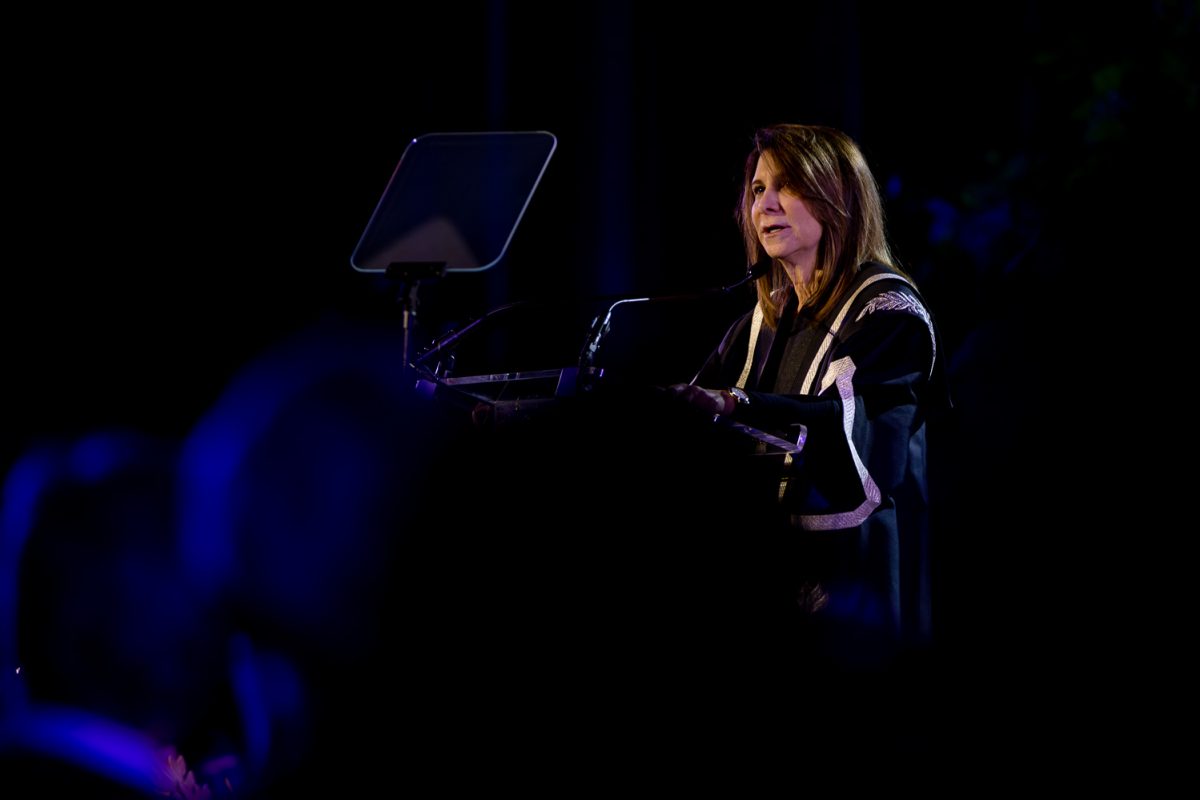













Since President Donald Trump entered his second presidential term, attacks on the LGBTQ+ community have permeated the United States and its universities. Whether it’s decisions upholding conversion therapy or NYU Langone Health’s cuts to gender affirming care for minors, queer identity has been under constant threat. Despite authoritative powers trying to diminish the queer community, CAS professor Gayatri Gopinath is committed to highlighting the artistic and organizational importance of queer communities as the director of NYU’s Center for the Study of Gender and Sexuality.
Serving as director of the Center since 2017, Gopinath has focused on programming that addresses transnational perspectives, like that of the global South, and their intersection with queer studies. With this also comes a foregrounding of queer feminism and queer people of color — in particular, their contributions to New York City life and history. From symposium events spotlighting social reproduction and Soviet and Eastern European feminism to workshops introducing the intersection of publishing with trans and queer studies, Gopinath’s programming aims to underscore global issues of queer activism as they play out in the New York and tri-state area.
“I want us to be a clearing house for the work on gender and sexuality that happens all over campus — but more than that, I’ve really tried to bridge campus and community life,” Gopinath said. “We’re in downtown New York, and that’s sort of the center, in some ways, of queer and feminist activism, organizing, artistic production. I wanted us to really be part of the city in that way.”
Gopinath first became involved with issues surrounding colonialism and migration while studying Latin American studies at Wesleyan University. However, she became drawn towards studying sexuality, migration, diaspora and gender while working on her Ph.D. in English and comparative literature from Columbia University. Inspired by the rise in queer people of color organizing in New York City in the ’90s, she focused on questions of literature and aesthetic practices while writing her dissertation. Eventually, Gopinath’s work culminated into her book “Impossible Desires” which develops a theory of queer diaspora through the lens of South Asian media.
“Becoming the director of the center just felt very natural,” Gopinath told WSN. “A kind of natural evolution of my academic, but also more my interests in relation to social justice. It felt like the right fit.”
In 2022, Gopinath was awarded a grant from the Mellon Foundation, which supports diverse communities through funding arts and humanities projects. Through this grant, Gopinath created a feminist and queer intersectional studies collective at NYU called Beyond a Boundary. The three-year initiative brings together graduate students from across New York City and the tri-state area to study feminist and queer issues through the lens of the city.
With the Mellon grant, Gopinath has also been able to work with and support community organizations. One of these organizations is Coalition Mexicana, an immigrant rights organization in the Bronx working to help Latino families integrate into American society. Another organization Gopinath works with is Red Canary Song, a Queens-based collective aiding Asian migrant massage and sex workers.
“Even though this moment feels particularly toxic, for a lot of queer-of-color communities, we have always found a way out of no way,” Gopinath said. “And so what I try to do in my own work is really foreground the endlessly creative and imaginative ways queer-of-color, queer immigrant communities have navigated these really difficult historical moments.”
Currently, Gopinath is planning “Breathing with An Other: Queer/Trans Performance Art,” the Center’s first exhibition set to open in spring of 2027 that aims to engage with the question of what solidarity means at this time of heightened state violence. The exhibition will feature performance work by both students and faculty, including Cassils, a performance artist and professor at the Pratt Institute, and the Center’s Associate Director Muna Diaf. Graduate students will also contribute critical essays reflecting on the featured artists.
Aside from her role as director of the Center, Gopinath teaches at the undergraduate level. She is currently leading the class Queer Cultures: Art, Archives, Activism for the Department of Social and Cultural Analysis, which delves into queer culture through historical and theoretical research such as the intersection between gender binaries and the prison industrial complex.
“A lot of the students who come to me are really passionate about what I’m teaching,” Gopinath said. “So they come to my class already invested, and there’s a really nice ‘give-and-take’ in that way.”
Though this period of time can be difficult for queer communities of color, Gopinath emphasizes that it is no different from other eras of oppression and that these communities will always persevere. She sees others confronting hatred and violence with wit and bravery — which are ideas she continues to introduce to the Center and her classes.
“The ways in which communities of color, immigrant communities, queer communities, have responded to this moment in really imaginative ways, gives me hope,” Gopinath said.
Contact Alessa Alluin at [email protected].