










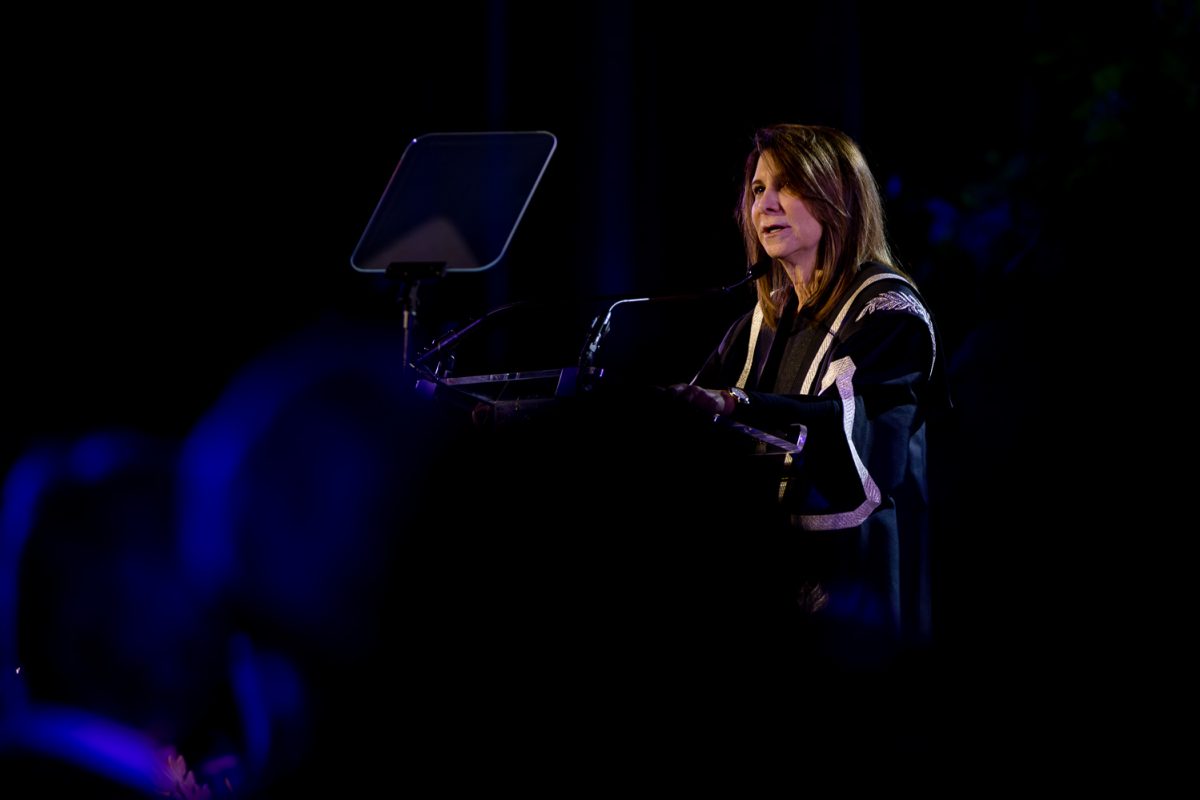

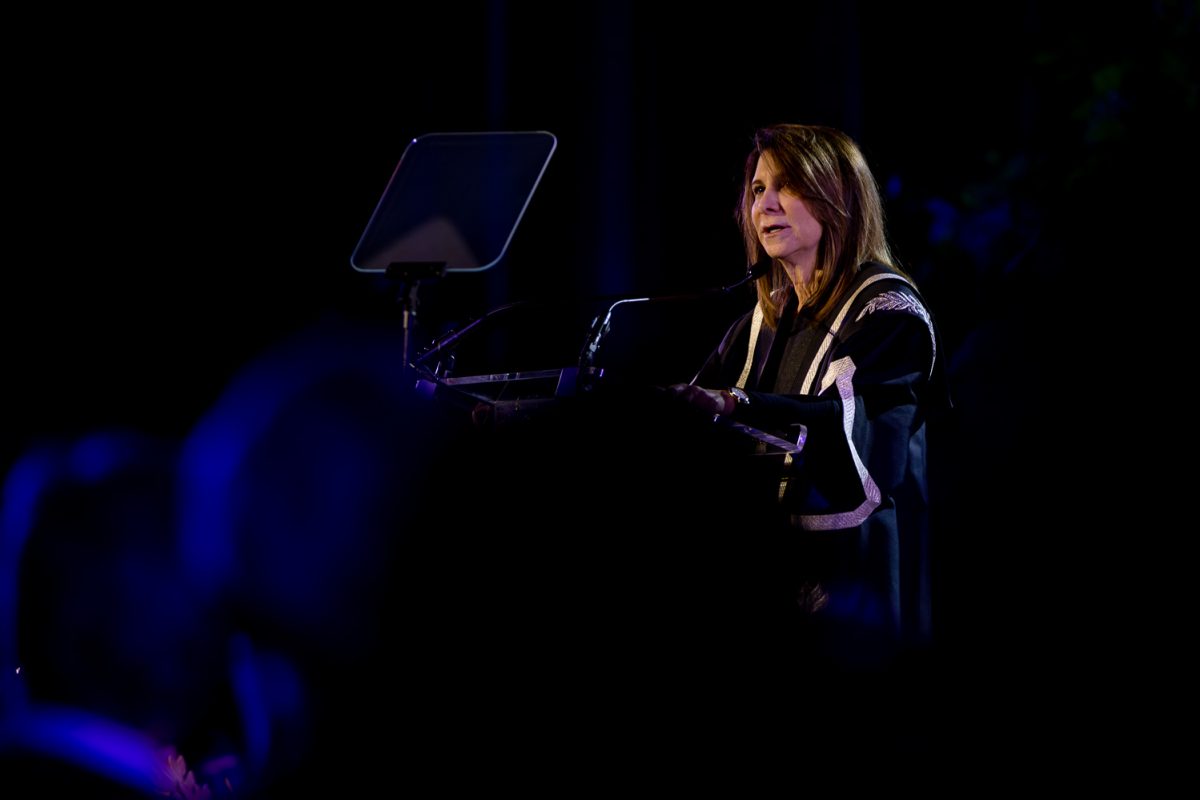










President Linda Mills said NYU “will and must do better” when responding to targeted safety threats on campus, referencing criticism of her response to last month’s hoax shooting threat at the first University Senate meeting of the academic year.
“We were remiss in not responding as quickly as could have or should have,” Mills said at the Thursday meeting, which was attended by representatives from administrative, faculty and student councils. “It was insult to injury. We will, and must, do better.”
Mills’ chief of staff Emma Wolfe said that while only a few dozen administrators received the initial email threat, which detailed plans to open fire on Black students and faculty on campus, screenshots quickly circulated among the student body. When administrators issued a universitywide alert around three hours after the initial threat was sent, they described its language as “racist” but did not specify that it targeted Black community members.
The move drew backlash from Black student groups, who accused NYU of willfully withholding information. Mills sent her first universitywide communication about the incident a few days later, where she condemned the threat and said she offers her “full support to our Black students, faculty, administrators and staff.”
Wolfe said that administrators are currently speaking with students and faculty about the incident and taking suggestions to improve NYU’s broader safety conventions.
“Both from a protocol perspective and a news perspective — and also for humanity, and how we connect with our community — we did not get it right,” Wolfe said.
Patricia McSteen, senior associate vice president and deputy for campus safety, said that when responding to campus safety developments, administrators aim to prevent “fatigue” from false, “swatting” threats. She said that Campus Safety immediately reaches out to the New York City Police Department, but that when threats are not deemed credible, administrators try to minimize “unnecessary anxiety” — sometimes limiting communications.
Wolfe said that the “swatting” threats are increasingly common across universities. When NYU received its hoax threat on Sept. 11, more than a dozen other U.S. universities received similar messages, many of which entered precautionary lockdowns in response.
Administrators also briefly addressed the Oct. 1 government shutdown, reiterating that NYU is bracing for federal changes but has seen “minimal” impacts thus far. Chief financial officer Taylor Jantz also said that while “there is no indication” that NYU will join the nine universities facing scaled pressure from the Trump administration to revamp their political priorities, the university remains “hyper-vigilant.”
“There’s so much uncertainty here, and it’s going to require a collective effort,” Jantz said. “It really takes all of us in this room to understand what these pressures are and how we can respond to them.”
Last week, President Donald Trump asked nine universities to pledge to implement a series of demands in admissions, teaching and financial practices. The compact agreement stipulates that the universities can continue receiving federal support if they ban consideration of race and sex in hiring, cap international undergraduate enrollment at 15% and require standardized test scores for admission, among other demands.
NYU was named one of 10 universities slated for investigation in February by Trump’s antisemitism task force last semester, and one of 52 universities under federal fire for “illegal” diversity initiatives. No apparent investigation has taken place.
Jantz said administrators are “working very closely with colleges” to address challenges with international student enrollment and H-1B visa holders. NYU approved 116 H-1B visas this year, which are offered to skilled foreign workers and recently came under Trump’s attack.
Jantz added that research funds have not been significantly affected by funding cuts, but that the university is continuing to raise tuition, use more of its endowment and pursue private partnerships to bolster its financial stability. NYU enacted an ongoing administrative hiring freeze in March, and its latest fiscal year budget took a 3% cut.
“Some of our industry peers have been more proactive — there have been reductions in workforce across many research institutions,” Jantz said. “It’s unfortunate, and it shows the pressures that we’re facing.”
Contact Dharma Niles at [email protected].