


























For exhibition curator Howie Chen, humanity’s belief system can be described through a clock. The gearlike mechanism is used for the escapement: triggered by the swing of a pendulum tuned to complete its movement in one second and push a clock’s hands to advance, quantifying motion into time.
Chen asserts that the escapement “creates the illusion of control and stability through a hidden process in dialogue with infinity.” The idea that even a concept as ubiquitous as time is man-made unsettles reality. Through his newest exhibition, “Escapements,” Chen leans into this discomfort. He showcases six artists who place nature in contrast with structure, highlighting tendencies to make conventional sense out of concepts that might otherwise be inexplicable.
The three galleries composing “Escapements” are dimly lit, and each artwork seems to cast a pool of light upon the floor. Inverting conventions of light and shadow sets viewers off-kilter from the start, enabling them to shed their expectations.
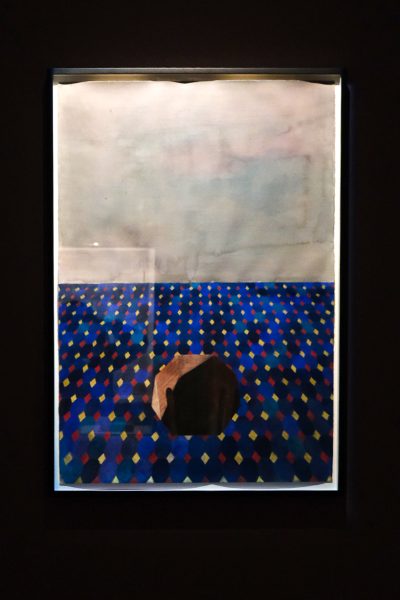
The exhibition’s second room furthers this sentiment, with pieces that challenge geography and depth to upend viewers’ expectations on a more instinctual level. Two paintings contributed by artist Adam Putnam, “(Untitled) – Hole 2” and “Tower VI,” combine vivid pastel colors and sharp perspective to depict unconventional structures. The former presents a tiled surface with a cavity, the windows drawn within the hole raising questions as to whether it’s a roof or a floor. The second piece displays a tower, which is a shadow that casts on the ground so that it appears twice as high. Putnam’s structures are sharply geometric and clever in how they use dimension, and also vertigo-inducing, leaving viewers wondering if they are looking from outwards in or inwards out at his architectural designs.
Thematically, Chen’s exhibition engages in a conversation between the spiritual and secular. Mark van Yetter’s “Fools” casts ink on paper to depict an ornate church, with people entering in their Sunday best for service. Human chaos exists just beyond the cathedral’s confines: overlapping depictions of people eating, smoking, sleeping, drinking and watching television in the nude. The piece contains contrasting imagery of virtuous acts in the face of biblical imagery and their indulgence in a natural state. It explores the surrender of instinct required to participate in institutions that are based on aspiration and self-refinement.
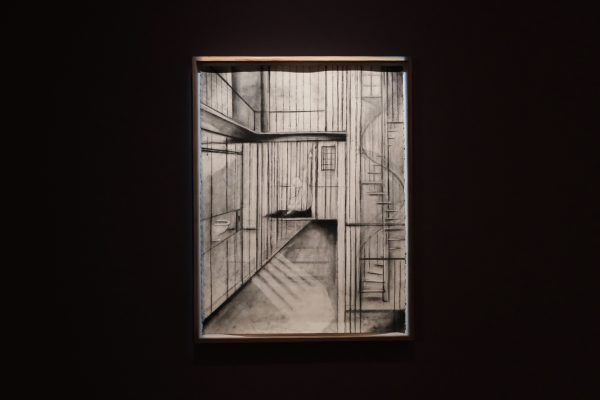
Another of van Yetter’s features, an untitled charcoal drawing, highlights the idea of self-imposed confinement. A nondescript figure sits in the fetal position in the cage’s center, but their environment is not as restrictive as it first seems — a spiral staircase stretches the height of the cage, and hallways extend off of the main structure, creating the impression that the inner walls of a home had been removed and replaced with bars. The work raises questions of seclusion in a domestic sense, situating our everyday habits and patterns as both protective and restrictive against possibilities lingering just outside.
Taína Cruz’s work, on the other hand, toys with internal possibility. The large-scale tempera painting “Stage Left” consumes the corner of the exhibition’s third chamber, and depicts an individual with pointed ears and disheveled clothing, ambling forward on all fours. The artist creates mythical elven creatures that evoke melancholia and feel evocative of the human experience of struggle.
Ultimately, “Escapements” does not propose that these physical, mental and emotional structures negatively inhibit us, or that they uplift us beyond a basic humanity that is otherwise base. Instead, Chen’s curation reminds us that consciousness of the ways we make sense of the world allows us to think of it — as well as our places within it — in a whole new light.
“Escapements” is on view at the 80WSE Gallery through Jan. 24.
Contact Eleanor Jacobs at [email protected].