
























Jane Jacobs: Village hero or harbinger of gentrification?
Under the Arch
Jane Jacobs: Village hero or harbinger of gentrification?
Twenty years after the activist’s death, her legacy in Greenwich Village remains complicated.
Sam Donagi, Deputy Culture Editor | April 20, 2026
A tension runs through the streets of Greenwich Village: one between its centuries-long history as a center for radical changemakers, and the rising cost of living that has permanently changed the neighborhood’s character.
Today, the largest threat facing the Village is the steep cost that comes with living there. But in 1961, it was the harsh shovel of a bulldozer, operated by developers carrying out New York City’s order for the area to be demolished and redeveloped.
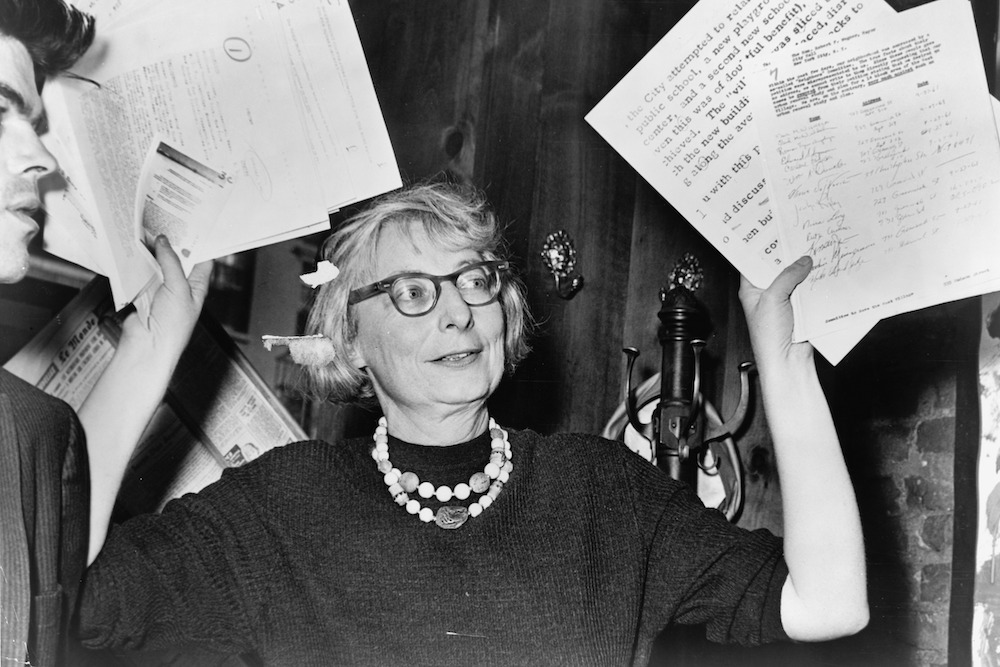
Today’s Village has largely been shaped by the legacy of Jane Jacobs. The journalist-turned-activist is credited with saving the West Village from redevelopment schemes — but at the same time, fueled the gentrification now embedded in our neighborhood. Throughout her many campaigns, Jacobs’ advocacy work often boiled down to one goal: Keep developers out of the Village.
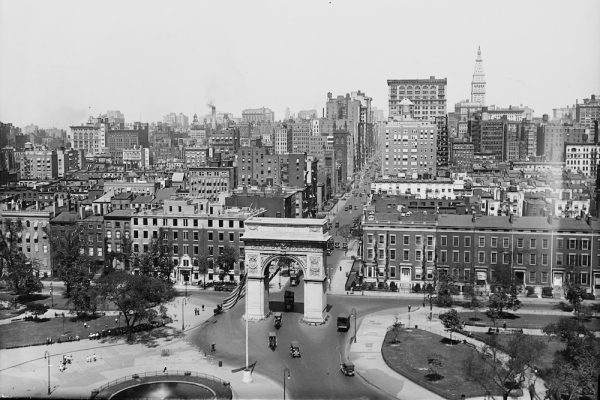
Many NYU students would feel indebted to Jacobs upon learning one of her biggest wins as an advocate. In 1958, Jacobs successfully led a campaign to remove cars from Washington Square Park, which once functioned as a de facto extension of Fifth Avenue, before warding off urban planner Robert Moses’ campaign to convert Washington Square into a four-lane highway. Jacobs would frequently oppose the ideas of Moses, who was notorious for his put-a-highway-through-every-park philosophy.
This April 25 marks the 20th anniversary of Jacobs’ death. Decades after she led opposition to some of the city’s wealthiest urban planners, what does her legacy mean for the Village, and how should she be remembered?
In the 1950s, the Village was absent of Blank Street coffee and NYU classrooms — instead the site of rundown buildings, warehouses, tenements and factories, widely seen as a blight on the city.
In 1961, the West Village was legally classified a slum — a section of the city “Containing Predominantly Non-Residential Areas Characterised by Blight and Suitable for Clearance” — and 14 blocks, from Hudson Street to West 11th Street, were set to be razed. Jacobs, who lived on Hudson Street and did not find it to be “predominantly non-residential,” founded the Committee to Save the West Village and spent much of the early ’60s campaigning for the removal of the slum classification. She eventually won substantial protections for the neighborhood, redefining much of the American consensus around urban design.
Jacobs became an advocate for walkable neighborhoods and human-centered design at a time when most Americans viewed suburban residence and car ownership as hallmarks of a successful life. Her 1961 book “The Death and Life of Great American Cities” laid the groundwork for many contemporary strains of urban design theory, emphasizing the need for vehicle-less and green spaces for residents to walk and interact with one another.
But her legacy is also rife with contradictions. As Jacobs campaigned to prevent redevelopment, she also made it more difficult to build new housing. Jacobs sought to keep developers out of the area, halt new buildings and preserve historical designs — but in the process, she froze the Village in time.
The stagnant housing supply raised prices for apartments and homes on the market, squeezing bohemian communities out of the neighborhood. Jacobs’ second book, “The Economy of Cities,” emphasized the importance of economic diversity in neighborhoods — Ironically, in the Village, that diversity has been all but lost in the last 60 years. What was once a diverse, mixed-income neighborhood is now NYU’s campus, with a median monthly rent of $5,495 for a one-bedroom apartment. Jacobs succeeded in preservation, but paved the way for a different kind of loss: gentrification.
Jacobs’ ideas are sometimes seen as precursors to NIMBYism — standing for “not in my backyard” — a term describing residents who support affordable housing in theory, but oppose its construction in their neighborhoods, often out of a desire to keep poorer people out. Her opposition to construction actively prevented the construction of new homes and businesses that would have relieved pressure on a shrinking housing supply. While term gentrification did not exist yet, Jacobs supported and coined the term “un-slumming,” which today is understood as the early stages of gentrification, when a previously impoverished neighborhood begins to pull in financial investment and new residents.
“We are 100% for improvement and we know our neighborhood can stand some,” the Committee to Save the West Village wrote in a 1962 newsletter. Improving a neighborhood sounds appealing, but local developments have historically coincided with displacement. As historian Sara Schulman wrote in her 2012 book on the West Village, “The Gentrification of the Mind,” black, queer and working-class New Yorkers were first to be driven out as the neighborhood’s price tag rose. When Jacobs pushed to preserve its character and improve its standing, she laid the foundation for the Village’s modern affordability crisis. Intended or not, Jacobs’ work turned the Village from middle-class, mixed-income and accessible into one of the city’s most exclusive enclaves.
It’s an exclusivity that NYU markets itself on, offering students a chance to live in a place that many could otherwise never afford. In doing so, NYU exacerbates only the messiest parts of Jacobs’ legacy: As the wealthiest private landowner in New York City, the university and its expansion in the Village has widened the gap between supply and demand. NYU also collaborated with the New York Police Department to force homeless individuals out of Washington Square Park, then boasted about the neighborhood’s safety to new students and families.
Jacobs herself actively protested NYU’s expansion as early as 1966, denouncing the construction of Bobst Library in fear that it would eliminate green space and block sunlight from the park. She accused the university of misleading the government and community members regarding details of Bobst’s use, alleging that it would predominantly be used as an office building and questioning the large empty space in the middle of the library — asking “Where are the bookstacks?” in an interview with The New York Times in 1966. For years, NYU fought Jacobs as it took over dozens of properties in lower Manhattan. Now, it profits off of the affluent neighborhood that Jacobs helped create.
The neighborhood that many NYU students take for granted would not exist without Jacobs’ advocacy. But in the process, the Village became trapped in cycles of gentrification and rising prices that have reshaped the community at its core. Being responsible citizens of the Village means knowing its history -– and her history — in all its contradictions.
Contact Sam Donagi at [email protected].

Sam Donagi is a first-year studying anthropology and data science — while dabbing obsessively in history, sociology and inorganic chemistry. He’s in...
Tom Lunke • May 4, 2026 at 10:29 pm
As a friend of Jane Jacobs, and an urban planner, here’s a takeaway: Jane wanted investment in the Village, only it needed to be incremental and not overwhelm the character that so many people loved. The fact that it has become a wealthy enclave for many is due to many factors, one being that people want to live in human-scaled environments that one can walk through to find what they need without a car. If there is one lesson to take away from the Village transformation it’s that we need to build more human-scaled neighborhoods, not wipe them out through overdevelopment.