






















The new reality for research
Under the Arch
The new reality for research
Medical researchers are navigating a new minefield of topic limitations and funding cuts.
Dharma Niles, Editor-In-Chief | December 8, 2025

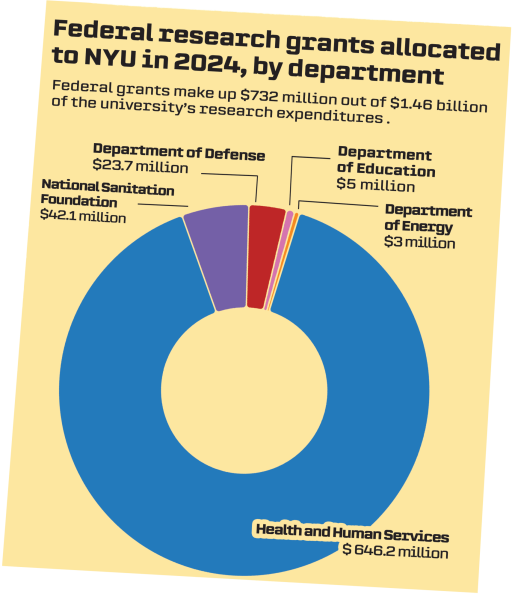
For more than a decade, NYU has received hundreds of millions of dollars for research annually from the National Institutes of Health, comprising the vast majority of its federal grants and more than one-third of its total research expenditures. But the Trump administration’s overhaul of priorities and ongoing threats to slash research funding have forced a shift at the university and its medical school.
“We’ve never seen anything like this,” Teresa Davoli, an associate professor at NYU’s Grossman School of Medicine, told WSN. “All of a sudden, you have to reconsider the way that you’re writing grants, you have to avoid certain words that aren’t favorable — you have to try to juggle the new reality.”
The first bout of grant cancellations came in January, when a sweeping executive order cut funding for all NIH Research Supplements to Promote Diversity. Termination of the program, which supported salaries for researchers from underrepresented demographics, ended at least three grants at the university.
Davoli leads a lab at NYU focused on targeting chromosomal imbalances in cancerous cells. She was using diversity supplements to support one Ph.D. student and one senior researcher across two projects, but received a letter in January saying that the supplement was unconstitutional and would be cut.
Davoli said that because the research was already over halfway complete, they didn’t cut the project altogether, but rather pulled funding for salaries from other avenues.
“It really created a deficit in the money from other resources that was supposed to fund other projects,” Davoli said. “It doesn’t make sense to cut a project when it’s midway, but I definitely had to cut some objectives.”
When President Donald Trump announced a more overarching funding freeze at the end of that month, NYU publicly announced that at least two grants were cut and that more would likely come. The NIH began issuing targeted cancellations, based on Trump’s growing list of over 200 words to “limit or avoid,” encompassing any language that could be tied back to racial or gender diversity, environmental sustainability or vaccine development.
Multiple Grossman faculty members told WSN that the university restricted their ability to disclose how many grants had been terminated to avoid drawing excess attention. The NIH alone has cut billions of dollars in grants in 2025 amid a proposed 40% funding cut — a stark increase from previous years, when it reportedly cut fewer than 20 per year, often due to research misconduct or fraud.
As the terminations came in — mostly throughout March and April — NYU established a hotline for researchers to consult upon receiving notice that their funding was cut.
“We built a pretty tight and fast organization where our faculty could come with problems,” Paul Glimcher, who chairs Grossman’s Department of Neuroscience and Physiology, told WSN. “It was pretty chaotic — stuff was coming all the time and was just completely insane. We were sharing information almost on an hourly basis, as best we could.”
Glimcher also had a diversity supplement terminated — for a Ph.D. student involved in a study aiming to support addiction recovery. His grant was reinstated in May after a court order blocked the blanket terminations, but he has advised researchers at his lab to apply for significantly more grants than they would have in the past.
Last month, NYU established a $25 million initiative encouraging researchers to “commercialize” their work, in an effort to appeal to private-sector philanthropists. Davoli also said that she and her peers had increased their applications to private foundations “by tenfold.” But compared to the rest of the university, the medical school relies more heavily on federally funded research: As of August, it held $882 million in active awards from the NIH and reportedly less than $100 million from the private sector.
Multiple researchers and administrators who spoke to WSN on the condition of anonymity in an effort to protect their work from further scrutiny said they have begun to strongly encourage international Ph.D. students — and even some U.S. citizens — to look for work outside of the country.
Researchers are also reframing proposals to exercise stronger caution over any words that could put grants at risk, such as “women” or “race,” by using AI models to check for terminology that the Trump administration may consider unconstitutional. Glimcher estimated that his colleagues were writing “nearly twice as many” grants, both public and private, as they were in the past.
“We’re very mindful that the administration is carefully reviewing grants with regard to their priorities,” Glimcher said. “We want to make sure that we are well aligned with their priorities in our grants.”
Contact Dharma Niles at [email protected].
Dharma Niles is a junior double-majoring in politics and data science. She talks a lot and can generally be found squinting at a lawsuit in the Third North...
Kyra Reilley is a senior studying interactive media arts with a minor in web programming. You can probably find her bouncing between all her clubs...