

































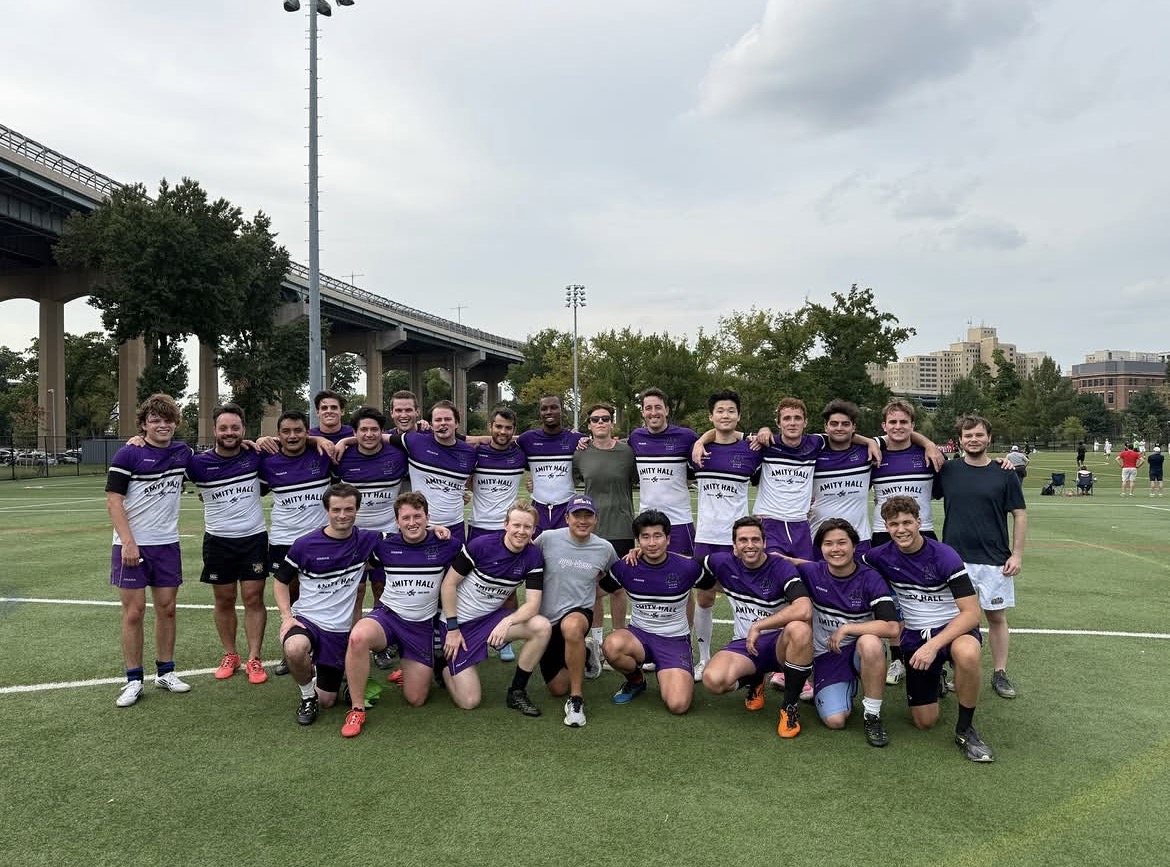
The NYU Stern Rugby Club tackled the MBA Rugby World Cup on Saturday, falling in all of its matches during a nonstop downpour on Governors Island.
The competition, NYU’s last of the season, brought together 12 men’s and four women’s teams from 12 leading business schools around the world — including Harvard, Columbia University and Stanford University — in a series of knockout rounds, culminating in a championship game at the end of the day. Two of NYU’s losses came at the hands of host Columbia in 2-0 and 1-0 matches.
Despite its ties to the Stern School of Business, the rugby club has integrated a more diverse range of students in recent years, with athletes representing the Tisch School of the Arts and Tandon School of Engineering. Today, the roster boasts its largest undergraduate cohort yet, marking a year of transition for a team typically led by graduate students.
“As a graduate student, you really don’t interact with undergraduate kids in any other capacity throughout your time here, and so it’s quite nice having some overlap with people that are a bit younger and on different career trajectories outside the business faculty,” club co-president Jack Wikman, a first-year MBA student, told WSN.
Unlike varsity athletics, the rugby team operates as a club sport that prioritizes accessibility without sacrificing competition — a principle that has become central to its identity. The team welcomes players of all experience levels, and this year’s large undergraduate cohort made it easier for new members to integrate into its existing culture.
For Stern junior Andrew Kang, that openness was what drew him to the team. After playing rugby in South Korea during middle and high school, he signed up for NYU’s club in his sophomore year. Since then, Kang has seen the team undergo a dramatic shift as its undergraduates have taken on a larger role.
“There is that age gap between the MBA students and undergrads, but they really welcomed us into the team,” Kang said.
The club also has a mix of experienced international players and newer American athletes. Experienced graduate students — many from countries where the sport is popular, like the United Kingdom and Australia — often contribute technical knowledge, while several undergraduates bring speed and energy.
“Because we’re all teammates, there’s no air of superiority,” member and Tisch junior Finn James said. “It’s a pretty level playing field.”
James, who is from the United Kingdom and is currently studying at NYU’s Los Angeles campus, has found a sense of familiarity among fellow international teammates, as well as a cultural change of pace from his typical film student crowd. He added that he has also learned from some of his older, more experienced teammates.
Under the guidance of alumni coach Lane Wang, preparation for the MBA Rugby World Cup was built through consistent in-season play, rather than a rigid training schedule. The team entered the season with a renewed sense of purpose following its runner-up finish to Harvard in last year’s tournament, taking home wins against Columbia, the University of Pennsylvania and the Queens Rugby Club.
Beyond the field, the club also boasts social and networking benefits — something that can be difficult to find at a university as large and decentralized as NYU. The club hosts bonding events at Amity Hall just south of Washington Square Park, which sponsors the team, where members often watch rugby tournaments and socialize with competitors after matches.
“One of the cool things about rugby is you’ll beat each other up on the field, but then at the end of the game you’ll have beers together,” William Reid, a second-year MBA student and the club’s treasurer, said. “It’s quite fun from that perspective, and perhaps unique among some contact sports. It’s kind of considered a gentleman’s game, which sounds bizarre, because it’s quite brutal.”
The club’s leadership aims to expand its reach over the next few years, bringing in more graduate students and connecting with alumni.
“You can tell a lot about someone’s character when they’re playing a contact sport,” Reid said. “There’s an inherent level of respect that you develop with each other and with the opposition. I’ve made some really good friends from some other schools — these are people I’ll probably bump into one day in a corporate environment, and I already know that I can trust this person, in a way.”
Contact Vienna Thai at [email protected].