
































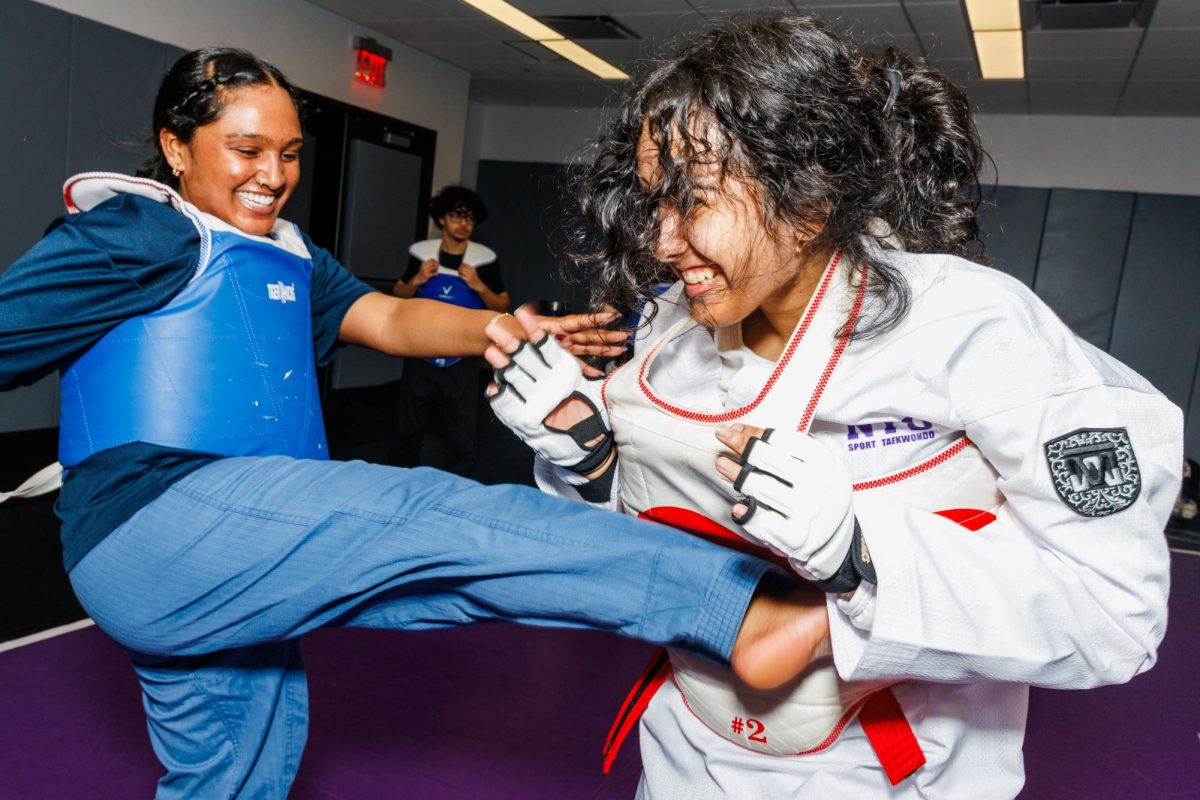
NYU’s sport taekwondo club team is set to compete at the National Collegiate Taekwondo Association Championships on April 24 at the University of North Carolina, Chapel Hill. Formed in 1987, the club competes at the Division I level — which it achieved only last year — under the Eastern Collegiate Taekwondo Conference and the NCTA. Without a strong performance at this year’s national competition, the team risks losing that status.
To qualify for the division, a taekwondo team must earn enough points by placing high enough in regional tournaments or at the national championships. Even though taekwondo isn’t a varsity sport, competing with a D-I standing is still regarded as a high honor.
So far, the club has had successful results at both the Massachusetts Institute of Technology and Brown University tournaments earlier this year. The team brought home 220 points and placed third in D-I at MIT, securing six gold medals and five bronze medals. At Brown, the team scored 104 points, earning 11 bronze medals and third place in D-I.
When most think of taekwondo, it’s common to imagine intense fighting. However, NYU sport taekwondo encompasses all aspects of the art, emphasizing a balance between sparring, board breaking, demo teams and Poomsae — which encompasses choreographed sequences of taekwondo technique.
“People might think it’s a violent sport, it’s very contact heavy,” CAS senior Bryan Kwon, president of NYU sport taekwondo, said. “But when you first start, it’s not really about immediately blasting kicks and punches at others. There’s a lot of technique and finding balance in your body.”
Most days, practice starts with a long warmup, including running and stretching. If the day involves sparring, the team will run drills with the paddles and then gear up for sparring rounds. When rehearsing Poomsae, they do additional stretches as flexibility is key for succeeding in the technique.
The team faces several difficulties while preparing for their tournaments. The wrestling mat, made of dense foam, is difficult to balance on and its crevices make turning movements especially challenging. Additionally, other teams have a leg up when it comes to practice time because NYU’s space constraints limit club sports to three practices per week. Master Andrew Park, the team’s head coach, opens his doors at his own dojang in Queens to any NYU student for free.
“We practice three times a week, which seems like a lot, but then we have other schools like Northeastern and Rutgers that practice every single day,” Rory Meyers junior and treasurer of NYU sport taekwondo Hayle Ortla said. “It’s hard because they are also Division I, so we’re going against schools that are not only practicing more, but are bringing more athletes, because they bring about 50 to 60 every tournament.”
Typically, the team competes at four to six regular season tournaments per year. Recently, NYU was forced to forfeit a tournament at Cornell University due to budget constraints — costing them valuable points. Each competition is an opportunity for a team to build up points, which add to its season standing.
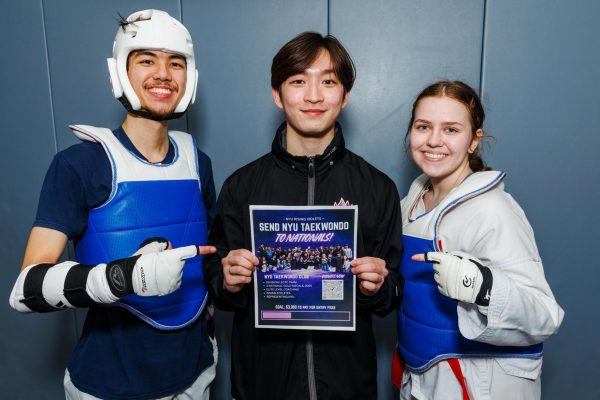
The team remains hopeful that a strong performance at nationals will maintain its D-I status. But to do so, they will need to send as many competitors as possible — an effort limited by budget constraints that many club sports face. The club is currently raising money to head back to nationals, with less than a week left until the deadline. So far, they have raised about half of the $3,000 fundraising goal.
“If we don’t hit the fundraiser goal, we’re going to have to cancel some of the plane tickets and the hotels, and then some of the athletes can’t go,” Ortla said. “Or, people are going to have to pay out of pocket again. When we had to pay out of pocket last year, we only sent four people because it’s a lot of money for college students.”
But to some degree, the limited spots bring out the best in every competitor — placing pressure on each to perform well. For many members, that pressure becomes a source of motivation rather than discouragement.
The team brought home three gold medals from nationals last year, including one in women’s blue and red belt board breaking from Ortla. In 2022, the team earned six medals — one gold, one silver and four bronze.
Attending nationals isn’t only about retaining medals or preserving D-I status, it’s also a chance for the team to grow closer. Spending long days traveling, practicing, competing and cheering one another on allows its members to bond in deeper ways — creating lasting memories and friendships.
“Knowing how far we’ve come, knowing how much our individuals worked, I can’t leave the semester feeling sad,” Kwon said. “I feel proud. I’m very happy with our team and how far they’ve come, so no regrets, even if we do go down. I also know our team is strong enough to bounce back, so it’s just a little step back. But besides that, I know we can make it.”
Contact Isabella Bickenbach at [email protected].