
































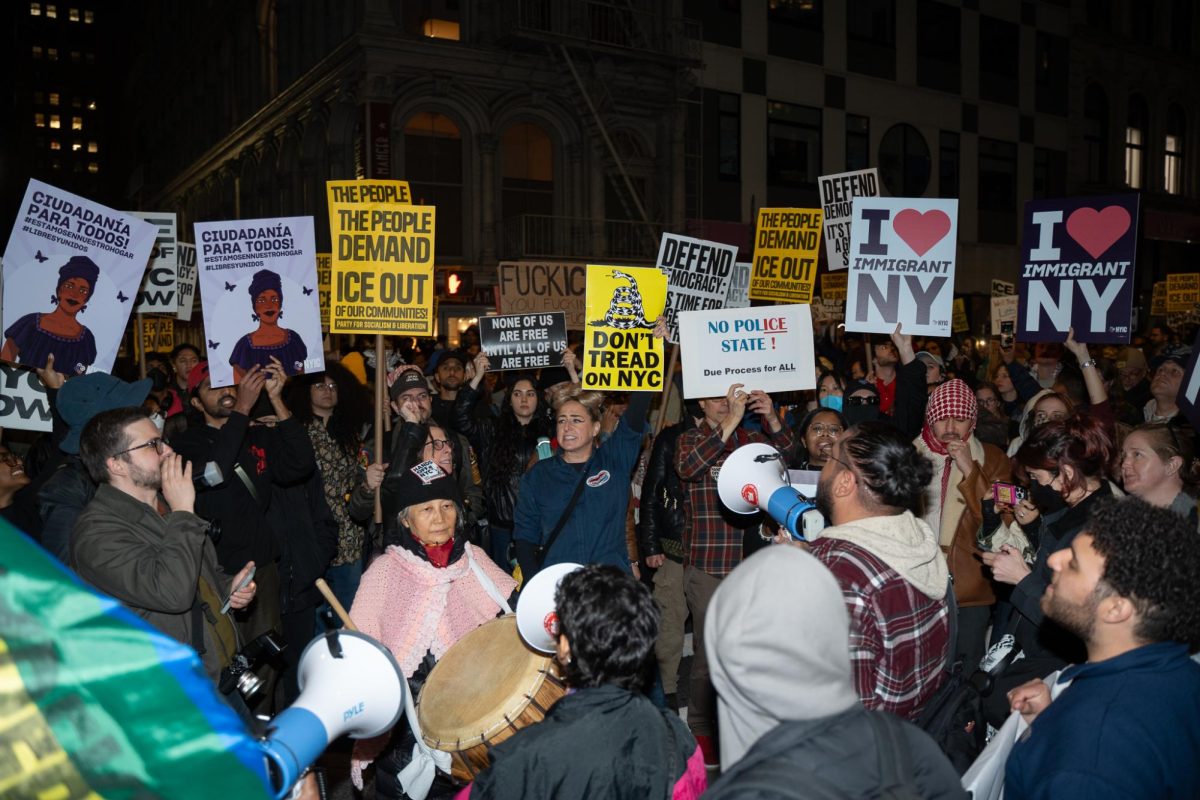
New York City is home to more immigrants than any other city in the United States. The growing crisis in immigration enforcement is not just a distant federal policy debate — it’s a reality unfolding in the city we call home, even if we only call it home for a semester.
Across the country, U.S. Immigration and Customs Enforcement operations have intensified with disturbing frequency. Instead of grappling with what this means for human lives and constitutional rights, many have shifted the conversation toward party-based scorekeeping, debating which administration deported more rather than confronting the current crisis at hand.
Many on social media posted charts showing former President Barack Obama deported more people than President Donald Trump, accusing the left of hypocrisy and insisting the majority of people only care now because Trump is in office. Amid all this finger-pointing, the actual issue is being lost: people are dying at the hands of ICE and barred from fair legal process before the state intervenes in their lives, dehumanizing them in the process.
Vice President JD Vance repeatedly calls immigrants “aliens,” while Trump once remarked that “they’re not people, in my opinion.” Immigrants are facing unprecedented levels of dehumanizing treatment, and while the Obama administration at least played at having humanitarian concerns, the Trump administration is making no such claims.
Yes, Obama’s deportation numbers were historically high. Reports confirm that millions were removed during his administration, many through expedited border processes where individuals never saw an immigration judge. Critics even labeled him the “deporter-in-chief.” But his enforcement strategy largely prioritized recent border crossings and individuals with criminal records, while simultaneously creating the Deferred Action for Childhood Arrivals, shielding hundreds of thousands of undocumented young people from deportation.
Trump’s administration scrapped this strategy for one more sinister. Immigration enforcement expanded from border zones into neighborhoods, workplaces and public streets. Family separation became policy. ICE raids increased far from the border. And in January 2026, the fear created by those shocktrooper tactics became the norm.
The recent deaths of Renée Good and Alex Pretti were not border encounters. These were publicly violent enforcement actions into American cities. While deaths in ICE custody and enforcement operations occurred under previous administrations, incidents like these were rarely publicly reported at this scale. When immigration enforcement expands into neighborhoods, transit systems, and public spaces, it creates fear — fear of attending class, reporting crimes, seeking medical help, or simply existing in public. That harm doesn’t stop at undocumented immigrants. It spreads to students, families and entire communities, undermining trust in the institutions meant to protect us.
Supporters of aggressive enforcement argue that outrage over Trump-era actions is hypocritical, because Obama deported more people than Trump’s first term in office. But this misses the point. Even if Obama’s administration committed wrongful enforcement practices, that does not make similar conduct acceptable now. Wrong is wrong, regardless of who occupies the White House.
As NYU students — many of whom are immigrants, children of immigrants or international students — this issue is not theoretical. I am a child of immigrants from Jamaica. I grew up hearing stories of my parents’ early years in the United States: the uncertainty, the fear of being pulled over and the constant pressure of trying to build stability in a country that has a history of prejudice toward outsiders. When I see federal agents carrying out detainments on public streets today, I don’t just see a policy debate. I see families like mine, neighbors like mine, futures that are cut short without warning.
So the real issue isn’t whether Obama deported more people than Trump — it’s that the United States is not honoring its constitutional promise, written into the Fifth and Fourteenth Amendments, that no person is deprived of life or liberty without due process of law.
If we care about justice, our focus must shift from party score- keeping to demanding transparency, oversight and legal protections in immigration enforcement. That means supporting legal aid organizations, pushing universities to expand immigrant-support resources and calling on lawmakers to require independent investigations when federal agents use lethal force.
At the end of the day, deportation is a policy choice, and if a government chooses to exercise it, it must do so transparently, lawfully and with respect for human dignity. A country’s commitment to law is not measured by how many people it removes, but by how fairly it treats them before doing so — every number represents a real human life.
WSN’s Opinion desk strives to publish ideas worth discussing. The views presented in the Opinion desk are solely the views of the writer.
Contact Robin Young at [email protected].