




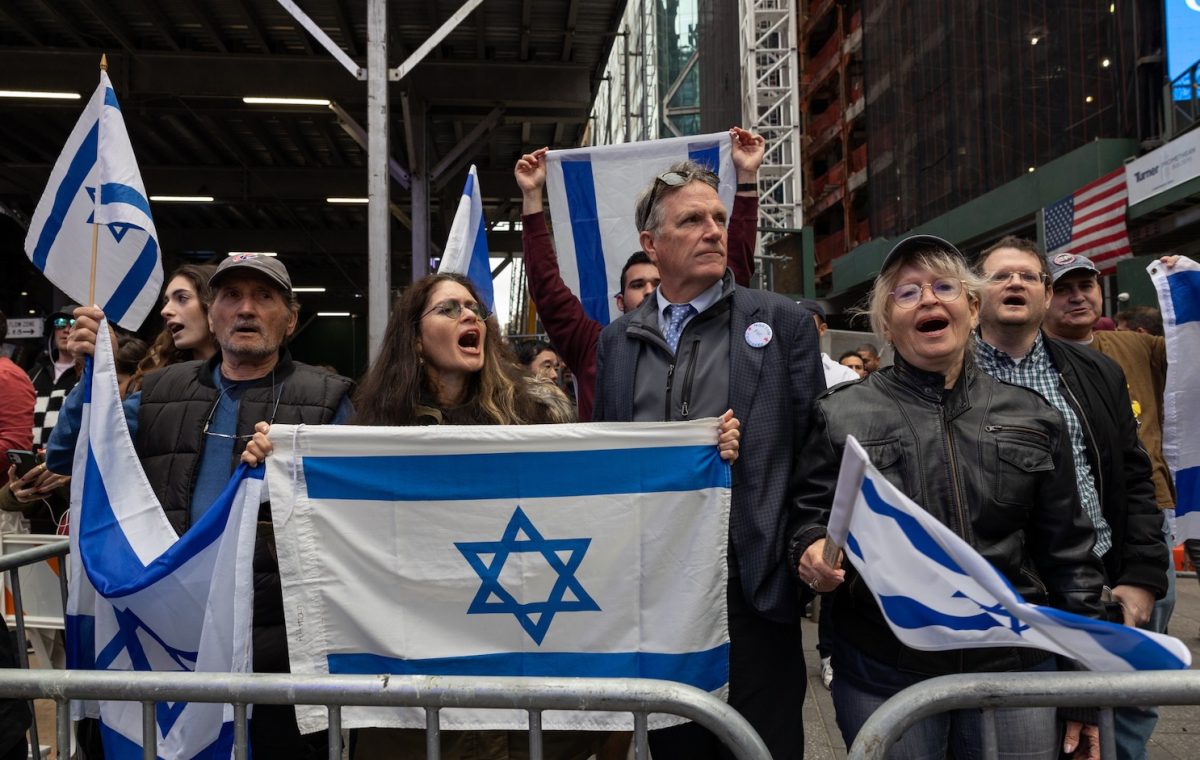



















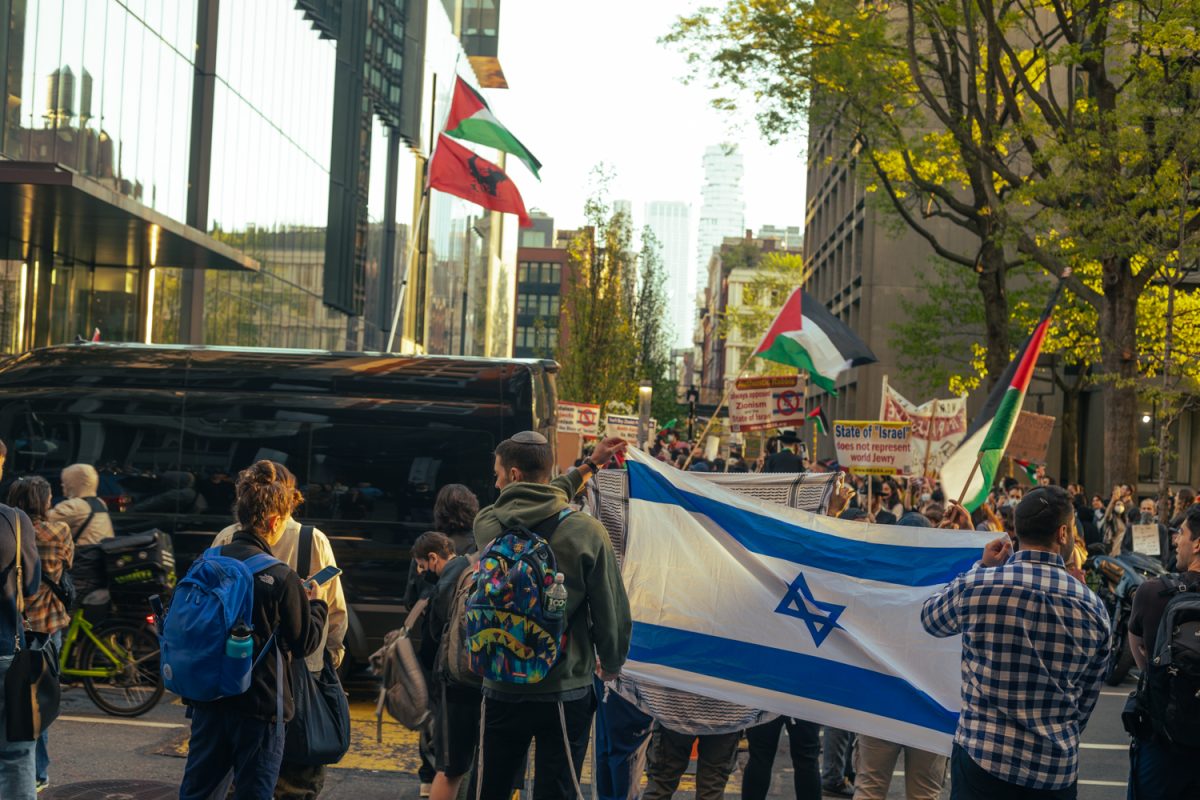
On April 20 and 21, Israel will observe Yom HaZikaron, its version of Memorial Day. Sirens will wail across the country, everything will come to a halt — traffic, work, conversation. But as the day ends, the sirens will give way to fireworks. Grief can become celebration, not because the grief is forgotten, but because that is what the Jewish people have always done: mourn what was lost, and then look to the future to build something better.
That transition will be different this year. On NYU’s campus, the existence of a Jewish state is increasingly treated as something not worth celebrating or mourning, and in some cases, as the problem itself. Students who feel connected to that state are being asked to apologize for that affiliation before they are allowed to belong here.
On college campuses, from lecture halls to club meetings, in the very air that Jewish students are asked to breathe, anti-Zionism is antisemitism. It begins with the Israeli government as a political object to be opposed. Then it expands outward: to Israeli citizens, to diaspora Jews who support Israel and to Jews who have touched it, visited it, studied there.
I want to define exactly what Zionism is, because I have seen the term become twisted and stretched beyond recognition. Zionism is the belief that the Jewish people have the right to self-determination in their ancestral homeland, and that Israel has an inherent right to exist as a Jewish state. You can be a Zionist and believe the Israeli government has made serious, consequential mistakes. You can be a Zionist and believe the war in Gaza is a disaster. You can be a Zionist and hate Benjamin Netanyahu. What you cannot do is hold Israel to a standard created to make its existence unachievable. Anti-Zionism demands exactly that: moral perfection, military perfection and ideological perfection from the Jewish state that is not expected from any other. That standard is antisemitic.
Jewish students understand this distinction better than anyone. A 2025 study found that a majority of Jewish college students did not consider the statement that Israel violates Palestinian human rights to be antisemitic. Criticism of Israeli policy is not where Jewish students draw the line. However, 93% said denying Israel’s right to exist crossed the line, and 84% said the same of the statement, “From the river to the sea Palestine will be free.” That distinction matters because the social cost is directly attached to the support for Jewish self-determination itself.
This described social cost was revealed in a peer-reviewed study of Jewish college students which found that those who hold positive impressions of Zionism report meaningfully higher rates of antisemitic incidents and significantly greater psychological distress. You don’t need to do anything. You only need to believe in the right of Jewish statehood, in Zionism, to be a Zionist. Which raises the question: If anti-Zionism is just a political position, why does the opposing view carry a price?
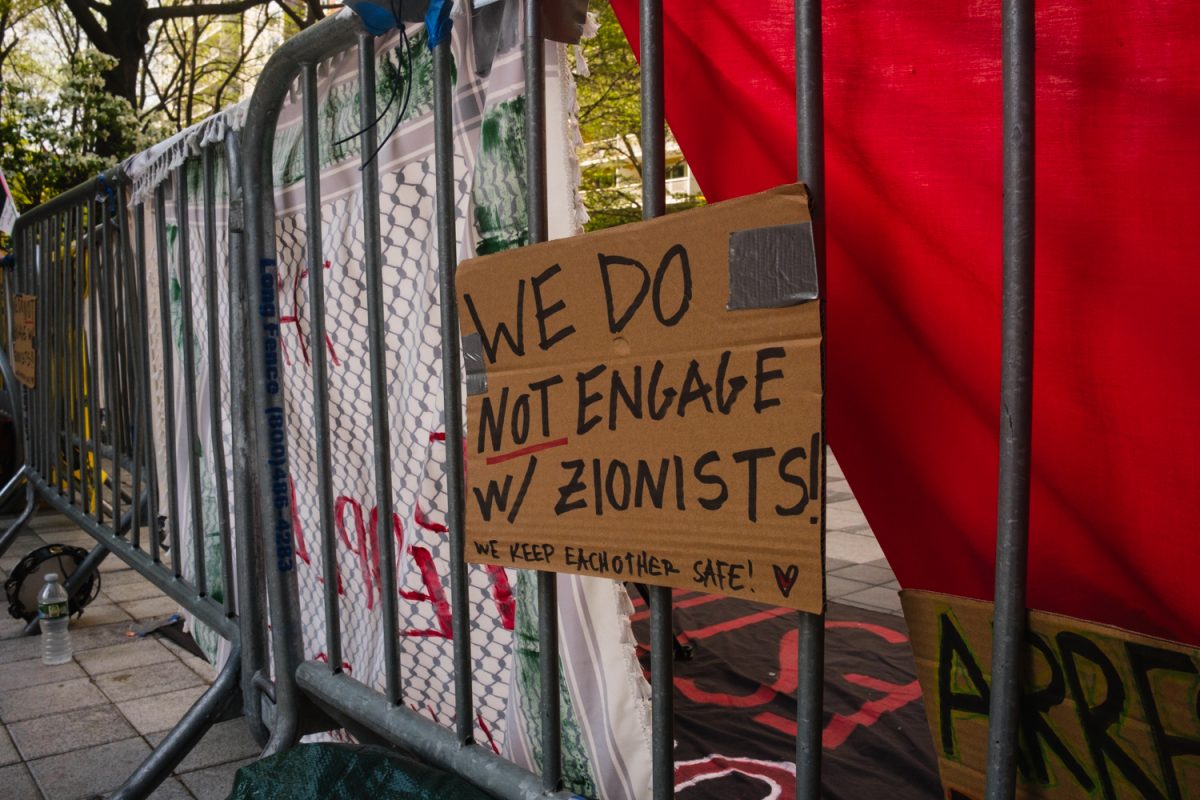
Vanderbilt sociologist Shaul Kelner has an answer: He argued that anti-Zionism is best understood not by what it says but by what it does. It’s a mass movement defined by actions — by encampments and boycotts, by the targeted harassment of Jewish students, by the defacement of Jewish property and by the deliberate and systematic exclusion of Jewish voices in public forums. Some will say that anti-Zionism is simply a political position, that opposing Israeli policy, even forcefully, is not hatred. But events at our own university go beyond just policy. A political position does not scrawl “Jew” on a first-year’s door in Weinstein Hall. A political position does not slip a pro-Palestine flyer under the door of the only Jewish student on the floor.
In a political climate such as this, it’s not hard to understand why certain Jewish students would be afraid to express their identity. Afraid to be told by another student that he is personally complicit in genocide for having lived in Israel. Afraid to wear an Israeli map necklace to class, lest she be asked whether she felt guilty wearing a symbol of occupation. When a movement’s actual behavior in the world involves the systematic targeting of Jewish identity rather than the critique of a government’s decisions, it has left the territory of political discourse.
I did not write this article because I believe NYU is a bad place. I wrote it because I believe it can be better. I believe the people here are capable of more honesty than the current climate rewards. But being better requires saying the uncomfortable thing out loud instead of looking away. It requires looking at a first-year who came home to find the word “Jew” scrawled on his door and calling that what it is. It requires looking at the students who’ve done the calculations, who take off their necklaces before class, who take down their flag before a friend comes over and acknowledge that their silence is not comfort. It is the product of an environment that has made speaking up feel dangerous, and it requires looking at me, a student senator-at-large and a sophomore at a university I chose because I believed it would welcome me, and reckoning with the fact that I still pause when I mention that I did a gap year in Israel. That I run the calculation too. And it represents the entirely rational reaction to an environment in which being Jewish and having spent a year in Israel is enough, for some people on this campus, to write you off entirely.
Anti-Zionism is antisemitism. It always has been. And the work of making this university a place where no student runs that calculation, where no one weighs the cost of their own identity before speaking up, has only just begun.
WSN’s Opinion desk strives to publish ideas worth discussing. The views presented in the Opinion desk are solely the views of the writer.
Contact Davin Rabman at [email protected].
Mer S • Apr 24, 2026 at 11:59 am
Thank you, Davin. Anti-Zionism is antisemitism. We have seen it firsthand on campus, and with the growing hatred towards Jewish people in the United States.
Yael G • Apr 24, 2026 at 11:51 am
Thank you Davin. So well said.
Tejas Sahni • Apr 20, 2026 at 8:38 pm
Literally not true at all. Yeah Zionism is about establishing an “ enthnostate” on Jewish homeland. But where is that homeland? On Palestine territory. And to get rid of the Palestines living there, Israeli settlers turns to genocide and apartheid. Not all Jews are Zionist . The mere conflation of Judaism with a political philosophy that seeks to oppress and kill innocents is anti semetic unto itself. Yes it is undeniable anti semetism is on the rise. And yes it is deplorable. But that does not mean Zionism needs to work as a response to that, nor should we conflate the two things.
Anna detke • Apr 20, 2026 at 7:07 pm
Conflating these two ideas goes against the very purpose of re-engaging in the discussion about Israel in our present movement. Not to mention, anti-Zionism and antisemitism are not in fact the same thing. This becomes so clearly evident when the writer’s sources are based on opinion surveys and anecdotal evidence. Shameful journalism.
Danny • Apr 20, 2026 at 11:50 am
The issue with Zionism is the belief in the ideology that, for whatever reason, the Jewish people have the right to an ethnostate. When it is quite widely believed that ethnostates encourage racial discrimination.
Dan G • Apr 20, 2026 at 9:07 am
Right on