




































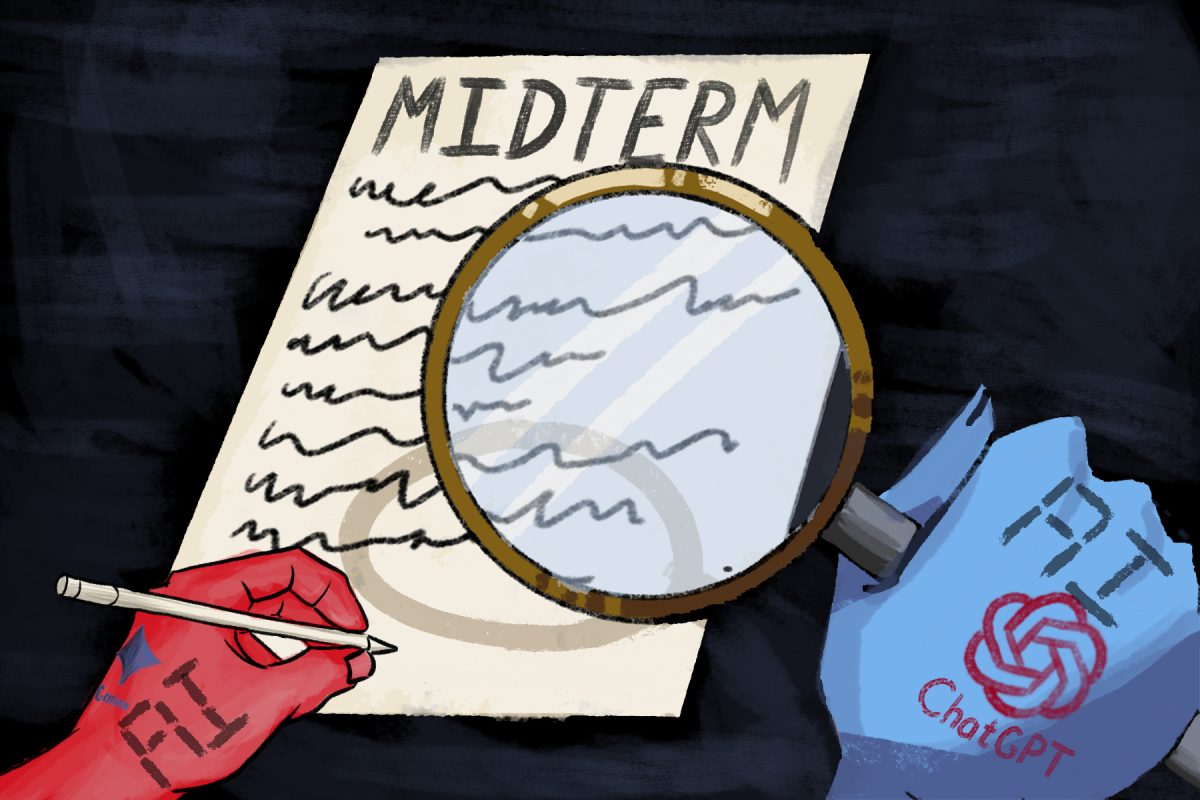
Researchers at NYU’s Tandon School of Engineering found that slowing down chatbot responses can make them seem more thoughtful, even when the answers themselves don’t change.
In the April 13 study, lead author and Ph.D. student Felicia Fang-Yi Tan and Tandon professor Oded Nov examined how 240 participants evaluate artificial intelligence’s response time. The researchers found that participants consistently rated slower responses as more useful and intelligent, despite identical output across conditions.
“If we just manipulate the latency — the response time that large language models take — it really changes the way that we perceive the quality of that response,” Tan told WSN.
The study, presented at the 2026 CHI Conference on Human Factors in Computing Systems, asked chatbots to respond to creative and advice tasks. Creative tasks involved creating content, such as drafting text or brainstorming ideas, while advice tasks focused on evaluating decisions or offering recommendations. Participants were randomly assigned to receive responses after two, nine or 20 seconds.
Even though the chatbot produced the same answers, participants who received responses after two seconds were more likely to view them as less thoughtful. Those who waited longer tended to rate the responses more favorably.
“We tend to attribute human-like qualities to LLMs,” Tan said. “We attribute that to the AI deliberating, the AI thinking, the AI going deeper into what I asked.”The findings contrast with long-standing assumptions in human-computer interaction that faster systems are always better. Wen Yin, doctoral student at Tandon and co-author of the study, who worked on the technical design and data analysis, said that this perception may stem from everyday interactions.
“If you ask for advice from your friend, and he just directly gives you an answer without even thinking about it, what do you feel? Maybe you feel like that is less thoughtful, right?” Yin told WSN.
While response time influenced perception, researchers found that users interacted with the system at similar rates regardless of whether responses were fast or delayed. Instead, behavior depended more on the type of task — participants engaged in more back-and-forth prompting during creative tasks than advisory ones.
Tan said the findings have implications for students who regularly use AI tools for writing and studying, particularly in how they engage with responses.
“When the responses are so fast that we don’t read them — that’s not good,” Tan said. “Speed had a very big role to play in the way we learn and the way we ask for advice.”
The study also raises questions about how AI systems should be designed. If slower responses are perceived as more thoughtful, developers could potentially adjust timing to influence how users evaluate output.
“If a designer were to want to have a model appear more powerful than it actually is, they could just make it slow,” Tan said. “So there are some ethical questions around that, whether that’s warranted.”
Yin noted that the study was conducted under controlled conditions, meaning participants were not under time pressure or other real-world constraints. Future research could explore how different response times affect users in more practical settings and across a wider range of tasks.
“In a couple of decades, our entire way of thinking and perceiving the world would have shifted as a result of these tools being used on a daily basis,” she said.
Contact Liyana Illyas at [email protected].