


























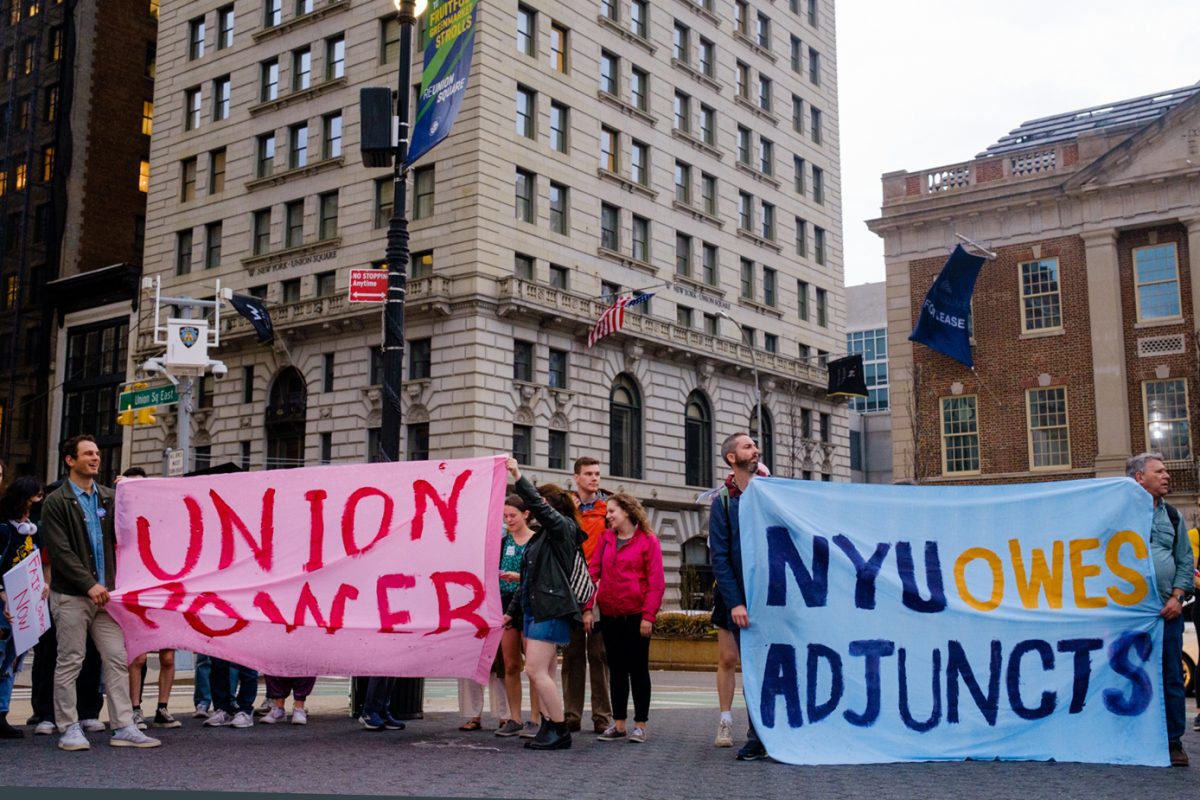
NYU’s adjunct faculty union demanded administrators address this year’s “sharp increase” in course cancellations among its members, calling for a meeting with university leadership before Thursday.
In a letter to administrators, David Palmer — who chairs the union, ACT-UAW Local 7902 — wrote that course cancellations increased by 31% this spring compared to last spring. He noted that course cancellations can significantly reduce instructors’ compensation and jeopardize their benefits — adding that if a course is canceled within two weeks of its first class, adjunct faculty are entitled to receive 20% of the payment for teaching the class under the union’s contract, while cancellations issued earlier may not require compensation.
Palmer told WSN that although class cancellations are generally determined over two weeks before the semester starts, the university could refer to budget projects and enrollment trends to anticipate cancellations and adjust faculty members’ course schedules accordingly to avoid loss of pay. The union set a deadline of March 12 to meet with administrators, two weeks after the Feb. 27 letter was sent, to prevent future disruptions.
“If you say that there’s budgetary cuts, what are those budgetary cuts? NYU is obstinate and doesn’t provide that information,” Palmer said. “We believe we have a strong claim to say that enrollment figures and budgetary information is something that we’re entitled to. We are awaiting information on that from the university.”
In a statement to WSN, NYU spokesperson Carol Ourivio said that classes are only canceled based on “clear and objective rationale.”
“This includes insufficient enrollment or for academic, programmatic or budgetary reasons,” Ourivio said. “These are precisely the circumstances set out in the union’s contract.”
Under Article 10 of the union’s contract, adjuncts who teach at least two semesters over two consecutive years are eligible to earn reappointment or termination pay rights if they are not reappointed for courses they consistently taught in the past. To receive that pay, members must send a reappointment letter to administrators — which the union claims will financially disincentivise the university from dismissing them from their roles in comparison to professors that did request reappointment.
For a course to be guaranteed to take place, it needs at least 50% enrollment: While just over 1% of the classes canceled last year were near the required threshold, that number rose to 7% this year. Palmer said that some instructors are asked to submit syllabi or prepare materials weeks in advance, only to learn their course will not run, which he said amounts to unpaid labor.
Ahead of this semester, the union’s representatives received a “huge volume” of emails from members saying their courses, which typically pay $11,000 have been cancelled, according to Palmer. The move prompted the union to initially raise the issue at a Jan. 22 Town Hall, which discussed the steady rise in courses canceled for insufficient registration. In the 2022-23 academic year, 169 courses were canceled — followed by 381 in 2023-24 and 469 in 2024–25. Preliminary figures for 2025-26 total 329 cancellations so far, with summer data still pending.
Palmer said that students may not always see the full impact of these cancellations, but they feel the effects in the classroom. When classes are cut, remaining sections often become overenrolled, and the maximum number of students allowed to enroll in a course will be raised before the semester begins without additional compensation for instructors. Larger class sizes can mean more grading and less individualized attention.
“It has a ripple effect where the idea of cost-cutting comes at the cost of the student experience,” Palmer said. “If people don’t have a thriving learning environment, education suffers.”
Contact Angel Dilwar at [email protected].