


































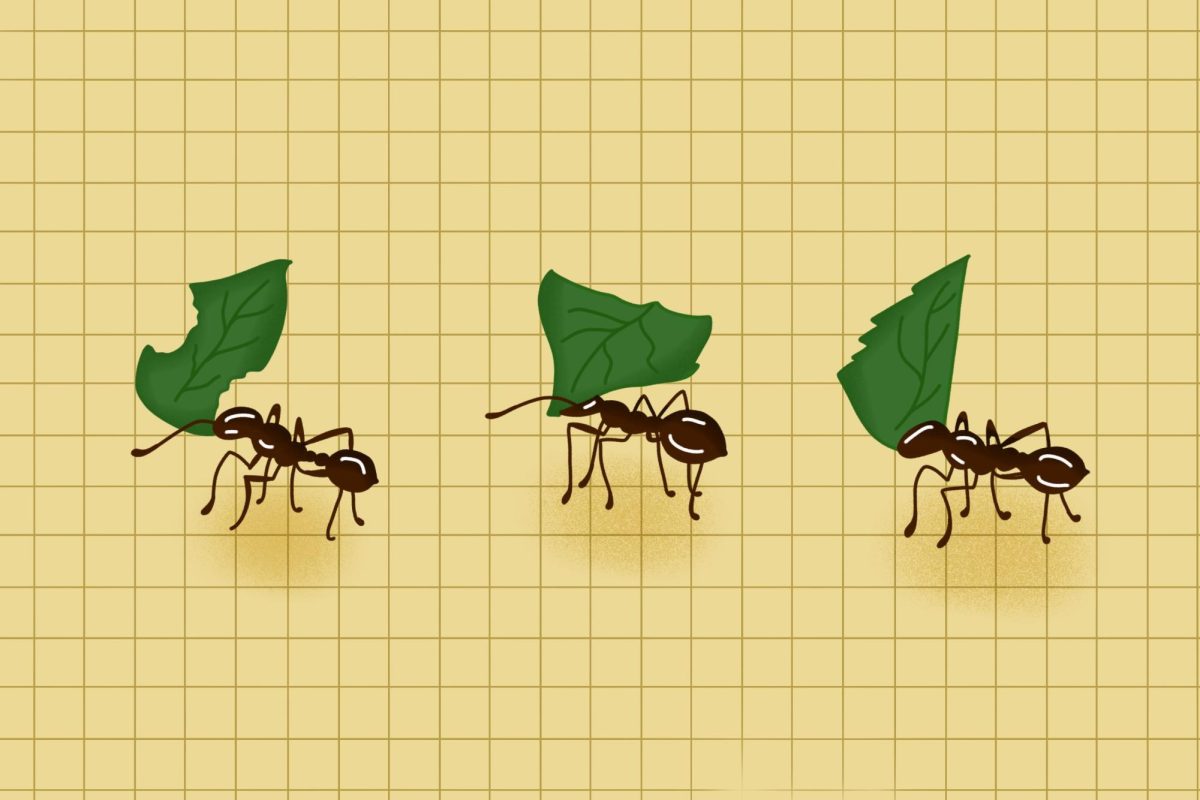
NYU biologists identified the unique transcriptional machinery that ants use to choose a single scent receptor out of the 500 they have available. Maintaining a keen sense of smell is particularly important for ants, which have poor vision and rely on olfactory receptors for hunting.
Ants possess hundreds of olfactory receptor proteins, organized into clusters with up to 59 genes each, and use a self-regulating mechanism to activate only one receptor per neuron, so that each neuron can only detect one scent. In the October study, the team mapped every neuron’s gene activity to track how ants flip an odor gene, identifying a pattern they called a “biological bulldozer.”
“We need just one gene to be activated in a cell, so a ‘bulldozer’ is transcriptional machinery that helps activate a specific gene,” Olena Kolumba, a Biology Ph.D. student and second author of the study, told WSN. “The bulldozer keeps going further to other genes, and because it doesn’t stop, this blocks those genes from activation so that only the first activated gene is actually functional.”
For most animals, when a cell is transcribing a gene through the transcriptional machinery, it starts at the beginning of a specific gene and stops at the end. However, through the biological bulldozer, ants’ transcriptional machinery runs downstream through the neighboring genes without stopping.
The team discovered that the downstream gene also makes RNA that simultaneously moves in the opposite direction. This prevents the transcription of the upstream genes and sets off a chain reaction, turning off the other genes upstream so nothing can affect it.
“By simply choosing one gene, they extinguish all of the other vertical transcription inhibitions,” Claude Desplan, a Silver biology professor and the lead author of the study, said. “You go through all the genes downstream, you just prevent them from being expressed — a bulldozer.”
Similar to ants, humans also follow the process of choosing one receptor per neuron, and our brains depend on genes that maintain connective neural circuits. Currently, researchers from Columbia University are studying the transcriptional process in humans.
Contact Jake Christy at [email protected].