



































NYU denied a faculty union’s claims that professors are paid unfairly based on race and gender, brought up in negotiations last week as part of the group’s ongoing push for higher salaries.
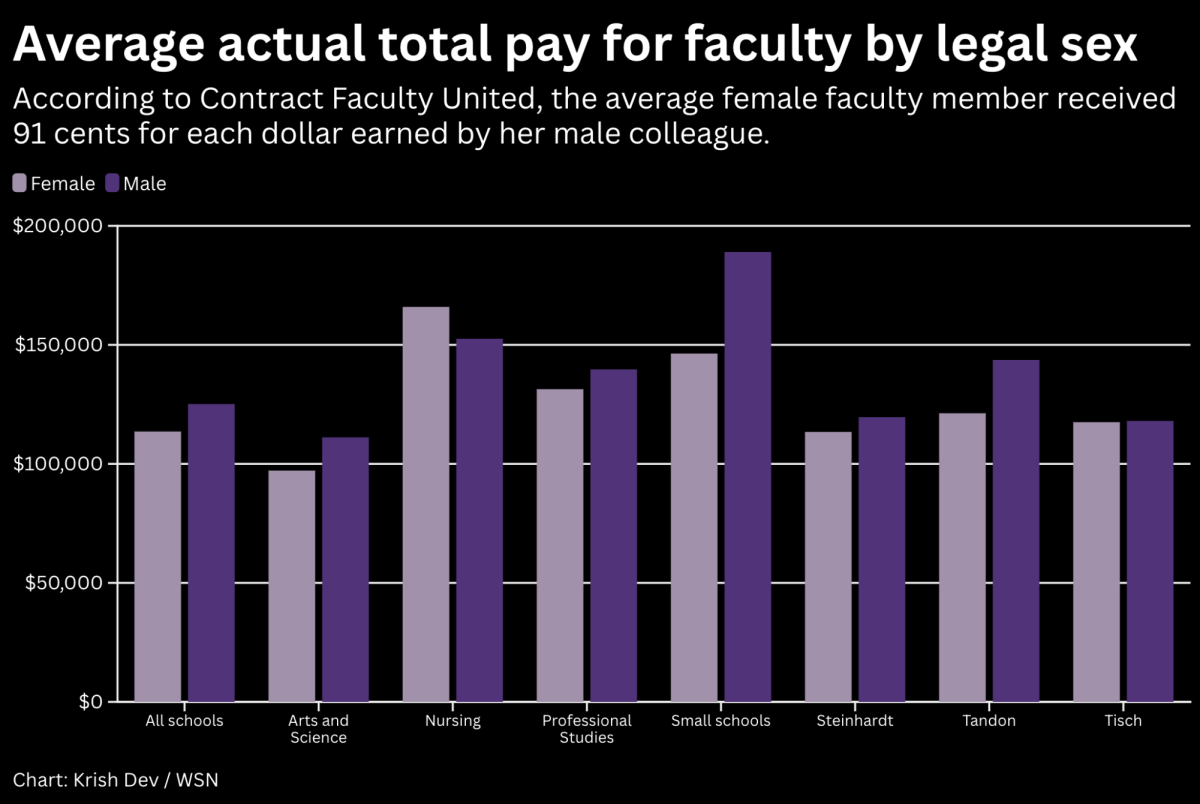
Representatives from Contract Faculty United, which represents over 900 full-time faculty at NYU, claimed that within the union, female faculty make 9% less than their male counterparts and women of color earn only 87% of what white male faculty make. They proposed that administrators conduct salary equity reviews and match with the average salary of tenure-track professors.
In a statement to WSN, NYU spokesperson John Beckman said that the accusations “appear to result from a flawed analysis” and are “an apples-to-oranges comparison” because they do not account for salary differences between academic departments, seniority and highest education degree earned. He also said that the university hired an outside firm to review salaries for equity concerns, which did not flag any discrepancies.
“Nevertheless, we will, of course, look at the union’s data and ensure it is subjected to careful, rigorous analysis, and will be discussing the matter further with the union in upcoming bargaining,” Beckman said.
CFU members compared their schools, ranks and pay, and found that female faculty receive $11,535 less in total compensation than male colleagues on average — equivalent to 91 cents on the dollar. While female faculty are 3% and 2% above the proportion at the assistant and associate ranks, respectively, they are 6% lower than their overall share at the professor rank. Female faculty also get $237 less per month than male colleagues when promoted to assistant, $835 less per month when they are associates and $1,396 less per month when they become a professor, according to CFU’s findings.
Beckman said that an Arts & Science Faculty Equity report found that in both 2018 and 2023, after accounting for rank, department and year of hire, the gap between gender, race and salary was “not significant.”
“We need to fix the salary discrimination by race and sex, and we need parity with tenure-track faculty,” Gallatin professor and CFU member Jacob Remes told WSN. “We keep saying that, and eventually they’re gonna have to listen.”
The union said that the administrators should adopt the University of Wisconsin-Madison’s 1993 salary equity review, which was implemented to ensure a “transparent system.” The union proposed that administrators compare each member’s pay to three faculty in the same department — for women and nonbinary faculty, this would include at least two men. Each salary review would be organized upon union members’ promotions, reappointments and up to three times per year upon request.
The administrators agreed to increase CFU members’ base salary by $2,000 in October, in addition to the 2% or 2.5% annual merit increase, after the union agreed to decrease its total demand by $60 million. The development comes after one year of bargaining sessions, where salaries have remained a prominent talking point,
“It’s still, frankly, insultingly low,” Remes said. “It still comes nowhere near to parity with tenure-track faculty. Right now, tenure faculty get paid 36% more than we do.”
At its most recent meeting, both parties got closer on issues around international faculty protection. Since President Donald Trump took office, the union has urged NYU administrators to sponsor green cards for its international members, as it does for tenure-track faculty. While administrators previously said that they would only sponsor permanent residency on an “exceptional basis,” they agreed to allocate $200,000 annually for CFU members to cover expenses such as visa application fees, allowing reimbursements of up to $6,500.
Previously, tenure-track faculty did not have access to legal representation during Office of Equal Opportunity investigations over discrimination and harassment allegations. Administrators have now agreed that both the union and tenure-track faculty have this right.
“All members of the NYU community deserve to have protection against caste discrimination,” Remes said. “We are continuing to talk to them about both making sure that it’s better and also enshrining it in our contract rather than just having it be a policy that the administration can change willy-nilly whenever they want.”
Contact Amanda Chen at [email protected].