





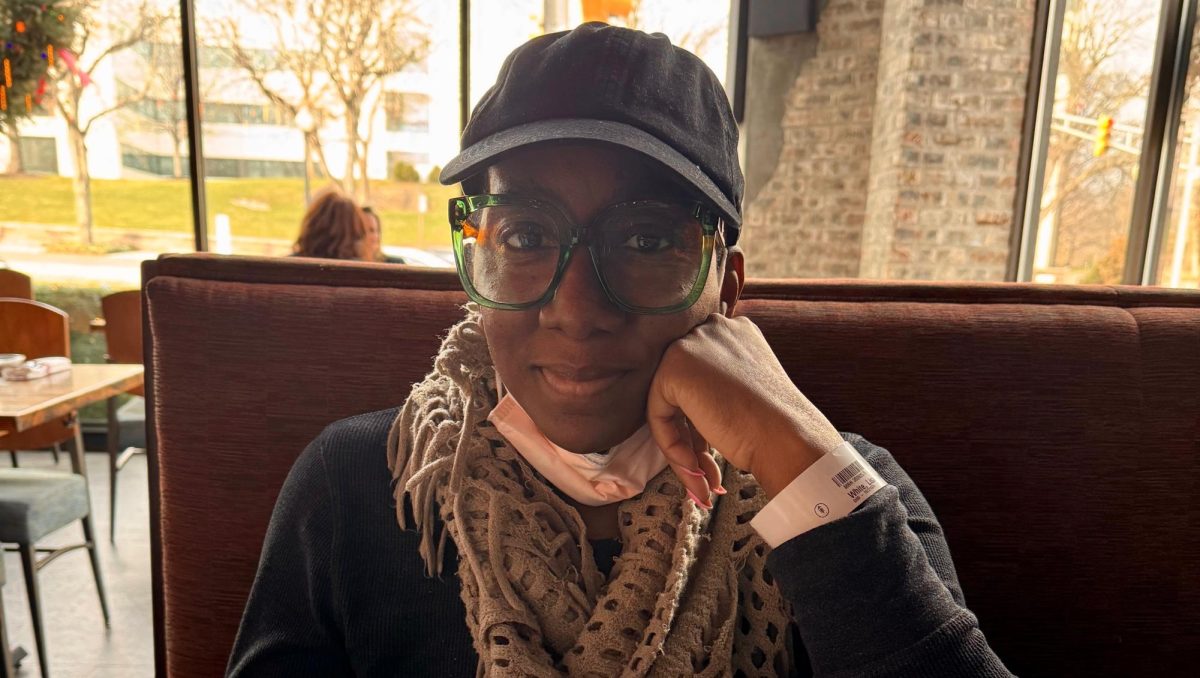



























Bryant Terry was always interested in fresh foods and vegan eating. Growing up in Memphis, his family grew their own food and exposed him to healthy, home-cooked meals — now, he’s working to make his plant-based diet accessible to everyone.
As a graduate student at NYU, Terry researched how early movements addressing food inaccessibility were led by Black activists in the ’60s, countering stereotypes of veganism being exclusive to affluent, white people. This fortified Terry’s mission to spotlight food injustice in the United States, eventually becoming a professional chef and author of several cookbooks.
Since 2006, Terry has written five books on vegan cooking and African diasporic cuisines, including “Vegetable Kingdom” in 2020, which was nominated for a James Beard Award. He is the founder of 4 Color Books, an imprint under Penguin Random House that focuses on publishing nonfiction works by writers and chefs of color. He was also the first chef-in-residence at the Museum of the African Diaspora in San Francisco.
Terry spoke with WSN about how he launched a decadeslong career in food activism and his passion for community-led empowerment.
This interview has been edited for length and clarity.
WSN: What got you interested in food?
Terry: My family was very proud of their agrarian roots in rural Mississippi and Tennessee and Arkansas. My parents moved to Alabama because they had families who grew up on farms and understood the importance of the way in which you grew food, cooked it. I often think about the way in which we talk about eating locally, and there was no need to really label those practices in my family. It was just the kind of culture, tradition and often survival.
In Tennessee, Terry would travel between his home in the suburbs and his extended family’s rural farms. His grandmother taught him preservation techniques like canning and pickling, as well as how fermented foods are beneficial for gut health. Watching his grandfather cook as a child also helped him understand cooking not as a strictly feminine domain, but rather a way to take care of his family.
After receiving an undergraduate degree in English, Terry went to NYU for a master’s degree in history, focused on studying the African diaspora. He learnt about how the Black Panther Party uplifted low-income communities by distributing healthy foods and establishing free breakfast programs for children.
WSN: How has going to NYU shaped your career?
Terry: Being in graduate school gave me a rigorous political and historical framework for thinking about food, art and liberation. That time really taught me how to treat cultural production, whether it’s creative writing like poetry or recipe writing — these are archives that carry memory, they carry resistance, they carry possibility. I always credit my time at NYU for the way that it sharpened my instincts as a researcher and a storyteller.
After graduating in 2001, he continued living in New York City and attended culinary school at the Natural Gourmet Institute. Combining his knowledge in vegetable-based cooking and his community organizing experience, he established b-healthy! — a project providing education programs to young people in underserved communities, where Terry offered cooking classes and workshops to combat unhealthy eating and food inequities.
WSN: What food activism issues are you most passionate about now?
Terry: It’s more about creating more avenues so that the most vulnerable among us have consistent access to healthy and fresh, affordable and culturally appropriate food. I think those things have to be owned and driven by the community. We are subject to a government that literally will use hunger as a kind of tool of collective punishment. We saw that with the government withholding SNAP benefits. Some of the historical ways that people have grown and fed communities, whether it’s through urban farms or independently owned businesses that aren’t solely concerned with profits. We need to put more energy into them.
Later on, while Terry lived in Brooklyn, he met his co-author Anna Lappé — the two of them would later collaborate on writing his first cookbook, “Grub: Ideas for an Urban Organic Kitchen,” focusing on using local and organic ingredients. He has since written four vegan cookbooks, including his most recent release, “Vegetable Kingdom.”
WSN: What is a memorable lesson you learn from authoring cookbooks?
Terry: I think one of the big lessons I learned from that is that you just have to jump in and start where you are. I could have had all this anxiety about, ‘I don’t know how to write cookbooks and I’ve never done this before. There was a time where I would look at the prior book with disgust, critiquing a lot of the things that I could have done better. I eventually just learned to have a different approach. With the kind of creative output that I have, the outcome is important, but the process is equally important.
In 2020, when the public directed their attention towards the killings of Black Americans including Breonna Taylor and George Floyd, Terry pushed the gas pedal on launching his imprint, 4 Color Books. The imprint serves as a platform to showcase voices of writers and chefs of color, allowing them to share how food has shaped their livelihoods and culture.
This spring, Terry completed his masters of fine arts at the University of California, Berkeley, where he studied Art Practice and explored food inequity issues through contemporary art. In his last art installation at UC Berkley, he depicted the “Freedom Farm,” a collective farming project in Mississippi founded by Fannie Lou Hammer in the ’60s.
WSN: What has motivated you to pursue so many projects throughout the years?
Terry: I felt so lucky that I had a lot of mentors and people who supported me throughout my career. For example, Anna Lappé — her mother, Frances Moore Lappé is a legend because she wrote this book in the 70s, ‘Diet for a Small Planet.’ I learned from one of the best in terms of how to be an author, how to be a public figure, how to interact with the audience, how to be a professional in that way.
Contact Kaitlyn Sze Tu at [email protected].