


























Around 35 philosophy professors and students across North America and Europe discussed the concept of intentionality — what they call “the mind’s capacity to direct itself toward something” — at NYU’s 20th annual Issues in Modern Philosophy conference.
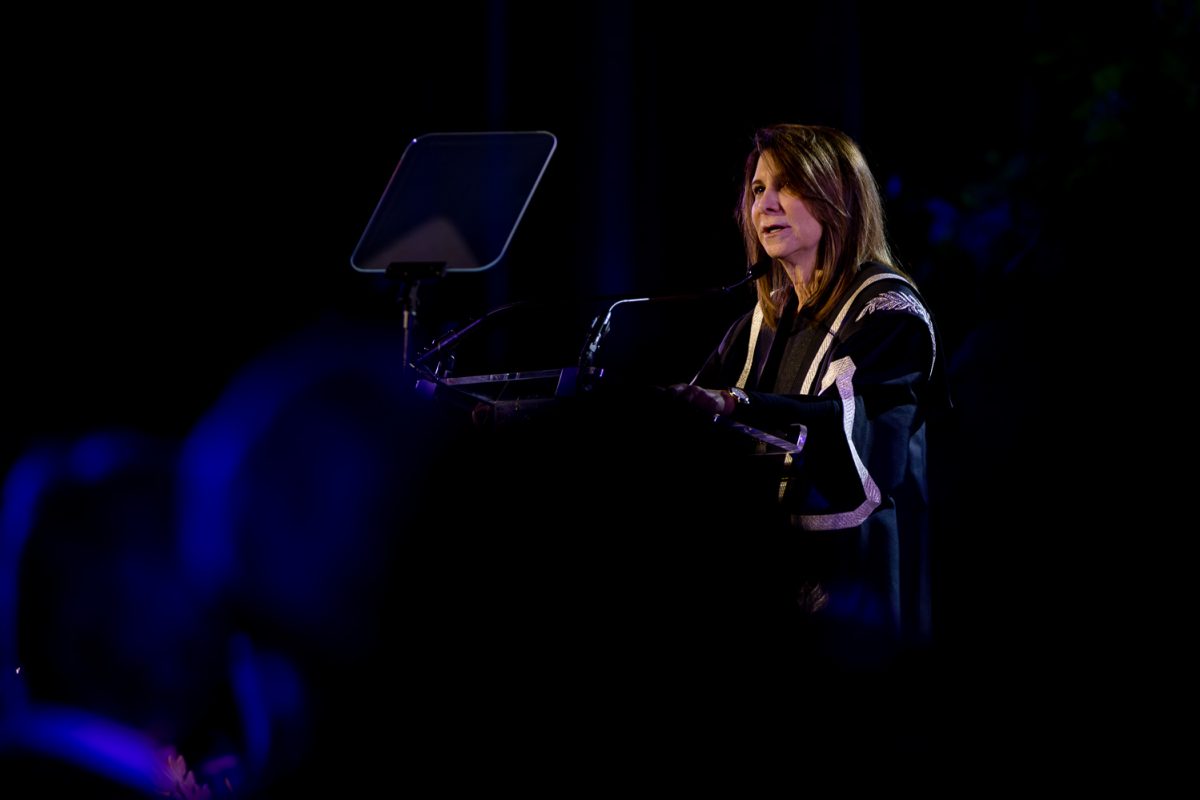
“Do not, whatever you do — under no circumstances — do not think about the camel,” Rice University professor Uriah Kriegel told attendees in the closing speech.
Attendees received a $1,000 cash prize if they could follow Kriegel’s challenge, which was based on theories of “unconscious intentionality.” It was part of his closing remarks, where he referenced his own book “Conscious Intentionality: What Vision and Mood Teach Us,” and aimed to describe how thought resists simple commands.
“Unconscious intentionality is the thing that you instantiated in your mind when you were thinking,” Kriegel said. “Some of you may have had an image of a camel. Some of you may have had conceptual representation. But these are all varieties of conscious intentionality.”
The two-day event — held on Nov. 7 and 8 by NYU’s philosophy department featured 12 guest speakers, commentators and chairs from schools including Columbia University, the University of Alberta, King’s College London and the University of Copenhagen.
Marek Lehocký, a graduate student at Fordham University, told WSN that he heard about the conference from a friend at NYU Abu Dhabi and had been curious about what other philosophers thought about intentionality. Another attendee, Jacob Geisler, told WSN he “is always keeping up to date with the NYU philosophy presentations,” and is consistently impressed by the size of its science and philosophy conferences.
“The aim was to produce a conference that will interest not just people at NYU but throughout the region,” philosophy department chair Don Garrett said in an interview with WSN. “It’s not just for academics — we also want to reach people who are simply interested in philosophy.”
On Friday, three speakers discussed the works of prominent philosophers René Descartes, who applied mathematical concepts to philosophy, Baruch Spinoza, who focused on philosophy and religion, and Immanuel Kant, a major thought leader during the Enlightenment. The second day featured three speakers who analyzed readings from philosophers Franz Brentano, who integrated philosophy and psychology, and Edmund Husserl, founding father of phenomenology.
NYU first held the conference in 2004 as both an effort to promote philosophy at the university and a resource for students and scholars. Now a fixture of the department’s calendar, organizers find scholars from around the world to give presentations, always concluding with a discussion on contemporary philosophy. Next year’s topic will focus on political philosophy and the social contract, according to Garrett.
“It’s been wonderful to see it become such an established thing people look forward to every year,” Garrett said. “We initially didn’t know how many people would show up to it so the attendance has been very gratifying.”
Contact Selin Kemiktarak at [email protected].