






















I spent the fall semester of my sophomore year in Accra, Ghana. I stood in the middle of Madina Market, pressed between narrow walkways crowded with people moving in every direction. Vendors called out over one another, music played faintly from behind a row of stalls and racks of colorful clothes brushed against me as my friends and I wandered through the busy area. It was early in the semester, and we were lingering at a clothing stall when the owner, a woman with quick hands folding fabric, asked where I was from.
“America,” I said instinctively.
She paused, tilting her head slightly, her expression shifting as if the answer felt incomplete.
“Where are your parents from?” she asked.
When I said “Jamaica,” her face lit up instantly.
“Oh, so you’re Jamaican.”
That moment stayed with me throughout my time abroad. For the first time, someone saw my Blackness not as a single identity but as layered, specific and connected to lineage. I had always considered my parents’ Jamaican heritage as theirs, not necessarily mine. But in Ghana, my identity grew in ways I had never considered — in the United States, I’m simply Black. In Ghana, people wanted to know which Black.
In my hometown of Ocoee, Florida, my understanding of Blackness exists within a complicated landscape. While my high school was predominantly Black, the broader city was majority white and shaped by a painful history. In 1920, a white mob attacked Black residents after a Black man attempted to vote, triggering dozens of murders and burnings of homes over the next two days in what became known as the Ocoee Massacre. Members of the Black community were driven out of the area for decades following the massacre, which remains one of the country’s most violent hate crimes.
Even without fully knowing that history as a child, I understood that just as much as Blackness was cultivated by the community I was surrounded by daily, it also existed within the parameters of a society built on white supremacy.
Still, my experience of Blackness didn’t always align with the dominant narratives I encountered in the United States. Growing up in a predominantly Black environment as a Caribbean American raised by Jamaican parents, I had a childhood filled with eating my mom’s curry chicken, jerk chicken, festival rice and peas, and plantain cornmeal porridge. These traditions were more than food — they were quiet lessons in culture, identity and belonging that needed no explanation.
Among my Caribbean friends, there was often an unspoken understanding that older siblings would help raise their younger counterparts, and that caring for parents as they aged was assumed rather than optional. Conversations with some of my African American friends revealed differences in upbringing — not as points of contention, but as reminders that Blackness contains multiple cultural languages. Over time, I began to recognize how differently I was raised from my African American friends, and I did not fully internalize those distinctions until I had the distance to reflect on them.
The curiosity of the woman at the market and others I interacted with in Ghana felt like a new awareness of the many forms Blackness could take. They asked follow-up questions. They leaned closer when I spoke. Some smiled in recognition, while others began telling me about Jamaican music or relatives abroad, as if searching for points of connection. Their curiosity was not skeptical, but attentive and driven by a desire to locate me within a broader diaspora, rather than reduce me to a single label.
In Ghana, people treated me like family before knowing my name. The compliments I received were not rooted in my outward appearance, feeling more like reflections of shared familiarity. I was beautiful because I looked like them.
Traveling abroad introduced me to the histories never taught. In the United States, Black history is framed through slavery, struggle and civil rights milestones — but being in West Africa reshaped that narrative entirely. I learned that Black history did not begin with oppression and suffering. It existed long before, rooted in kingdoms, cultures and leadership that stretched across centuries. My ancestors weren’t just enslaved people, but kings, queens and visionaries. Learning about figures like Kwame Nkrumah, Ghana’s first president, expanded my understanding of the meaning of legacy. For the first time, I saw Black history not only as survival and resilience, but also as power and greatness.
The following semester, I studied abroad in London, where I had the opportunity to visit Italy. There, people stared openly, sometimes with curiosity and sometimes with disdain. My Blackness felt hypervisible there, as if I stood outside the space rather than within it.
That shift reminded me that identity does not exist in isolation — it is shaped by those who surround you and how they see you. Even within the United States, identity shifts depending on location. New York City alone contains multiple worlds: Walking through NoHo carries a different energy than walking through Harlem or the Bronx, where Black history and culture are rooted in collective strength. Geography influences both how others perceive you and how you understand yourself.
While Black history is expansive and deeply layered, it also exists in small moments of recognition across the globe. Sometimes it looks like another Black woman complimenting my natural hair on the subway, or getting tips from a London local on the best braiding salons. Of course, leaving the United States did not make me more Black — but it did change how I carried myself, and made me less concerned with fitting a definition and more comfortable inhabiting complexity.
But it still left me wondering: What does it mean to belong when belonging changes depending on where you stand?
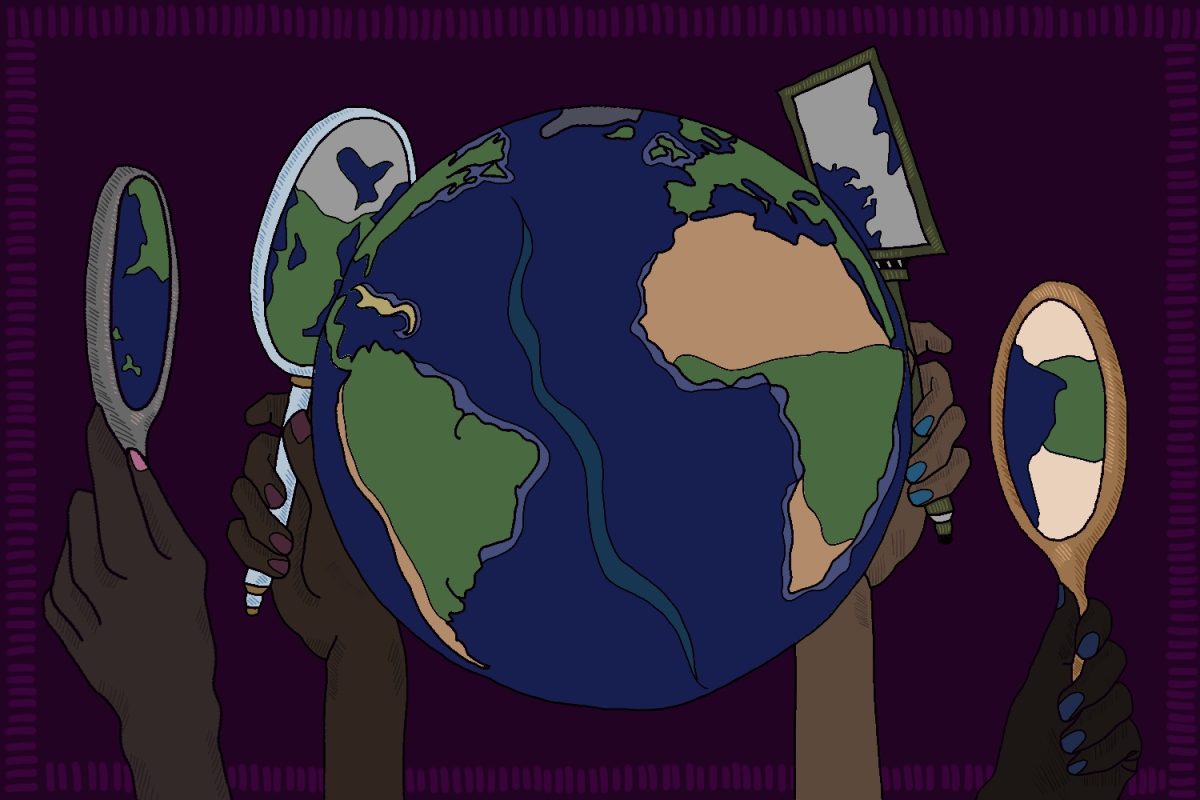
Each of these places echoed a different version of myself back to me, evidence that identity exists as a living conversation between culture, geography and self-understanding. My Blackness does not change when I cross a border, but what it means in different places does. Maybe belonging isn’t about choosing one version of myself, but learning to carry all of them at once — knowing that wherever I go, I will find someone that asks which Black I am, and I will keep discovering new answers.
Contact Robin Young at [email protected].
Saadiq s. • Feb 20, 2026 at 2:05 am
Loved this
ROBIN YOUNG • Feb 24, 2026 at 11:03 pm
Thank you so much Saadiq! That means a lot to me. Writing this was super therapeutic and opened my eyes to so many things that I had experienced that I didn’t know impacted me so deeply.
Roxane Pickens, NYU Libraries • Feb 19, 2026 at 10:26 am
Wonderful essay–thank you! Reminds of Taiye Selasi’s TED talk, “Don’t ask where I’m from, ask where I’m a local” (https://www.ted.com/talks/taiye_selasi_don_t_ask_where_i_m_from_ask_where_i_m_a_local).
ROBIN YOUNG • Feb 24, 2026 at 11:04 pm
Thank you so much Roxanne. I will definitely take a listen to this TedTalk. So much to learn and so much to reckon with.