

























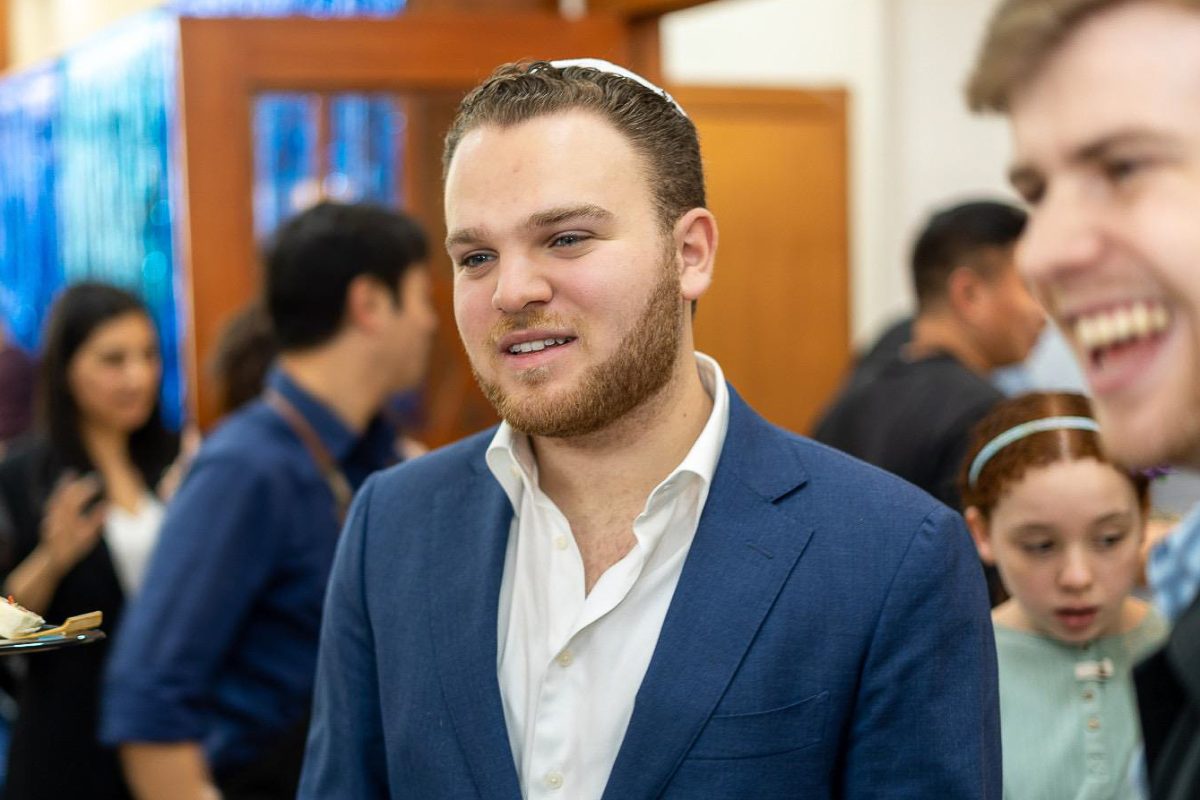
Owen Roubeni landed at NYU Shanghai by mistake. On his application, he marked the Shanghai campus as his second location of interest, thinking he’d only study there for a year before returning to New York City — but once Roubeni received his acceptance letter, he quickly realized that he’d be there much longer than he had thought.
“I get my acceptance letter back, and it says, ‘Congratulations, you got accepted to NYU Shanghai!’ I’m like, ‘Wait, what? What does that mean?’” Roubeni said in an interview with WSN. “So then I look it up, and it’s like, ‘No, it’s the full thing. You’re in China the whole time.’”
Roubeni applied to NYU in early decision, meaning he was unable to back out of enrolling at the Shanghai campus. But he took it in stride, deciding that the four-year investment would be a “once-in-a-lifetime opportunity” where he could meet people and visit places he had never imagined of before.
A practicing Jew, Roubeni knew that NYU Shanghai would not have kosher food options to meet his dietary needs. Over the Chinese messaging app WeChat, he connected with Shalom Greenberg, a rabbi in Shanghai who directed the city’s Chabad house: a center to support Jews living around the world, established by the Brooklyn-based Chabad movement.
“We have this thing called the Chabad Squad — sometimes after Chabad, we’ll go to a bar or something, and we’ll talk and get together,” Roubeni said. “Because the community is so small, I feel like it’s very close and intimate. You know everyone. You see the same faces every week. It’s a very, very nice community to be a part of.”
Roubeni estimates that there are only about three or four practicing Jews at NYU Shanghai out of the campus’ over 2,000 undergraduate students. For them, the Chabad house offered kosher meat, in addition to other services like Torah study and Jewish holiday rituals.
“We celebrated Thanksgiving together as the Jewish students of NYU Shanghai. That was very nice,” Roubeni said. “We had a fruit turkey — unfortunately, turkey is one of the few meats that we cannot get kosher in China.”

Roubeni felt deeply grateful for the support he’d received from the Chabad of Shanghai, and started looking for ways to give back. He noticed that many Jewish students were struggling to access mezuzahs — parchment scrolls containing Torah verses placed on doorposts — which are deeply important in Jewish tradition. Shanghai’s Chabad didn’t have the resources to provide mezuzahs to everyone who needed one, so Roubeni took it upon himself to start a fundraiser to purchase mezuzahs for his fellow Jewish students and staff at the Shanghai campus.
Roubeni created a GoFundMe called “Help Provide Mezuzahs for Jews in Shanghai” and advertised it on WeChat, Instagram and Facebook. Over the next month, 24 people donated over $1,700 to the fundraiser, allowing Roubeni to purchase 26 mezuzahs for students at NYU Shanghai and nearby colleges, including Duke Kunshan University and Shanghai Jiao Tong University. The number he bought, he said, was special.
“This is a crazy thing. I don’t believe in coincidence,” Roubeni said. “So it just happened that I was able to raise 26 mezuzahs, and 26 is the number associated with God in the Jewish religion. It’s very nice that it worked out.”
Now in his junior year, Roubeni is preparing to study abroad at NYU Sydney for a semester. He said he was grateful for his time in China because of the people he met there — both the diverse population attending NYU Shanghai and the native Chinese people around the city.
“I’m told by all of my Chinese friends, because I have many from China, that I’m the first Jew they’ve ever met,” Roubeni said. “I’ve experienced no antisemitism at all in China — it’s actually such a safe place. It’s incredible, honestly. I hear all these horrible things happening in New York, Sydney and London. China? It’s really the safest, safest, safest place.”
NYU Shanghai still does not provide kosher food options for its students, although it does provide halal and vegetarian accommodations. Roubeni said that while he suspected the Jewish population at the Shanghai campus was too low for it to consider supplying kosher food, he petitioned the issue in an email to NYU Shanghai leadership. He did not receive a response.
Roubeni believes the relationship between NYU Shanghai and its Jewish students should work the other way around: If the university offers kosher meat, more Jewish people will attend the Shanghai campus. He hopes a relationship between NYU Shanghai and the Chabad house, in which Chabad acquires frozen kosher meats and the Shanghai campus purchases and prepares them, could be a productive start. While Roubeni is still waiting for a response from the board on the accessibility of kosher dining at NYU Shanghai, he still sees hope for the future of his faith on campus.
“It’s not the end,” Roubeni said. “It’s only the beginning.”
Contact Zachary Karp at [email protected].