






















As debates over food insecurity and dietary guidelines intensify nationwide, NYU’s “Feast and Famine” lecture series offers a space for community members to engage with experts. Launched in 1996 alongside the Department of Nutrition and Food Studies, the program hosts several talks each semester focused on pressing food issues, followed by open discussion.
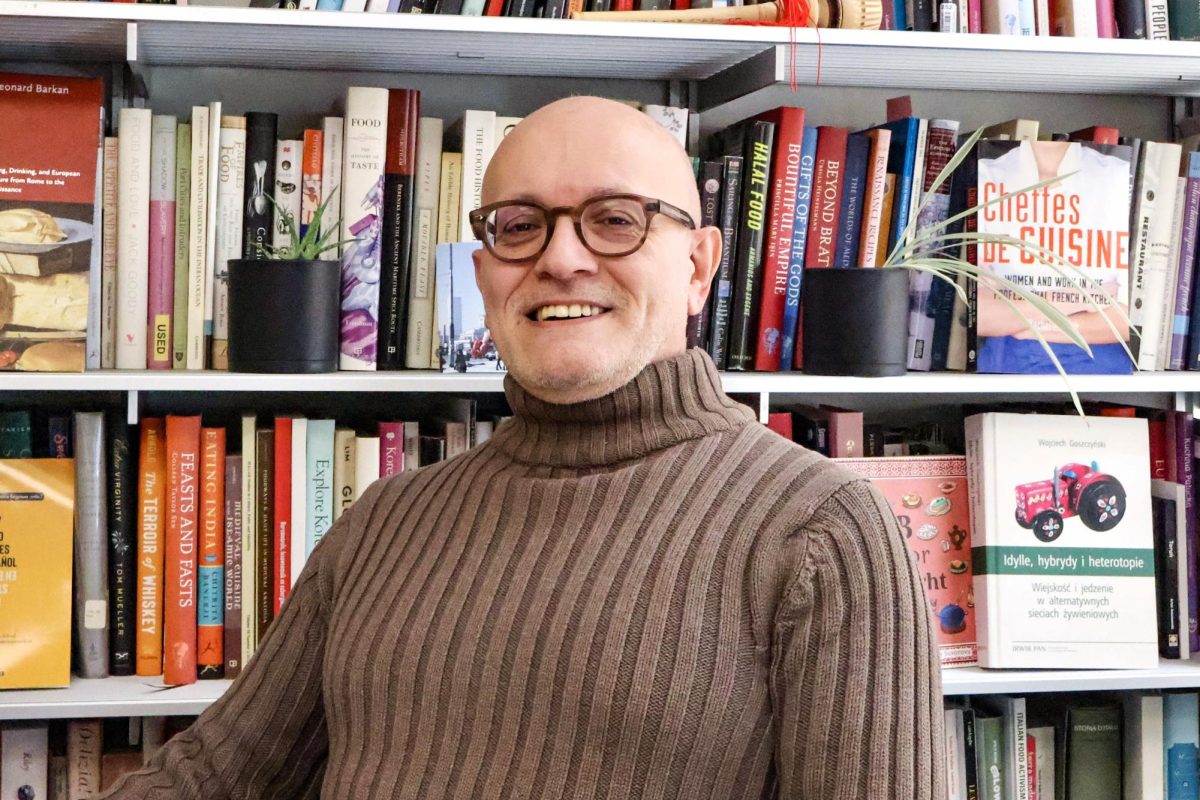
Steinhardt professor Fabio Parasecoli first attended a “Feast and Famine” lecture in 1999 while working as a journalist for food and wine magazine Gambero Rosso. Invited to a school food discussion in France, Parasecoli said the series introduced him to a more exploratory way of thinking about food that welcomes unfinished ideas. He later joined NYU and, since last fall, has helped plan lectures — including one in September where he presented his latest book, “The Pierogi Problem,” which focuses on Poland’s changing culinary landscape.
At the most recent lecture in February, University of Toronto professor Josée Johnston discussed “Happy Meat,” her book exploring the moral paradox among North American meat eaters who insist on only consuming animals that had good lives. University of California, Davis professor Charlotte Biltekoff will discuss her book “Real Food, Real Facts: Processed Food and the Politics of Knowledge” on March 9, examining tensions between the U.S. public and food industry marketers over processed foods.
Parasecoli spoke to WSN about the series and why, 30 years later, conversations about the intersectional impacts of food are still important.
This interview has been edited for length and clarity.
WSN: Since the series began in the ’90s, how has the meaning of ‘feast and famine’ evolved — and how has the lecture series remained relevant?
Parasecoli: When we started, we were the only game in the country, so it was easy to get a lot of attention. Now, you have to be really careful about the content, the program and how you communicate it, so that has been a development. In many ways, some of the main characteristics of these lectures — the fact that we discuss work, that there is always a very lively, long question and response, and that we look at current, important contemporary issues — have remained the same. Of course, back in the ’90s or the early 2000s, most presentations didn’t include PowerPoint or video because that wasn’t the style at the time. Now, all presenters come with their materials, so there is very often a visual engagement as well.
WSN: How do you and your colleagues go about selecting speakers and topics each semester?
Parasecoli: We try to select speakers who have a certain cultural relevance, including well-known authors and well-respected scholars. Then it’s a matter of figuring out what they can talk about — it doesn’t necessarily have to be about a new book; it can be about ongoing research or something new. For us, it’s important that the topics are current and speak to what our students and the community are interested in. In my case, it was Polish food, and we collaborated with the Polish Cultural Institute New York. Depending on the topic, we might also collaborate with other institutions and community centers, since many of us in the department have contacts in the city. Sometimes we build our talks around those collaborations. You can really look at food from so many different points of view, so we try to reflect this complexity.
WSN: Given today’s global economic pressures, what food issues feel most urgent — and how does the lecture series contribute to those conversations?
Parasecoli: Definitely food security, not only in far-flung parts of the world, but also in the United States, where people — including NYU students — are struggling to put food on their tables. Then there are issues of health: What do we eat right now? With the administration changing the dietary guidelines, there are many conversations about that. There are also environmental issues: What is the impact of food production on the Earth, on climate change and development? Economic issues are important, too: Who makes money and who is exploited? Because people working in food systems are often migrants, they are exploited, especially in agriculture and slaughterhouses. And there are also cultural and political issues — like the ‘soy boys’ versus the ‘milk boys’ and whether the hamburger represents a ‘real American.’ The lecture series points out these important issues and allows authors, scholars, students and community members to exchange ideas around those topics in a space that is friendly, but at the same time grounded in solid, well-researched information.
WSN: How should young people meaningfully engage with food issues?
Parasecoli: Getting serious information would be the first step, rather than saying, ‘I’ve seen this influencer on TikTok.’ Especially for younger participants, it’s a challenge because much of their information comes from there, while we present work that may represent four to six years of research. We try to provide reliable information based on studies, and I think it would be good for the younger generation to be exposed to that kind of material — where maybe you have to listen to somebody for 40 minutes, rather than watching a two-minute clip.
WSN: What surprises first-time attendees most, and what do you hope they take away?
Parasecoli: The collegiality and the dialogue — it’s a very welcoming place. Many people have been attending for years, if not decades. There is a sense that we’re part of a community of researchers, scholars and activists — we know each other. I hope they walk away with new ways of looking at an issue or an aspect that they thought they were familiar with, and maybe they discover something new. We have students who come to our events precisely because they’re trying to expand their perspectives and are ready to be challenged.
Contact Colette Yehl [email protected].
Shabeermon Mankada • Mar 6, 2026 at 7:52 am
The visit of Fabio Parasecoli to Kerala in 2018 played an important role in stimulating academic interest in the field of food studies in the region. This engagement eventually contributed to the introduction of Food History as part of the Four-Year Undergraduate Programme in 2024 at University of Calicut, India. As an interdisciplinary field, food studies offers a powerful analytical lens through which scholars can examine the past, exploring the social, cultural, economic, and environmental dimensions of food and their role in shaping the evolution of modern societies. The development of this academic initiative reflects the growing recognition of food as a significant subject of historical inquiry. In this regard, Professor Parasecoli’s scholarship and intellectual engagement have been influential in encouraging new directions of research and teaching in this emerging field.