























On Tuesday morning, I invited two of my friends (who are actually my coworkers) to join me in an ill-conceived, probably laughable idea: We were going to go birdwatching in Washington Square Park.
The plan was to hunt for the red-tailed hawk, a species ubiquitous around my hometown in the Maryland suburbs but harder to spot in the concrete jungle. I’d heard it was common around Washington Square Park, so I felt a compulsion to go see it for myself.
The best time to go birdwatching in one of New York City’s green spaces is from dawn to 11 a.m., when birds are most active. Groups like the NYC Bird Alliance curate web resources to learn about how to prepare for birdwatching and recognize birds, eBird offers lists of “iconic birds” common in different locations and the Merlin Bird ID app can identify species from their calls. You should bring a pair of binoculars (we didn’t) and, ideally, a guide to distinguishing local birds.
Peak spring migration in New York City lasts from mid-April through mid-May. Now is the best time to catch a songbird or woodpecker on its journey north — they’re most common around the north side of the park, atop the canopy trees. The red-tail is the park’s biggest prize: It’s a big, stout bird with a broad wingspan and distinctive screech. My dad, an avid birder, had hinted it’d be a difficult find.
There’s a red-tail nest outside a window on the top floor of Bobst Library. Washington Square Park’s internet-famous hawk couple — Bobby, named after Elmer Holmes Bobst, and Violet, named after NYU — built it in 2011. Bobby has since disappeared, but other red-tails still squat in his old house. Finding the nest was the easiest part of our journey, but it was empty. The hawks were on the prowl.

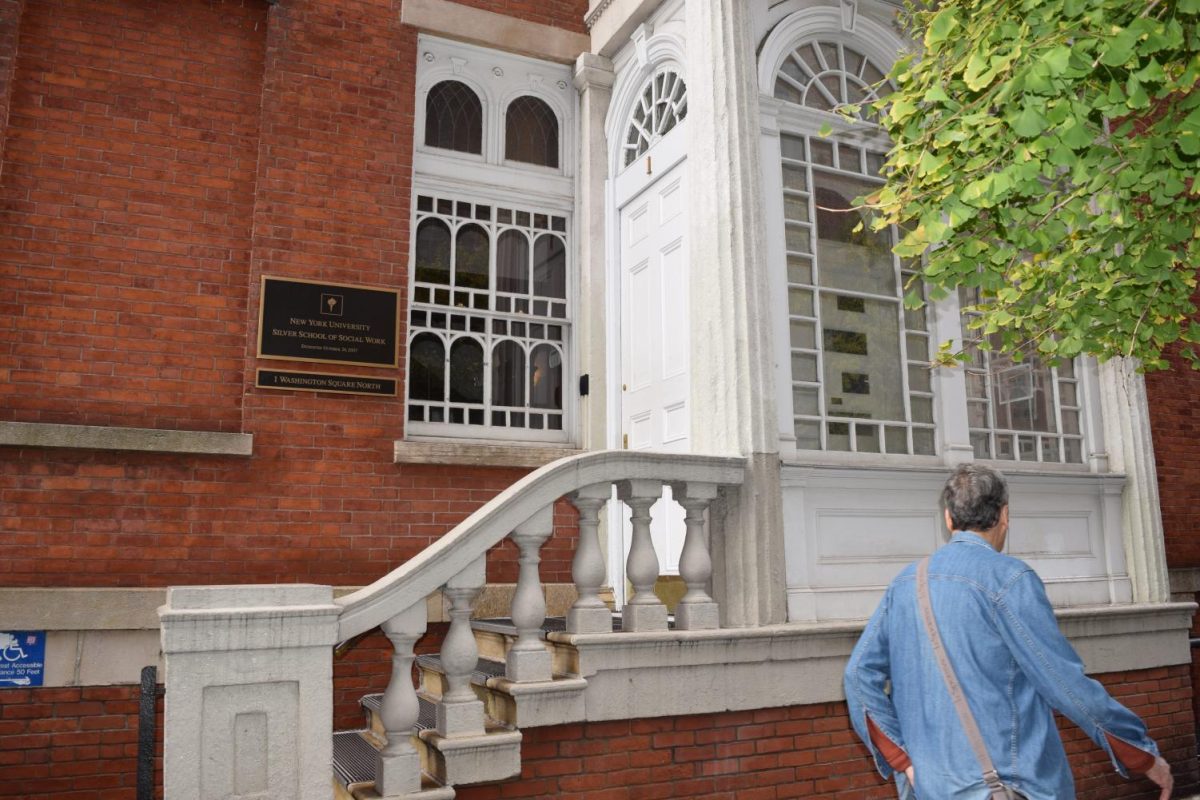
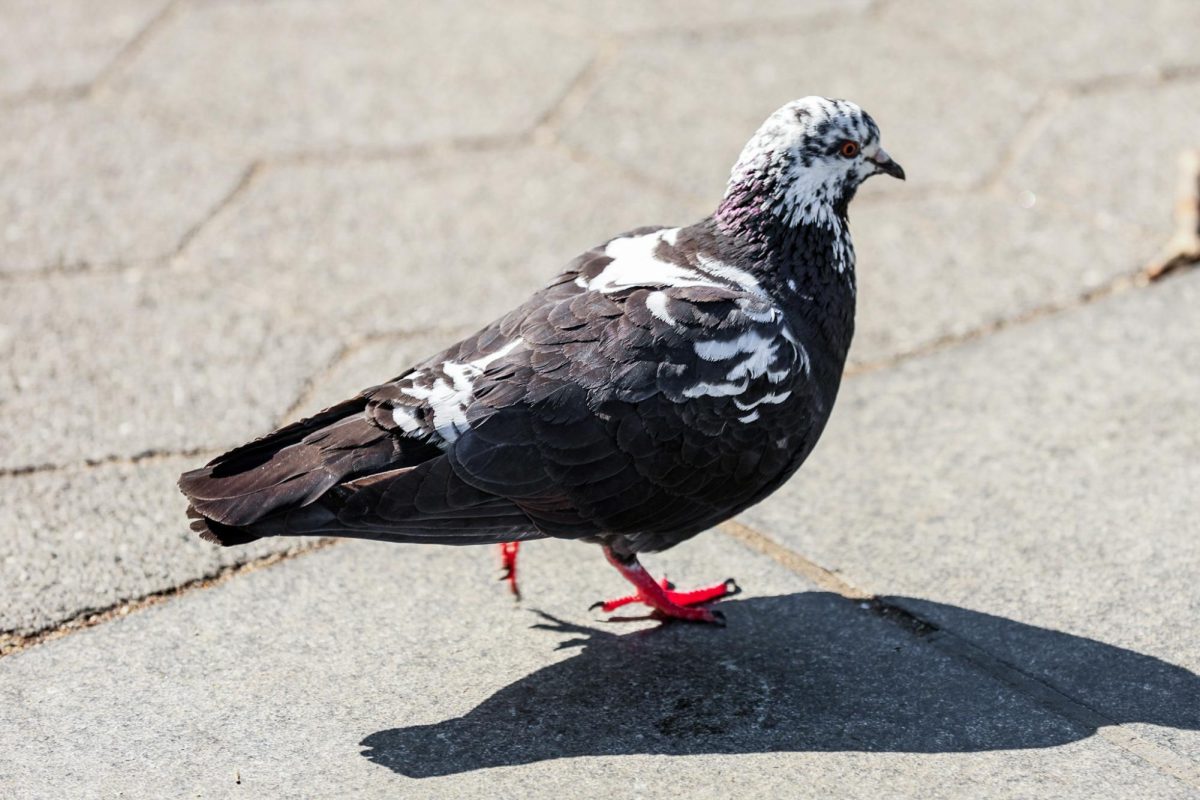
Red-tails are raptors, or birds of prey: They eat squirrels, rats and smaller birds, and occasionally swoop down onto the pavement to snatch one up and fly away. We checked the metal cross atop Judson Memorial Church, where Urban Hawks reported red-tail sightings in 2022 — bare. Disappointed, we set off for the Silver Center, where the species can occasionally be spotted on the roof. My friend pointed out a cool-looking white-speckled pigeon on the pavement.
A singsongy call interrupted the chirping of sparrows in the trees. My Merlin app identified it as the sound of a white-throated sparrow, a little bird with black-and-white stripes on its head and sharp yellow splotches by its eyes. It was probably one of the last still hanging around New York City — white-throated sparrows migrate northward in the spring, preferring to breed further upstate and in Canada. We looked around, but couldn’t locate where the sound was coming from.
The Silver Center’s roof was similarly empty. With class looming, we decided to check the last location around the park where red-tails have been reported — 37 Washington Square W. — and call it there, hawk or no hawk. I was, honestly, getting a little desperate. I’d been running around the park for over an hour and still hadn’t seen anything other than rock pigeons and house sparrows.
It was a little anticlimactic. There were no red-tailed hawks atop the building. But on our way there, we passed the prettiest part of Washington Square Park: the area opposite the arch, where you can find pink azalea shrubs and Japanese cherry trees in full bloom.

It’s impossible for them not to catch your eye. Around 270 trees of 40 different species live in Washington Square Park, from the native red maples by the northeast entrance to the Japanese flowering cherries just south of the fountain. Most famous is the “Hangman’s Elm” in the northwest corner, a 110-foot-plus English elm more than 300 years old — one of Manhattan’s oldest. In the southwest corner is the park’s only Atlas cedar tree, one of around 400 in New York City. It’s a thin tree with lanky oval-shaped cones, native to the Atlas Mountains in Morocco and Algeria.
Most days, I spend the morning in class and the evening holed up in WSN’s office in the Third Avenue North basement. If you go birdwatching on NYU’s turf, chances are you won’t witness anything particularly stunning. But you will find a chance to connect with the beauty of the city’s flora and fauna. Birdwatching trains your eye to focus on small details, and grows your appreciation for even the tiniest glimpses of nature.
Contact Zachary Karp at [email protected].