























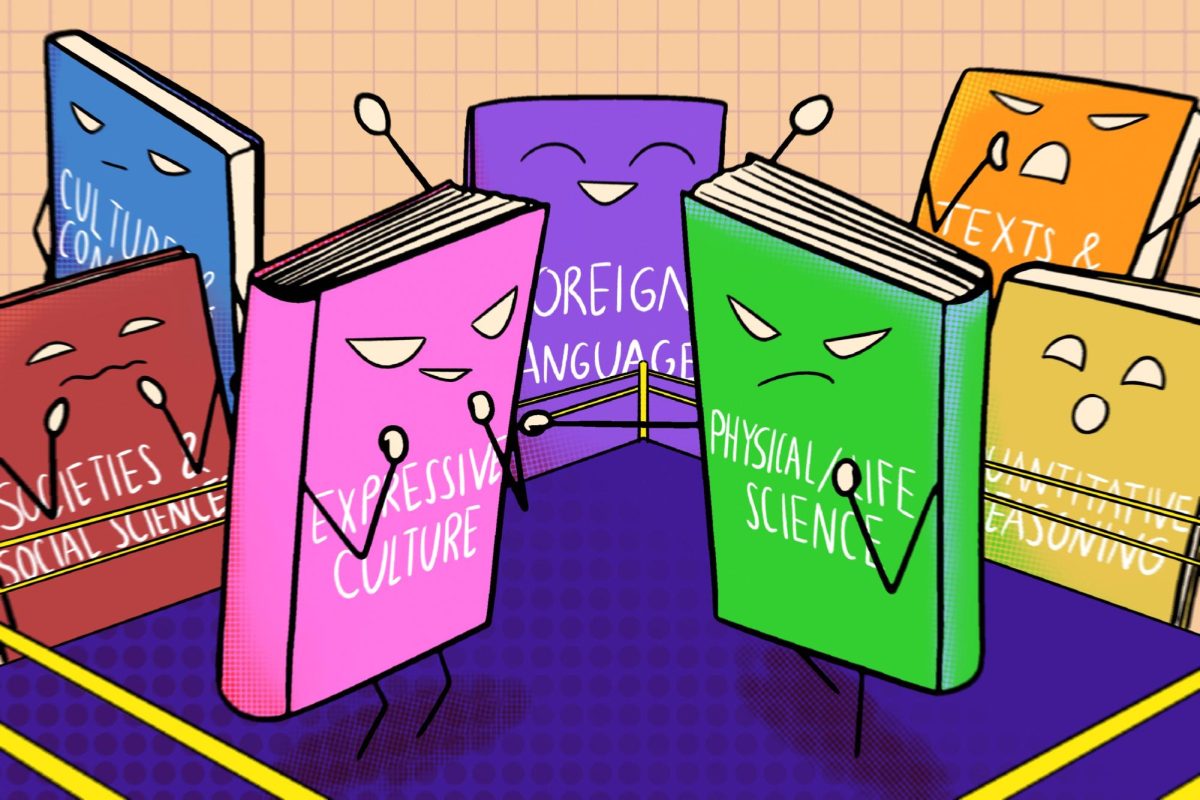
Ahead of class registration for the upcoming fall semester, we each took the time to reflect on our favorite classes at NYU and their moving professors, transformative opportunities and most enduring impacts. Full disclosure: It turns out, the Culture desk loves studying, well, cultures, so we’ve picked an array of humanities classes for you to try out, none of which have prerequisites. For the STEM students perusing this list, not to worry — to satisfy your empirically oriented minds, we have a data class lined up for you too.
Arts and Cultures across Antiquity
ACA-UF 101 | Mon, Wed, 9:30-10:45 a.m. | Jared Simard
With only two semesters in Liberal Studies under my belt, the best class I’ve taken thus far comes as a package of long-winded yet immensely interesting texts paired with an eccentric, exhilarating professor. In Arts and Cultures across Antiquity, LS professor Jared Simard introduced me to literature I considered far beyond my reading capabilities, using them to form larger understandings of the world around us. From the exploration of heroic hubris in “The Iliad” to Psyche and Cupid’s iconic love story in “The Golden Ass,” we discussed the complexity of grief, sexuality and the ancient understandings of the afterlife. The course also asked students to take weekend trips across the city, one of which was to Woodlawn Cemetery in the Bronx, and allowed us to create immersive videos about Disney on NYU Stream. From the very first day, Simard was full of enthusiasm, inside jokes and fun surprises, the most notable being a drastic haircut at the end of the semester that left the entire class with jaws dropped.
— Shreeya Goyal, Beauty & Style Editor
History of Fashion Photography
ARCS-UE 1020 | TBA | Elizabeth Marcus
As a Politics and Fashion student, my course load always looks like a seemingly random assortment of lectures and practicums that leave my STEM or Sternie friends scratching their heads in confusion. Among this mixed bag, History of Fashion Photography with Steinhardt professor Elizabeth Marcus pushed me the most out of my comfort zone. The class consisted of a series of lectures that explored prominent fashion photographers from the 20th and 21st centuries, with a focus on fashion media trends set by magazines like Vogue and Harper’s Bazaar. As someone with no background in photography, I was initially worried about my lack of prior knowledge — but Marcus’ enthusiasm and passion manifested in eye-opening activities that were simply impossible to resist. For instance, as an introduction to the course, we engaged in an exercise called “talking pictures,” where classmates were paired up and sent one another fashion photographs with corresponding aesthetics back and forth. This course unexpectedly gave me a new perspective on photography’s impact on society, as well as how I make sense of seemingly normal advertisements and campaigns around me.
— Ivanka Sun, Culture Editor
Introduction to Cultural Anthropology
ANTH-UA 1 | Tue, Thu, 9:30-10:45 a.m. | Amy Zhang
Have you ever taken a class that totally changes your worldview? For me, that course was Introduction to Cultural Anthropology. Over the course of a semester, the class attempted to investigate what culture is by walking you through important historical works in anthropology from around the globe. Readings cover everything from why gift-giving is important in friendships to why coming-of-age rituals are so universal. Mostly, you’ll learn how to think like an anthropologist, slow down and devote your attention to the most unspoken elements of everyday life. That kind of thinking is an advantage across disciplines. I had friends in that class majoring in journalism, biology, marketing, psychology and even math — and learning how to think anthropologically turned out to be useful for all of them. For our final, each student conducted an ethnography as a first-person field study of a community or place in New York City, and wrote a paper on their findings. Student projects covered everything from high-end watch collectors to Tibetan monks. The best part is it had to be a community you knew nothing about — something far outside your comfort zone that forces you to really pay attention to what makes people tick.
— Sam Donagi, Deputy Culture Editor
Quantitative Reasoning: From Data to Discovery
CORE-UA 111 | Mon, Wed, 4:55-6:10 p.m. | Julius Damarackas
It is a rite of passage for CAS students to complain about all of the College Core Curriculum requirements they have to take, stress over finding one that happens to be open come registration and then complain all over again when actually taking the class. I myself have experienced this phenomenon one too many times. However, From Data to Discovery — the course I took to fulfill my Quantitative Reasoning requirement — felt like a breath of fresh air. As an English major, it is quite obvious that I hate math and, frankly, math also hates me. Yet, because this course was a mix of intro-level coding and basic algebra, my deep-seated hatred for the subject never bled into my studies. In fact, I actually enjoyed the math I was completing throughout this course. Not only did I find the content to be simple yet engaging, I also felt that connecting data to real-world scenarios made the information more applicable to topics I explored in my humanities classes like online surveillance and education disparities across the city. From Data to Discovery defied my expectations of being just another requirement to check off as it showed me that there is more to math than strict formulas and right answers.
— Noor Maahin, Identity & Equity Editor
Social & Cultural Analysis 101
SCA-UA 101 | Mon, Wed, 12:30-1:45 p.m. | Robert Reid-Pharr
I don’t think any NYU student should leave the university without taking a class from the Department of Social and Cultural Analysis, housed at 20 Cooper Square. It’s been one of the only sites on campus where I’ve felt that conversations on racism, capitalism and colonialism are not only validated as legitimate points of discussion, but are reinforced through an incredible selection of readings on the syllabi. As a Gender and Sexuality Studies major, I took this course last semester with CAS professor Robert Reid-Pharr, and while it is an introductory class, my friends and I still find ourselves trying to wrap our heads around learned concepts over dinner on a Friday night. With content spanning art production within carceral contexts, the historical archive as shaped by racial and gendered violence, the everyday practice and politics of queerness and more, I can definitively say that the course provided me with both the historical knowledge and theoretical concepts to articulate my own experiences and understand myself as both in relation and resistant to systems of oppression. In addition, Reid-Pharr’s lecturing style never fails to be engaging and sometimes intimidating — he loves a cold call.
— Julia Kim, Culture Editor
Cultures & Contexts: Contemporary Latino Cultures
CORE-UA 529 | Tue, Thu, 3:30-4:45 p.m. | Cristina Beltrán
Curating my first-ever college class schedule, I was overwhelmed by NYU’s core requirements. Thanks to my Advanced Placement credits, I was able to dodge some basic courses, but others, like Cultures & Contexts, still stood in my way. Without much thought beyond the title piquing my interest, I selected “Contemporary Latino Cultures” — and it ended up being my favorite class of the academic year. The course explored a wide range of Latino cultures, dove into intersecting themes and underscored that Latino identity is not a monolith. With each unit structured around unique readings about history and recent events, CAS professor Cristina Beltrán did a great job of explaining topics in an enthusiastic and straightforward manner, and despite the large lecture size, she encouraged students to share their interpretations and connections to the content. This class was not just academically rich but also immediately relevant — in our last class, we discussed President Donald Trump’s oppressive immigration policies targeting the Latino community. The lecture left me feeling angry and compelled, emotions I’d never felt after a class. Contemporary Latino Cultures doesn’t just fulfill a requirement — through comprehensive teaching, it inspired students to become more profoundly engaged with the world beyond the classroom.
— Colette Yehl, Food Editor
Contact Shreeya Goyal, Ivanka Sun, Sam Donagi, Noor Maahin, Julia Kim and Colette Yehl at [email protected].