

































When Gallatin students walk the graduation stage, their diplomas don’t bear recognizable majors like economics, engineering or English. Instead, students build individualized programs of study throughout their time at the university, creating interdisciplinary concentrations whose names often give them a reputation for being innovative at best, and frivolous at worst. But if these students are unique for any reason, it’s not so much because of their path of study, but rather how they make it work.
Gallatin associate dean Patrick McCreery said that he would find it odd for students in the school to be completely self-assured in their academic program.
“I would be a little concerned about any Gallatin student who had no doubts at all about, ‘Was this the right choice?’” McCreery said. “Because it’s not easy to put together an individualized program of study.”
Questions about putting together a major aren’t only being asked by the students themselves, however. For many, friends and family often struggle to grasp the concepts of their concentrations.
“I swear there’s never a day where someone’s not asking you, ‘So what are you doing?’” Gallatin senior Ahaan Sabherwal, who studies Finance, Capital and Culture in Historical Perspectives said. “‘What are your job prospects? What are you going to graduate with? What does your degree say?’”
Though you wouldn’t be able to tell from the title, Sabherwal’s 15 years of classical violin training were a formative influence on his studies.
“When I found out about Gallatin, it felt so fitting to me,” Sabherwal said. “But at the time, music wasn’t part of it. I was thinking about journalism, neuroscience, econ.”
But Sabherwal, who grew up playing in the D.C. Youth Orchestra Program, soon found himself playing much less than he used to when he arrived at NYU. In hopes of incorporating violin into his life in a more concrete fashion, he began taking classes in musicology — and as disparate as his fields of study are, he finds a way to connect it to his studies.
“I’ll be writing about the development of the commercial music industry, and how music is often influenced by business perspectives and broader movements within society,” said Sabherwal, describing his history classes. “It’s really tough to break it into different parts because it is also interrelated.”
Though Sabherwal will be working in finance after graduation, he still intends to find a way to incorporate music into his career outside the classroom.
“I don’t know where this all comes together and how it all comes together in the end, and I think that’s something I’m going to have to navigate,” he said. “I’ve made my own individualized major. Now let me make my own individualized career.”
Similarly, Anabel Giacobbi, whose concentration is Science, Technology and Society, is looking for ways to incorporate her studies into her post-graduation plans. Though her academic work examines how things such seemingly mundane household appliances impact our understanding of the family unit, gender and labor, on a greater level, the fundamental focus of her concentration is storytelling.
“Something I had always been interested in is this idea of storytelling, and how we decide what narratives are going to organize us and govern us and allow us to relate to each other,” she said.
By exploring the intersection of technology and building narratives at Gallatin, Giacobbi plans to apply her lifelong passion for theater and being a theater technician to her work.
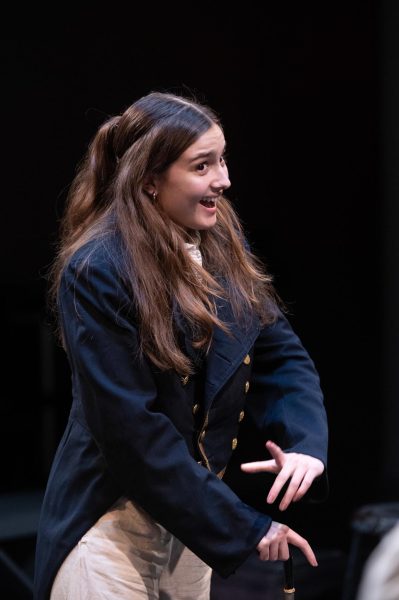
“What I’m doing next year, if everything goes according to plan, is working with a theater company, so I’m applying what I’ve studied in that regard — I think about theater technologies, but also, about how we tell stories and what artifacts we use. And so it’s almost a full circle moment for me.”
Senior Sofia Ciminello is studying Medical Advocacy and Patient-Centered Care with a cross-school minor in Child and Adolescent Mental Health Studies. Her personal experiences with the U.S. healthcare system informs her study of access to care.
“My concentration kind of dives into what are the factors that impact patient access to care,” she said. “Once they’re within that system, what shapes the way that they experience disease and care?”
When asked about the unique nature of her studies at Gallatin, though, Ciminello noticed that it’s not necessarily a drawback, but rather a healthy talking point.
“It’s unique from just having a double major or a major and a minor in another school, because they can have nothing to do with each other and you don’t have to make them interact,” she said. “Gallatin asks you to consider how things are related.”
Contact Noah Kim and Mia Shou at [email protected].