




































Caiqiong Liu works five 24-hour shifts as an elderly home attendant per week: helping patients use the bathroom, turning their bodies to prevent sores and ensuring they’re safe throughout the night. She has developed lower back pain and insomnia. And most days, she is entirely unable to see or care for her family.
“They don’t care whether we sleep — we have to make sure the patient is safe, day and night,” Liu told WSN. “If we don’t provide for the patient, we will lose our job.”
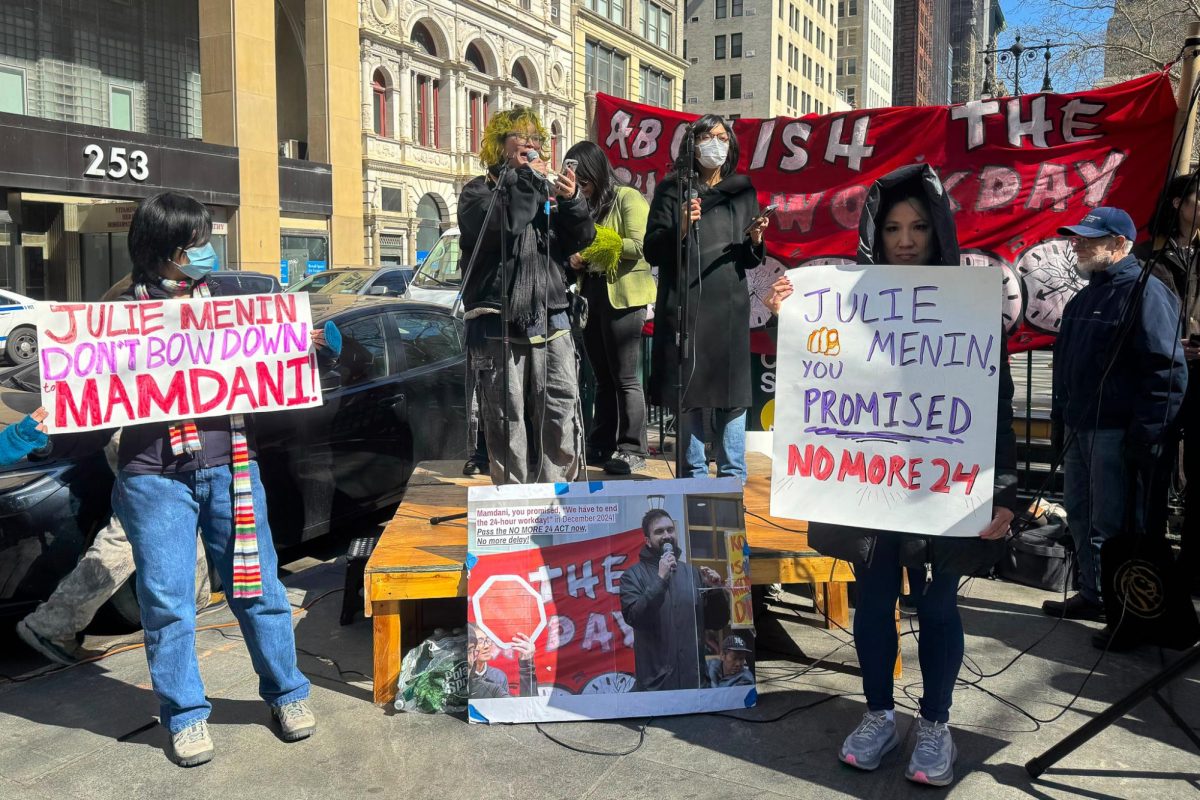
Liu is one of many home care workers who have been fighting to end the 24-hour workday since March. Dozens rallied outside City Hall on Thursday, announcing a pause on their six-day hunger strike in support of the No More 24 Act — a New York City Council Bill that would cap shifts at 12 hours and give them more freedom over their schedules.
The strike adjourned after City Council Speaker Julie Menin promised to submit the No More 24 Act to a vote by May 14, as several home care workers and politicians voiced their support for the legislation, also known as Intro 303. Local advocate Jasmin Sanchez, who is running to represent the state assembly’s District 65 — which includes several lower Manhattan neighborhoods — spoke to the crowd in both Spanish and English, calling on fellow legislators to introduce the bill to city council.
“There is nothing normal about asking someone to work 24 hours straight,” Sanchez said. “There is nothing acceptable about building an entire care system on the exhaustion of women, on the backs of immigrant women, Black women, Asian women, Latina women, who are told that their labor is essential but their humanity is optional.”
The strike was led by the “Ain’t I a Woman?!” campaign, encompassing a group of both teenage and elderly employees. Since last month, workers have staged sit-ins at City Hall to push lawmakers to bring the No More 24 Act to a vote. They have increasingly pressured Mayor Zohran Mamdani, Governor Kathy Hochul and Menin to advance the legislation, and over five dozen students signed an open letter on Tuesday with the same demands.
Immigrants make up one in three long-term care workers in the United States, who provide bedside support to the elderly and other patients with chronic illnesses or disabilities. Yinny Tan, who has worked 24-hour shifts in elderly care for the last 16 years, said she is often expected to assist with groceries, accompany patients to medical appointments and clean and prepare meals — often with little to no rest.
“We are human beings, we are not machines — we cannot work 24 hours,” Tan said in a translated interview with WSN.
Under current state regulations, home care agencies are allowed to assign 24-hour shifts based on the assumption that aides work an average of 13 hours per shift and take breaks to sleep and eat during the remaining 11 hours. But given the hands-on nature of the care their patients need, home care workers often easily work throughout the night despite only receiving 13 hours’ worth of pay.
Many of the state’s 623,000 home and personal care workers are routinely scheduled for back-to-back 24-hour shifts, sometimes totaling up to 72 consecutive hours. The demanding work may create physical, psychological and economic damages for employees and undermine their ability to provide quality care.
“I’ve learned how important it is that working women take the forefront of the campaigns, as we’ve seen earlier,” Hannah Agustin, chairperson of Gabriela New York, told WSN during an April 8 sit-in at City Hall. “They’re not backing down, and they have been insistent on doing the hunger strike, and on doing the sit-in. We are really following their lead.”
Nearly 20 disability organizations signed a letter earlier this month in opposition of Intro 303, arguing that they were not considered in the legislation and raising concerns that thousands of patients could lose access to the 24-hour coverage they rely on to avoid institutionalization. They also wrote that home care workers could see significant income loss, destabilizing a 24-hour home care system largely funded by Medicare.
Still, the bill’s supporters stress that the only path to addressing worker exploitation is through collective action that unites workers and their allies.
“I’m a teacher and educator by trade, and I realized that even if you go get an education and you get a master’s, we’re still very much exploited by this system.” Sarah Ann, an organizer and volunteer at the Flushing Working Center, told WSN. “The only way to get out of it is to actually come together with other people to change — to change it fundamentally.”
Contact Aryana Arora at [email protected].