




























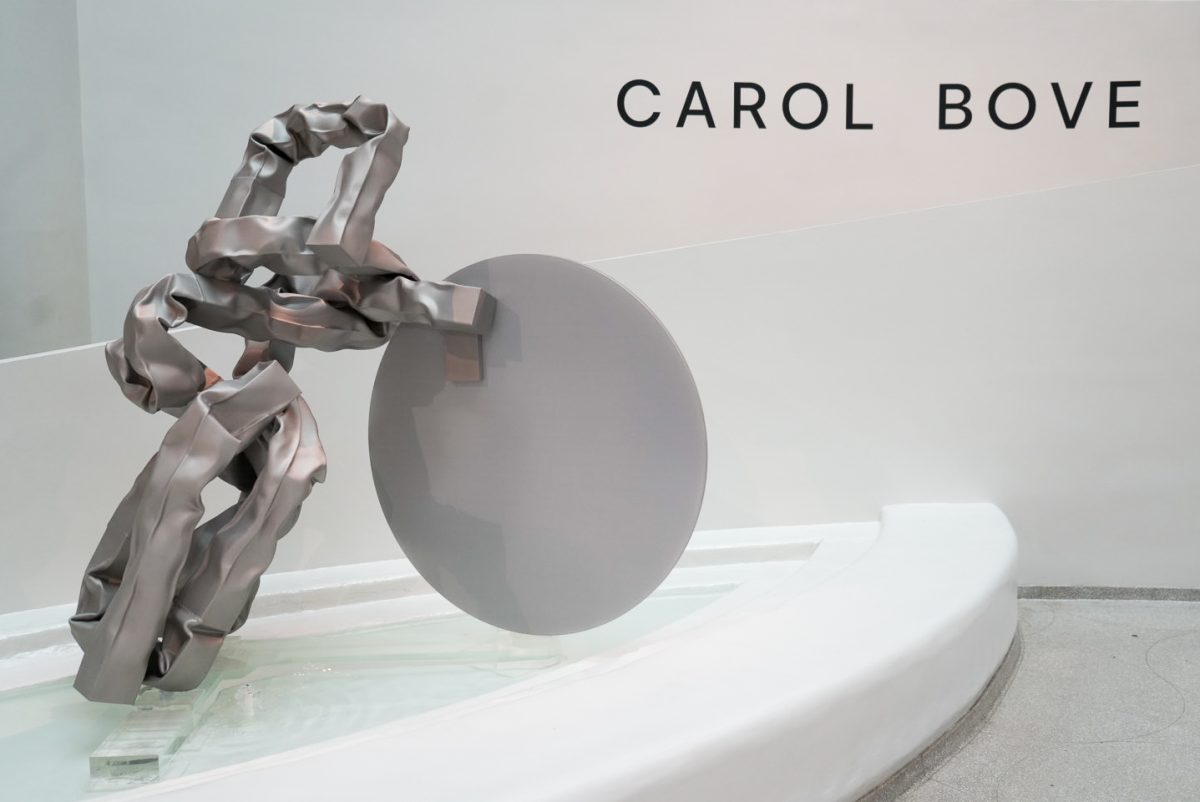
Installed along The Solomon R. Guggenheim Museum’s ascending rotunda, “Carol Bove” immediately pulls the eye upward: Small mirrored circles climb the museum’s walls as bursts of color from sculptures peek through at each level.
A former NYU professor and Studio Art alum, Bove is a contemporary sculptor and installation artist who experiments with steel, used in her most monumental works. Curated by Katherine Brinson, the exhibition opened on March 5 and explores space and physical form, tracing Bove’s evolution from small works on paper to large-scale metal installations.
Displayed in descending order, the exhibition allows viewers to begin with the artist’s most recent work and move upward toward her earlier pieces. This layout places the works in direct conversation with the museum’s architecture, guiding the viewer to move up the ramps and rewind time.

The show begins with a partially exposed permanent mural, “Alicia” (1965) by Joan Miró and Josep Llorens, revealed through a cutout in the museum’s wall. Hidden for decades, the black abstract lines on the painted ceramic tiles are part of the architecture itself, not a traditional standalone work. Glimpses of color fill the composition, with the name “Alice” embedded in the design in reference to Harry Guggenheim’s wife, Alicia Patterson. By uncovering a work embedded in the building, the exhibition frames Bove’s sculptures within a larger artistic practice of highlighting the Guggenheim’s significant history. It illustrates how the artist’s installations prioritize tying her work to its exhibition space and how they can be in conversation with a historical archive.

“Sweet Charity” (2026) towers with colorful “collage sculptures” that stand two ceilings high, their steel tubes manipulated and crushed into different configurations into dynamic and irregular forms. Despite being thick and heavy metal, the matte-painted tubes curve and fold in a way that makes the material ripple and appear soft. A few bars of rough, exposed steel contrast with the textures as circles rest atop two of the structures. Created specifically for the space, the installation invites viewers to walk through and around each piece, offering an immersive and bodily experience. While the work is tied to the Pleiades from Greek mythology — the story of seven sisters who transformed into a constellation of stars — the reference remains largely dependent on the wall label, making the visual impact more immediate than its conceptual framing.
Towards the middle of the show stands a tactile library, a supplemental space where visitors can touch and hold the materials Bove used. Her pieces use a wide array of textures, from fragile feathers to crushed steel, inviting a curiosity to interact. Being able to actually feel the smooth, cold steel and recognize its weight and thickness allows visitors to connect with each work beyond sight alone. This makes the experience all the more immersive as it goes against the general rule of keeping distance from the art.
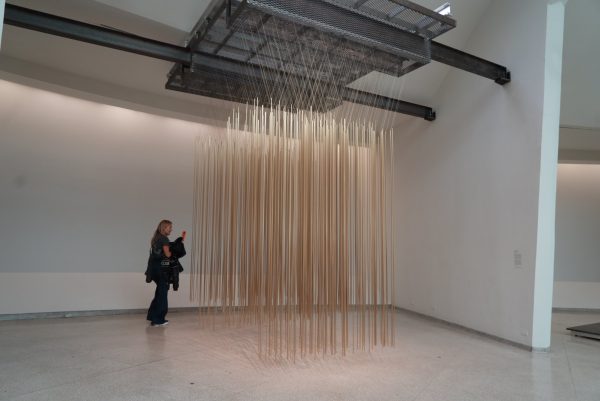
“The Night Sky Over New York” (2007), an earlier work in a series, maps celestial stars at a specific location, date and time. It commands 475 metal rods that suspend from the ceiling, while remaining delicate and minimal. At the top of the rotunda, its thin, golden bars shine from the skylight above it and gently move with the gusts of wind as people pass by. It is one of her most astonishing early works and reinforces Bove’s interest in making the environment an active part of the work, with pieces changing depending on the angle it’s approached. From one position the rods appear as a dense haze of gold, while from another each rod becomes distinct and plays more with line.
The flaw of the show lies in its curatorial approach to these works. There is an inconsistency in the number of artworks occupying the space, with some areas brimming with pieces and others extremely empty, distracting from the overall exhibition design. Because of this, there is uncertainty about whether a label corresponds to one piece or another — some reside on an adjacent wall rather than the typical beside the work, while others lack a clear wall label altogether.
With an exhibition so invested in making visitors feel immersed, there are moments when the layout’s congestion by the density of works and unclear wall labels work against this, pulling viewers out of the experience of fully enjoying each piece. Despite these moments of confusion, the exhibition reaffirms Bove’s bold and evolving approach to form, allowing the work to resonate through its materiality.
“Carol Bove” will be on display at The Guggenheim until Aug. 2.
Contact Meghan Mandra at [email protected].