




























From its profiles of city life to its vivid cover art, The New Yorker has cultivated an unmistakable visual and literary identity. These trademarks anchor “A Century of The New Yorker,” an exhibition that opened on Feb. 22, 2025, at the main branch of the New York Public Library. Co-curated by Julie Golia and Julie Carlsen, the gallery draws from the library’s extensive collections in a comprehensive tribute to the magazine for its 100th anniversary.
Situated in the Rayner Special Collections Wing on the library’s third floor, the exhibition feels at home around the McGraw Rotunda’s ornate reading rooms and vaulted murals. It features iconic illustrations like Saul Steinberg’s facetious “View of the World from 9th Avenue” (1976), whose detailed depiction of Manhattan streets and beyond pokes fun at the city’s self-importance, alongside Rea Irvin’s Eustice Tilly, whose simplistic lines and vibrant colors laid the groundwork for the magazine’s sophisticated visual style for the next century.
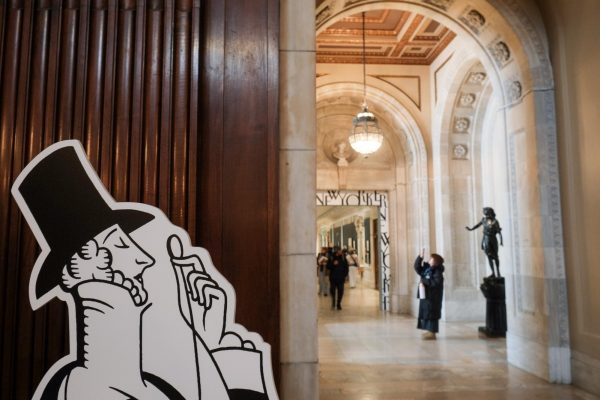
While these familiar artifacts affirm The New Yorker’s prestige, the exhibit’s strength lies in its focus on the publication’s inner workings. Opening sections “Beginnings” and “Anatomy of a Magazine” delve into the magazine’s early years, including photographs of founders Harold Ross and Jane Grant next to their initial prospectus for The New Yorker, describing it as a “reflection of metropolitan life.” These sections also chronicle the magazine’s development of its visual identity, showcasing multicolored graphics, a gray and red banner from its fact-checking department and a style guide exhibiting Irvin’s flowing, streamlined font used for its now-iconic headlines and typefaces.
Scribbled “Are You a New Yorker?” quiz drafts and a Truman Capote manuscript flecked with handwritten comments reveal snippets of the magazine’s rigorous processes. Revisions and editor’s notes pop up across these papers in swirls of red, black and blue ink, illustrating The New Yorker’s meticulous curation of its image throughout the publishing process.
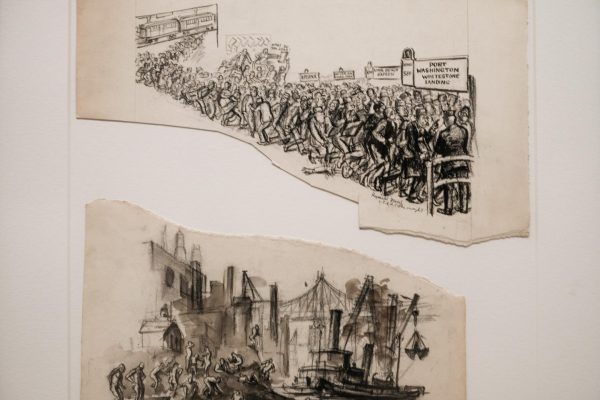
The section entitled “The New Yorker Makes Its Mark” chronicles the magazine’s rise to prominence throughout the 1930s and its subsequent expansion of coverage. One such example is Reginald Marsh’s grimy pencil sketches, which portray throngs of commuters at a train station and ships at a Brooklyn waterfront against the backdrop of World War II. In spite of being entirely monochrome, Marsh’s art vividly encapsulates the publication’s trailblazing work in covering the war alongside its focus on local subjects, which ranged from the Black religious leader Father Divine to the oldest Irish saloon in New York.
This section also documents the magazine’s wartime instability, culminating in its publication of the historic “Hiroshima.” One of the most striking artifacts in the exhibit, Charles E. Martin’s cover of “Hiroshima” (1946) paints an idyllic scene of Japanese citizens walking, biking and playing in a park. The cover — one of the only remaining copies to date — remains wrapped in a strip of white paper, reading, “this entire issue is devoted to how an atomic bomb destroyed a city.” Staged next to a photograph of a nuclear detonation, the cover is a testament to The New Yorker’s ability to conduct nuanced storytelling through an illustration and a headline alone.

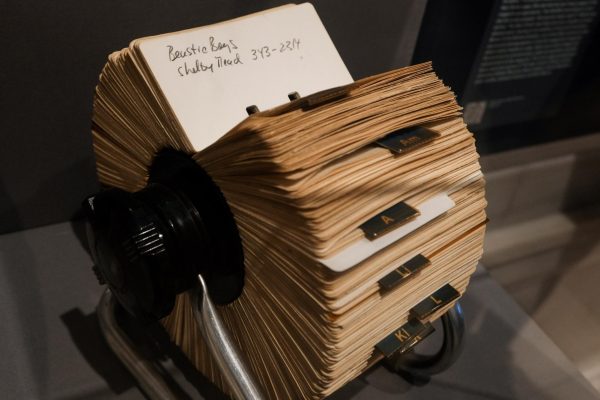
“The Story of the Century” showcases the magazine’s ethos of social change in the late 20th century. It highlights personal narratives like the making of literary giant James Baldwin’s “Letters From a Region in My Mind,” alongside its progressive stance on broader issues like environmentalism, showcasing Peter Arno’s 1962 magazine cover for Rachel Carson’s “Silent Spring.” In “A New Era,” leadership transitions also take center stage, including staff members’ letters of protest against editor William Shawn’s replacement and Tina Brown’s modernization of the magazine during the 1990s. The latter is demonstrated by Richard Avedon’s photography spread of fiction writers, alongside a Rolodex belonging to Brown’s assistant that includes contacts like Carolina Herrera and the Beastie Boys.
The exhibition’s final sections offer a 21st-century depiction of The New Yorker. Early wireframe mockups and covers responding to the #MeToo and Black Lives Matter movements illustrate the magazine’s ongoing efforts to adapt to the digital age and contemporary politics. Personal artifacts like a proof of Jhumpa Lahiri’s “Once In A Lifetime” (2006) and Kara Walker’s 1969 commemorative artwork of late author Toni Morrison reiterate The New Yorker’s amplification of underrepresented voices as it reckons with its own questions of equity.
One of the most prescient documents displayed in the exhibit is a telegram from Ross to author E. B. White. In an attempt to convince White to remain on his staff, Ross wrote, “This thing is a movement and you can’t resign from movement — it has just started.” True to Ross’ words, “A Century of The New Yorker” traces the publication’s history across drafts, memos, letters, art and beyond, honoring the collective of diverse individuals that created a magazine like no other.
“A Century of The New Yorker” is on display at the New York Public Library through Feb. 21.
Contact Kaleo Zhu at [email protected].