























Walking past the 20 Cooper Square Gallery, the phrase “Hawaiʻi is not the United States, but it is your future” blazes across the floor-to-ceiling windows. The statement provokes curiosity and confusion, forcing viewers to question Hawaii’s history of land divisions and dispossession.
As an artist-in-residence for the Asian/Pacific/American Institute at NYU this fall, Sean Connelly’s exhibition encourages critical analysis of land occupation, ecology and our relationship to oceanic borders. Connelly has developed an alternative art and architecture practice driven by an ever-evolving Oceanic and Pacific perspective.
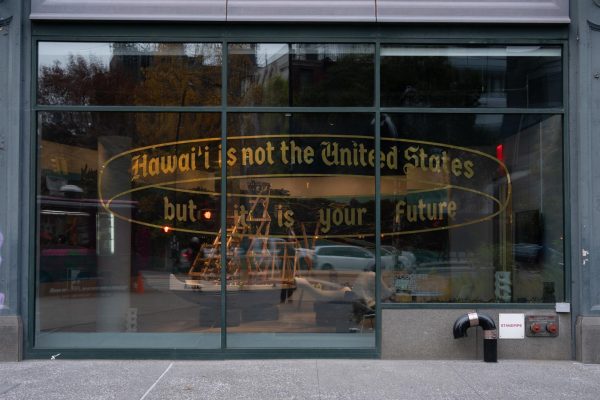
His multimedia approach draws in viewers with large-scale structures, including a cartographic wallpaper of the East Coast and a literal canoe that houses a geometric wooden structure. Similarly, the bold, blackletter font greeting invites the viewer to explore Connelly’s background as someone raised in Hawaii. It takes inspiration from Hawaiian heirloom bracelets, which physically mark family ties and ancestral lineage.
After launching his career in 2010 with two solo exhibitions in Honolulu, he caught the attention of the A/P/A Institute, which invited him to speak on a global panel about land use and art. NYU reached out again in 2020, pairing him with a Palestinian artist for a conversation on settler colonialism. Connelly’s work often explores the tension between Hawaiian history and U.S. stories of settlement, statehood and geography, a dialogue that shaped his return to NYU.
The exhibition examines what it means to belong to a place, a community or a history, and what it means when that belonging is contested. Connelly’s work maps the layered identities that shape Hawaii today, from Indigenous experiences to immigrant narratives and the people who move between those categories.
“I just see a word cloud of local, Native, Indigenous, immigrant, belonging, not belonging, resistance, trying to survive,” Connelly said. “All the different dynamics of what it means to be a human in a place.”
Within the gallery space, neon-colored wallpaper wraps around all three walls, illustrating a map of the East Coast stretching from Georgia to Maine. However, it might not be instantly recognizable to most viewers. Instead of utilizing a Western cartographic approach, Connelly’s map reorients the landscape as if cut in half, with an emphasis on topography — a principal tool in Hawaiian maps — to emphasize the role of the ocean across the coast. This reconfiguration forces the viewer to consider North America from a Hawaiian visual perspective, emphasizing our shared relationship to the ocean.
“In a lot of my work, I present things in an unfamiliar way,” Connelly said.
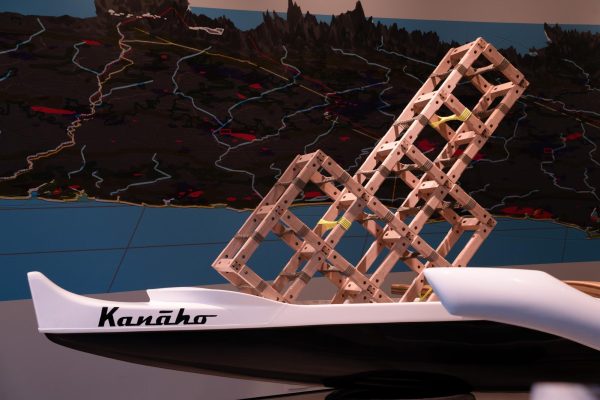
Building upon the human connection to waterways, a gigantic canoe lays in the center of the gallery, with all seats occupied by erected wooden structures. The canoe was made in Kona, Hawaii, then shipped to a boathouse in Hoboken, where Connelly himself paddled it across the Hudson into Manhattan. The canoe’s construction, history and physical journey are reminders that the ocean is a cultural equalizer that facilitates exchange.
The wood silhouette structures emerging from the canoe are classical examples of lashing — an ancient Hawaiian art ritual that prioritizes specific knotting techniques to assemble boats and other structures. Devoid of any glues or metals, lashing highlights the ecological awareness of Hawaiian artistic traditions. Having learned this technique back home in Hawaii, Connelly brings his own upbringing into the present and celebrates their unique boating technology.
Connelly approaches Oceanic identity as a layered, evolving set of perspectives rather than a singular narrative. He draws on that multiplicity to imagine a shared future. Living and working in New York, Connelly is acutely aware of the distance from home, allowing that feeling of separation and longing for home to inform his artistic process.
“I have to find joy in the homesickness,” Connelly said. “And part of the joy of the homesickness is remembering how to appreciate home.”
“Hawai’i is not the United States, but it is your future” is on view through Dec. 12 on the first floor of 20 Cooper Square. Admission is free for NYU students.
Contact Leila Tarighi at [email protected].