

























When I sat down at the Samuel J. Friedman Theatre to watch “The Balusters” on Broadway, I had no clue what a baluster was or why it warranted an almost two-hour-long play. Oh, how foolish I once was. The handrail support posts are among the most important design choices a homeowner can make — important stuff to keep in mind from your picturesque Third Avenue North double.
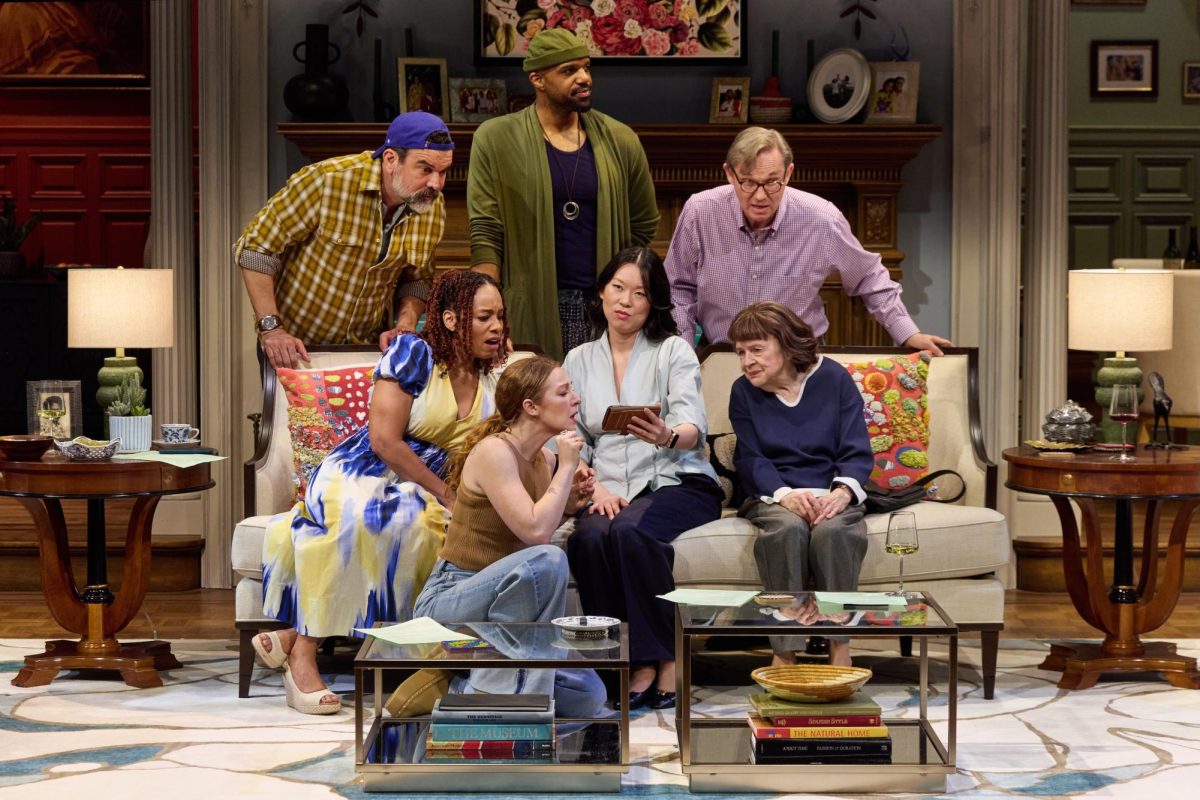
As banal as its namesake sounds, Manhattan Theatre Club’s production of “The Balusters” is anything but boring. Residents of a historically white Northeastern neighborhood quarrel over front porches and dog poop, with biting insults and passive-aggressive remarks aplenty. It’s mostly petty bickering until newcomer Kyra (Anika Noni Rose) joins the board and brings forward a resolution to install stop signs on a dangerous intersection, which would ruin the postcard-like beauty of the unobstructed boulevard.
Kyra hosts the board at her home — a stunning, lively Victorian by scenic designer Derek McLane — and immediately clashes with Elliot (Richard Thomas), the board’s president who grew up in the neighborhood and is obsessed with preserving its traditional charm. Michael Esper plays the token confused white guy Alan, who constantly butts heads with the token white liberal feminist Willow (Kayli Carter).
Unsurprisingly, the play is really about much more than just exterior decor. David Lindsay-Abaire — who won the Pulitzer Prize for drama in 2007 for “Rabbit Hole” — is the latest American playwright to tackle the hypocrisy of performative liberalism by the privileged, following in the footsteps of Jonathan Spector’s “Eureka Day” and Tracy Letts’ “The Minutes.” Each character is a raging hypocrite, calling out others for their blind spots while remaining oblivious to their own shortcomings: Willow works for PETA and criticizes a neighbor for wearing fur, but is then caught sneaking pork dumplings. And Kyra confronts Elliot for trying to bribe her into dropping the stop-sign resolution by offering to help her evict a Black-owned wig shop to open her bookstore — but, as it turns out, she didn’t need Elliot’s help to evict the business and was more than happy to make the calls herself.
Although Lindsay-Abaire’s observations are not necessarily original, they are still sharp and unapologetically funny. All of the play’s clashing characters are well-rounded and avoid stereotypical tropes, an especially impressive feat for a one-act with ten characters. No one in the group is off limits, though easy targets like Alan and Willow get the bulk of the attacks, with digs about their white savior complexes and trust funds.
The actors handle their characters’ constantly shifting allegiances and clueless duplicity with tact and endless humor. Margaret Colin is especially hilarious as the unapologetically snarky Ruth, while Marylouise Burke is charming and sweet as Penny, the group’s most good-natured elder and secretary. Elliot is the play’s most villainous character, but some of the complexity he earns through an explosive mental breakdown of a final monologue is diminished by the cheap quips Lindsay-Abaire bookends the moment with.
The writing throughout the play is formulaic, with upcoming plot points obvious from a mile away. More thought is given to various snarky remarks than to creating any meaningful emotional stakes, resulting in a show that is certainly entertaining, but not particularly memorable or groundbreaking.
Lindsay-Abaire’s writing is at least witty and interesting enough to make up for the tedious direction that has become Kenny Leon’s signature, most recently in his uninspired take on “Othello” and bare-bones revival of “Our Town.” Characters turn their backs to one another as they speak, sitting in chairs set up in a straight line across the stage and facing the audience head-on at all times like they’re in a multi-camera sitcom. Leon attempts to inject some creativity into his monotonous direction through scene transitions with rave-style lighting (Allen Lee Hughes) underscored by tonally mismatched songs from Kendrick Lamar and Kanye West that end up feeling jarring.
Even with a few hiccups along the way, the ensemble of “The Balusters” works together in perfect harmony to easily surpass any predictable plot points and dull directorial choices, and it’s refreshing to see a cast free from celebrity stunt casting take the stage in a new American play. So sure, the production may not be the most inspiring or original show on Broadway, but it’s certainly a good time — who knew balusters could be so much fun?
“The Balusters” is running at the Samuel J. Friedman Theatre until May 24. Tickets are available online, and $35 tickets are available for those 35 and under through MTC35.
Contact Chantal Mann at [email protected].