




















Content warning: This article contains mentions of gun violence.
The first time it happened, I didn’t know what gunshots sounded like yet. I was five, or maybe six — a lot of the details are fuzzy, and I’ve never had the guts to look into it — and walking through a crowded South Florida mall with my mom and sister, when everyone suddenly started running past us. The second time, I was waiting outside my middle school’s bus loop as my friends relayed information about a shooting at a nearby high school and the suspect on the run, wondering if we were safe standing out there in the unforgiving Florida sun.
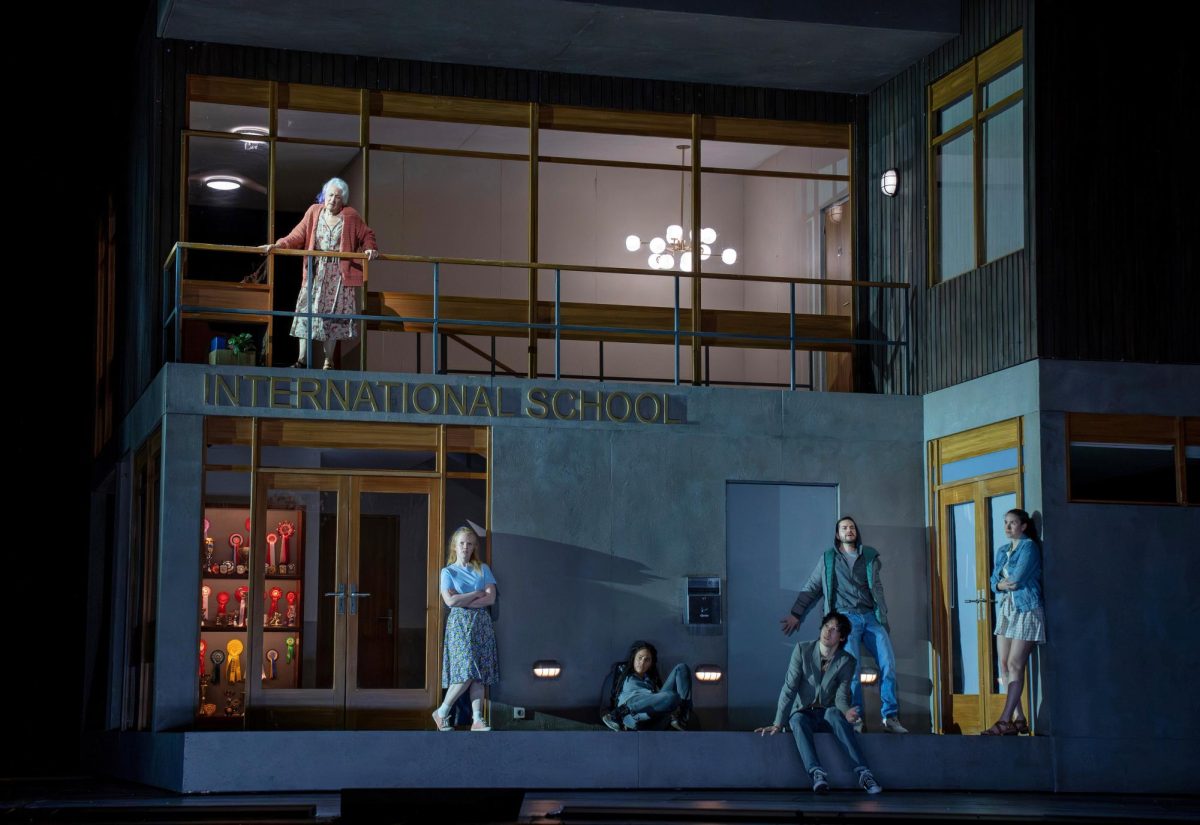
When I came to college, with all my subconscious escape routes and constantly sounding internal alarms, I felt a little bit safer. There were no gun stores lining the streets, unsettling older men openly carrying pistols in the supermarket or big malls that made me feel claustrophobic. Instead, I encountered artists who had made mass shootings their muses — most recently, Finnish composer Kaija Saariaho’s opera “Innocence,” which is making its New York debut at the Metropolitan Opera tonight.
Art about mass shootings is nothing new. The 2003 film “Elephant” draws heavily from the Columbine High School massacre, and Foster The People’s 2010 song, “Pumped Up Kicks,” is told from the perspective of a troubled individual planning a school shooting. New York theaters have offered their takes on gun violence with “columbinus” at New York Theater Workshop, “Office Hour” at The Public Theater and “On The Exhale” at Roundabout Theatre Company.
But, when I first heard about the upcoming production of “Innocence,” I felt conflicted by what The New York Times called “completely exhilarating.” The opera takes place in Finland and depicts the aftermath of a school shooting — likely drawing inspiration from the 2007 Jokela High School massacre that killed eight people and the perpetrator. The violence isn’t shown on stage, which focuses instead on the trauma caused by the event.
While violence isn’t a uniquely American issue, mass shootings disproportionately affect Americans — 31% of global public mass shootings take place in the United States. There have been over 90 mass shooting events in the United States so far this year, according to the Gun Violence Archive. From 2020-2023, there were over 600 per year. Nearly 400,000 students have experienced gun violence since 1999. Roughly 48,000 people in the United States died from gunshots in 2022, when guns were the leading cause of death for children aged 1-17.
The problem with “Innocence” and other stage productions that deal with gun violence as their subject matter lies in their artistic intention. My peers and I belong to a community where these issues were our reality, not just hypothetical — we can’t just walk away from ourselves after a two-hour performance. So then, if not the victims, for whom is this piece of art made? What conversation is it meant to spark? And why is opera — or music, movies and theater — the correct forum to have that conversation?
Growing up in a community shaped by gun violence meant that any mention of it was taboo. Lockdown drills had to be announced with prior warning, gunshot sounds had to be omitted from any stage productions and prop guns were banned from our theater classrooms.
There are no ethical guidelines for staging violence or trauma. Many artists, including playwright Jen Silverman in their 2024 New York Times op-ed, argue that art isn’t supposed to make the audience comfortable. Art should provoke you, test your boundaries and make you feel something. But artists are also storytellers, and that comes with a level of responsibility that isn’t clearly defined. There are no rules that dictate what stories an artist has the right to tell, but it feels exploitative to tell the story of — and potentially profit from — someone else’s trauma.
Not all stories are ours to tell. Manuel Oliver performed “GUAC” at The Public Theater in 2024, exploring the loss of his son, Joaquin “Guac” Oliver, to a mass shooting. The play was written by Oliver and co-produced by ENOUGH! Plays to End Gun Violence and Change The Ref, the anti-gun advocacy group Oliver founded. The difference with “GUAC” is that it is, undoubtedly, Oliver’s story to tell. It would have been distasteful if someone else had performed the piece or if another artist had written it, but that same sentiment isn’t being extended to works like “Innocence.”
“Innocence” and other shows about mass shootings are often diagnostic, trying to uncover why and how individuals are driven to commit these acts of violence. They examine those questions through the inherent spectacle of the stage with extravagant sets and dramatic vocal stylings. They try to make it, somehow, beautiful. Except there’s nothing left to understand, and there’s no aesthetic value to mine from these events. We have all the facts and figures, and all of the unnerving statistics have been collected and published. There is no mystery behind gun violence, what causes it or how we stop it. And no matter how masterful a score is, transforming someone else’s trauma into a theatrical night on the town isn’t art.
Contact Chantal Mann at [email protected].