































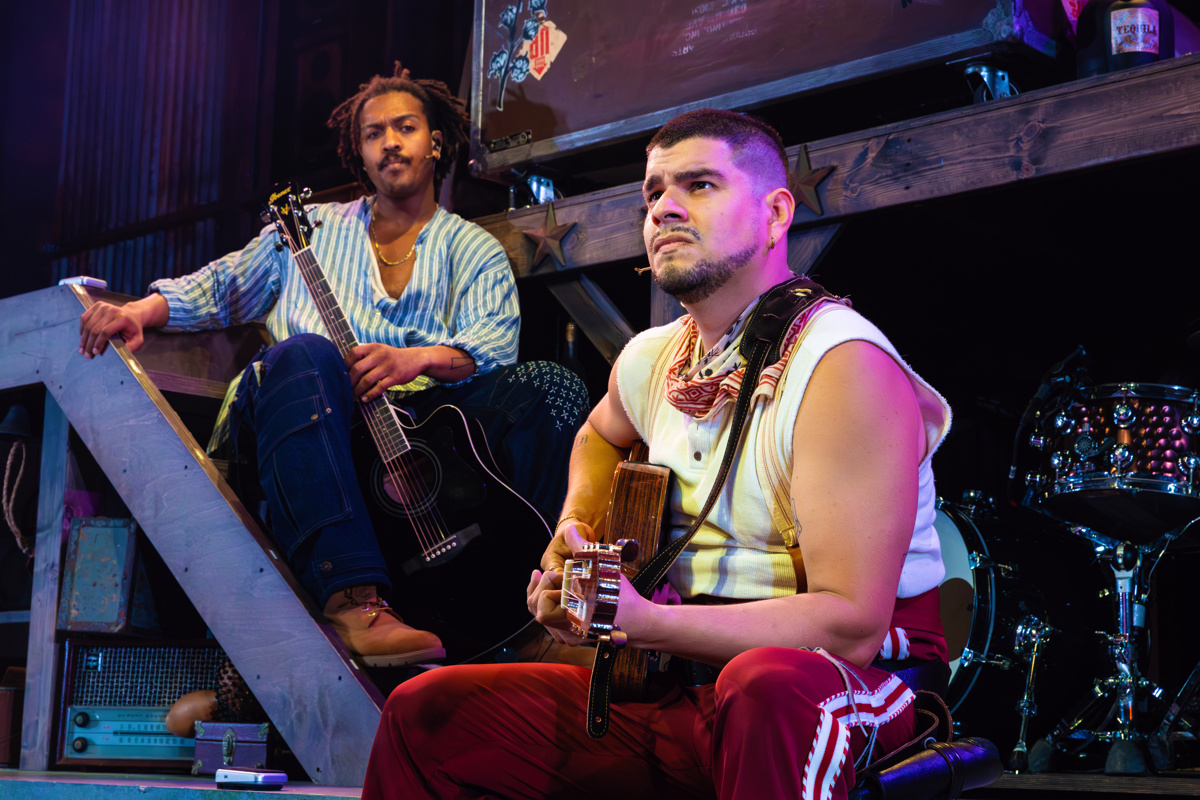
For enslaved people seeking freedom in 19th-century Texas, traveling north wasn’t the only option. The off-Broadway musical “Mexodus,” returning for a limited engagement after running at the Minetta Lane Theatre last year, recounts a history lesson rarely taught in American classrooms: enslaved people fleeing south on the Underground Railroad to Mexico, where slavery had already been abolished.
Co-created and performed by musician Nygel D. Robinson and Emmy-nominated playwright and composer Brian Quijada, “Mexodus” blends hip-hop and spoken word to explore this overlooked narrative of migration and freedom. The two-person production uses live looping — a music arrangement style that records and replays multiple live music layers — to build sound in real time, bridging past and present together without relying on traditional musical theater conventions.
“Since we started, we were two people who were two bodies in America right now, about to tell you a story about America 200 years ago,” Robinson told WSN. “We’re on a loop. It’s still happening, I’m just not in chains.”
In the show’s opening number, the performers share that between 4,000 and 10,000 people escaped slavery by crossing into Mexico through call-and-response before the music settles. The play moves on to follow Henry (Robinson), a man fleeing enslavement in Texas who crosses the Rio Grande in search of freedom, and Carlos (Quijada), a former Mexican soldier grappling with his own history of conflict and identity. As the two travel together, their relationship shifts from a cautious alliance into something closer to brotherhood, shaped by their need to survive and the risks they take to protect one another.
Robinson told WSN that the live construction of sound is central to how audiences understand the performance. He layers vocals, percussion and melody in real time, spelling out how the music forms piece by piece. The result is intimate and immediate, drawing attention to both what is being said and how performers are saying it.
“I like the audience to see the work happening in real time,” Robinson said. “You’re watching something get built in front of you, the same way history itself is pieced together.”
The show exists within a lineage of contemporary musical theater that draws from hip-hop, using rap and rhythm to engage with American history. But where many historical musicals race through events, “Mexodus” moves differently. Robinson and Quijada step out of character to address the audience directly several times, and give silence just as much weight as melody.
“I want you to dance a little, but not too much,” Robinson said. “Sometimes people are popping along and I’m like, ‘but I’m saying something really heavy right now.’”
That distinct approach has not gone unnoticed by leaders in the genre: Lin-Manuel Miranda, “Hamilton” creator and a pioneer of modern hip-hop musicals, applauded the show’s “outstanding musicianship” in an Instagram post.
The collaboration between Robinson and Quijada is equally essential to the show’s form. The two creators approach storytelling from different angles: Robinson through emotional texture and musical theater tradition, and Quijada through specificity and narrative detail. Their collective writing process often began separately, with each bringing material into the room before shaping it together.
“Mexodus” was inspired by an article Quijada read on the show’s historical premise, which sparked a realization among the two creators: “Where would you go if not Mexico?”
What makes “Mexodus” stand out most is its intention — it doesn’t aim to overwhelm audiences by recounting the pages of a history textbook. Instead, the show invites viewers to listen closely and engage with history as a living force. The production frames the past as a work in progress rather than a distant memory, challenging audiences to sit with its weight and consider how its echoes shape the present.
“We’re living inside something our ancestors couldn’t even imagine,” Robinson said. “So the question becomes: what do we do with that freedom now?”
“Mexodus” is running at the Daryl Roth Theatre until May 17. Tickets are available online.
Contact Robin Young at [email protected].