
































“The Surgeon and Her Daughters” is Brooklyn-based theatre company Colt Coeur’s latest world premiere. While the play tackles grief and immigrant identity, its inconsistent storytelling and rushed emotional arcs keep it from fully delivering on its thematic promise.
Written by Chris Gabo and directed by Adrienne Campbell-Holt, the production drops audiences into a tense 2016 New York household haunted by memory and regret. “The Surgeon and Her Daughters” opens with a chance encounter between Marine sergeant major, Mariana (Liza Fernandez), and Sudanese immigrant and ex-surgeon, Mohammed-Ahmed (Brian D. Coats), sparking a brief romance. Mariana’s sudden deployment to an unspecified location forces her daughters, Cecilia (Yadira Guevara) and Ashley (Kana Seiki), to confront her absence and find an unexpected support system in Mohammed-Ahmed and Isaiah (Eden Marryshow).
The play’s compelling commentary on immigrant values comes to fruition through Isaiah’s conversations with Mohammed-Ahmed and their boss, Mr. O’Halleron. While convincing Mohammed-Ahmed to partner with him in his drop-shipping business, Isaiah’s dialogue eventually devolves into a critique of immigrants’ limited space to nurture their cultural values in the United States. The disconnect between the two is almost painful, as Mohammad-Ahmed carries himself with discipline and a quiet optimism that immigrant families are raised on, believing that “there are honest ways to make a living.” Isaiah, burned by the system one too many times, knows better. This back-and-forth expertly exposes the gap between immigrant faith in upward mobility and the lived experience of actually trying to survive in a system that routinely exploits minority groups.
Ashley’s character ends up feeling surprisingly thin in this discussion. Her primary role serves as an emotional catalyst for the other leads, as the quintessential other daughter whose rage builds until she bursts. She studies and performs dance at Juilliard, which proves to be her one facet of individuality. While this gives her a brief connection with former Julliard student Isaiah, it feels entirely disconnected from the play’s larger ideas of grief, identity and family. It’s hard not to notice how much unused space the show had to integrate her into these larger conversations about immigrant identity in capitalist America, especially given her similarities to Isaiah, whose character centers on these discussions. As an Asian adoptee raised outside her home country and in a culturally different household, she could’ve brought a completely new perspective to the family’s story.
In the end, audiences are left without meaningful closure, uncertain about the mother’s fate, the family’s stance on Mohammed-Ahmed and the many relationships the play failed to flesh out. While everyone gathers to mourn Mariana’s presumed death at the end, it feels more like strangers pushed together as opposed to the expected found family trope. Most confusing was Mohamemed-Ahmed’s emotional collapse over Mariana’s presumed death. He only knew her for one night before her sudden deployment, yet the play frames him as deeply in love and somehow responsible for helping her daughters pick up the pieces together or apart. The emotional logic just isn’t there. With no indication whether they’ll discover his lie about being a surgeon, the ending feels unintentionally unresolved.
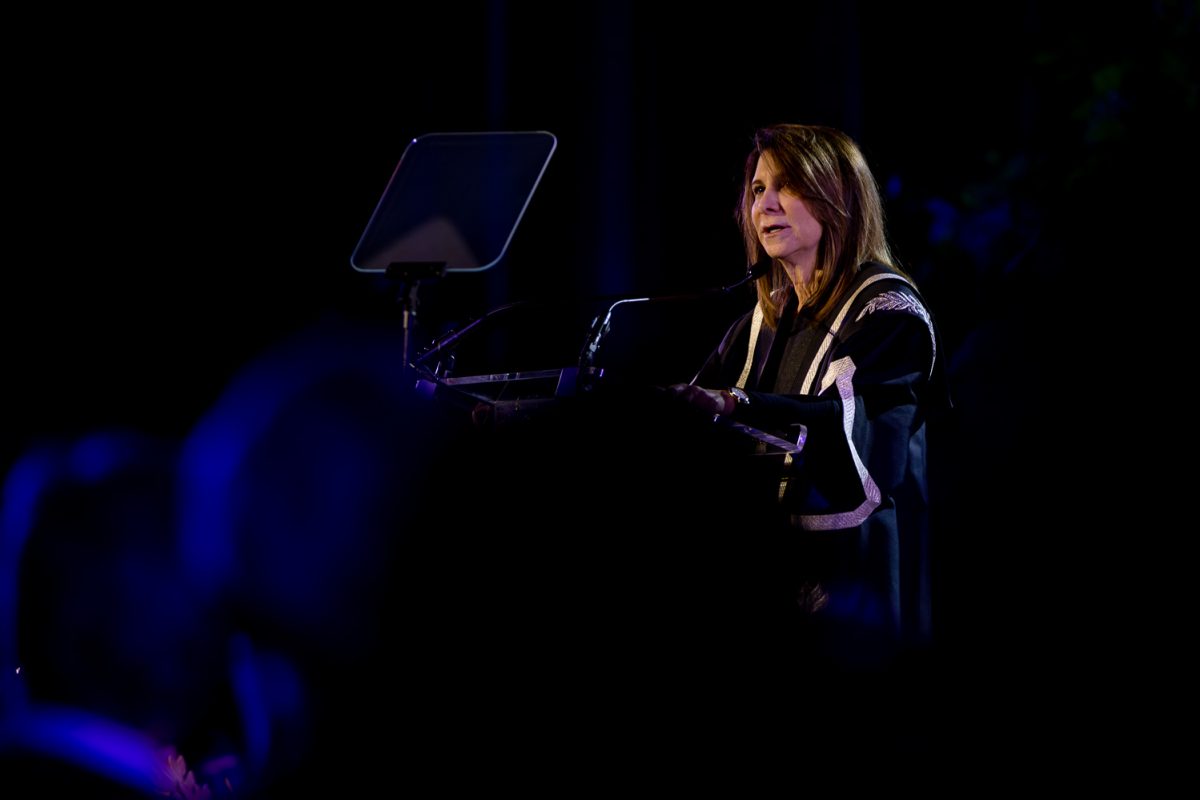
The production’s technical choices were ambitious, even if not always fully cohesive. Music choices like the loud, rap-like sounds in moments of tension took audiences out of the scene entirely. Still, the set design was thoughtful with the O’Halloren’s family bar also seconding as a Federal Office and the leading family’s kitchen being fully stocked down to the last pan. Campbell-Holt’s creativity shone through moments such as Cecilia cooking real bacon and pancakes onstage and Mariana’s offstage foreshadowing, elevated by a spotlight that drew us into her character before she even stepped into the scene.
For all its imperfections, “The Surgeon and Her Daughters” remains both relevant and enjoyable. The play does not explore its important themes to the fullest, merely attempting to be a commentary on important societal conversations. Its acknowledgment of discrimination and community grief are compelling, but the script rarely digs deep enough to make these ideas resonate. Ultimately, the play offers nothing more than a good time.
“The Surgeon and Her Daughters” is running at Theatre 154 on Christopher Street until Dec. 20.
Contact the Arts desk at [email protected].