























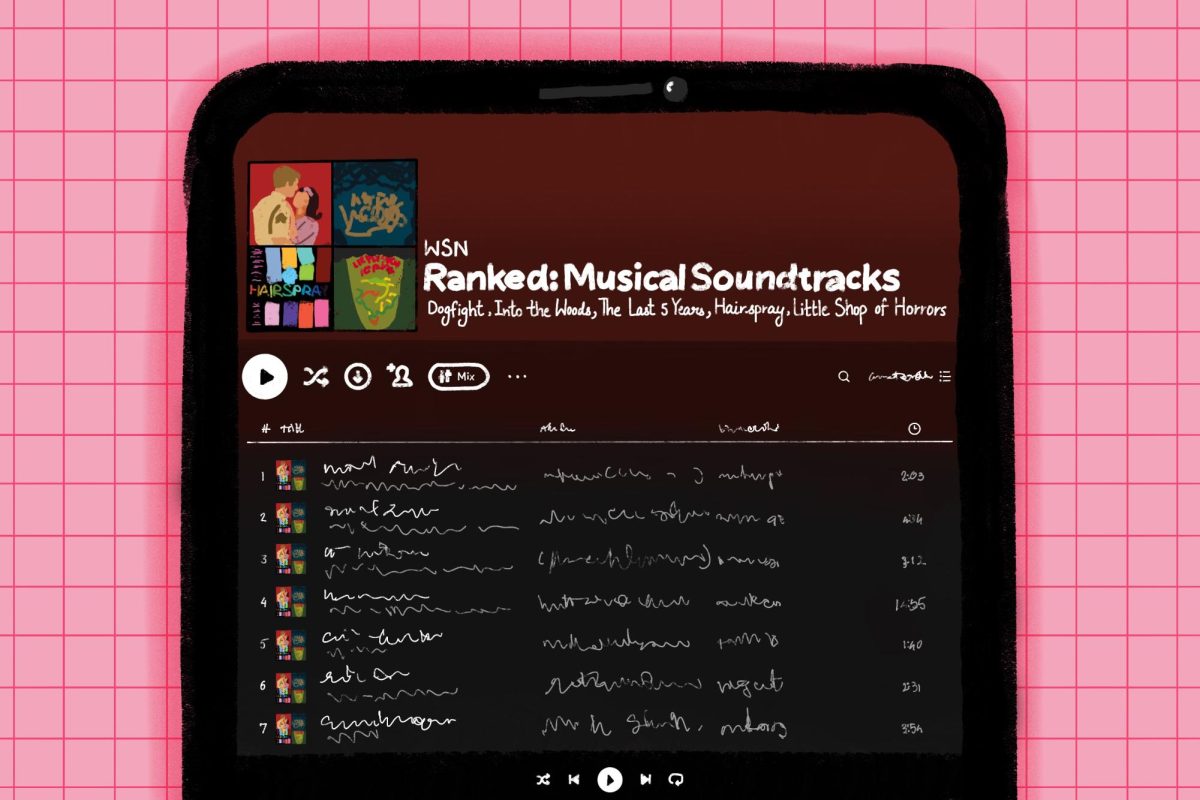
Cast recordings aren’t just collections of songs. They tell complex stories and give listeners the chance to relive the joy that otherwise, can only be experienced in the theater. As someone who spent most of middle and high school doing musical theater, I can attest that the music is just as important as the plot. These five scores, representing both Broadway classics and contemporary shows, encapsulate the laughter, the tears, the standing ovations and the moments that feel impossible to put into words.
“Dogfight”
When I first came across the “Dogfight” cast recording on TikTok, it struck me as a score that understands quiet emotion. First debuting as a musical in 2012 based on the 1991 film, the musical follows wary Marine Eddie as he invites Rose, a shy waitress, to a “dogfight” date, a cruel tradition where Marines compete to bring the ugliest girl. The night slowly softens into an unbreakable bond. The act one finale, “Pretty Funny” is stripped down and fragile, carried by soft piano and Rose’s hesitant, trembling vocals as she painfully expresses her insecurities about her appearance.
After the violent “dogfight” in the second act, “First Date/Last Night” drifts on gentle strings and tender harmonies, capturing the bittersweet realization that Eddie and Rose’s meaningful relationship has formed too late. While “Dogfight” is emotionally beautiful, its softness is often overshadowed by more dramatic and theatrical scores.
“The Last Five Years”
This cast recording unfolds and collapses the tumultuous love between a couple. Rising novelist Jamie’s story starts at the beginning of his romance with Cathy, a struggling actress. Her story, on the other hand, starts at the end of their relationship, with both narratives ending on the opposite side they began.
The music makes every emotional disconnect impossible to ignore. In “Still Hurting,” the quiet piano leaves room for Cathy’s grief to settle as she sings, “Jamie is over and Jamie is gone / Jamie’s decided it’s time to move on,” each word heavy with the weight of being left behind. Meanwhile, Jamie’s “Moving Too Fast” rushes forward with bright, jazzy urgency, reflecting his emotional attachment to Cathy. The contrast between his momentum and her stillness turns the cast recording into a portrait of love remembered differently by two people who once shared it.
“Little Shop of Horrors”
I wanted to be Audrey. Period. Her melodic belt in “Skid Row (Downtown)” culminates in the note I dreamed of hitting — a high, longing cry from a girl who desperately wants a life brighter than the one she knows.
The off-Broadway staple, which first hit theaters in 1982, follows Seymour, a struggling florist who becomes trapped in a dark bargain with a bloodthirsty plant. The score walks a fine line between comedic camp and genuine sadness; “Skid Row (Downtown)” skips along with upbeat irony while Audrey sings about a world where “the folks are broke” and “your life’s a joke,” revealing that the melody’s cheerfulness is more of a facade behind which her reality resides. The “Little Shop of Horrors” score makes you want to dance while the story breaks your heart a little, and that combination is rare.
“Into the Woods”
This musical, which debuted in 1986, follows familiar fairy tale characters who venture into the forest to chase their wishes, only to face unexpected consequences. Stephen Sondheim’s score is intricate and conversational, full of fast-paced patter songs.
Midway through the first act, “Agony” stands out as a booming, mock-operatic parody, with two princes belting dramatic declarations about love they barely understand. The exaggerated vocals turn the entire number into a joke about how unserious they actually are. The song is just one of many from “Into the Woods” that are cleverly layered and musically brilliant — making for a score that grows with you the more you listen.
“Hairspray”
“There’s a light in the darkness / Though the night is black as my skin” were lines I sang with conviction for my first theater solo in the eighth grade, long before I fully understood their weight. “I Know Where I’ve Been,” sung by R&B producer Motormouth Maybelle, features choir harmonies that weigh heavily in your chest — and as a result, the song carries the moral heartbeat of the musical.
The iconic “Hairspray” balances joy with political commentary on segregation, body image and integration in 1960s Baltimore. Yet it remains full of life: “Good Morning Baltimore” bursts with bouncy brass, handclaps and a trampoline rhythm that mirrors the optimism of protagonist Tracy’s who dreams of stardom, singing about rat-filled alleyways like they are Broadway stages. Both fun and socially powerful, the musical has forever shaped my voice, childhood and passion for musical theater — and nothing else strikes that same balance.
Contact Robin Young at [email protected].