































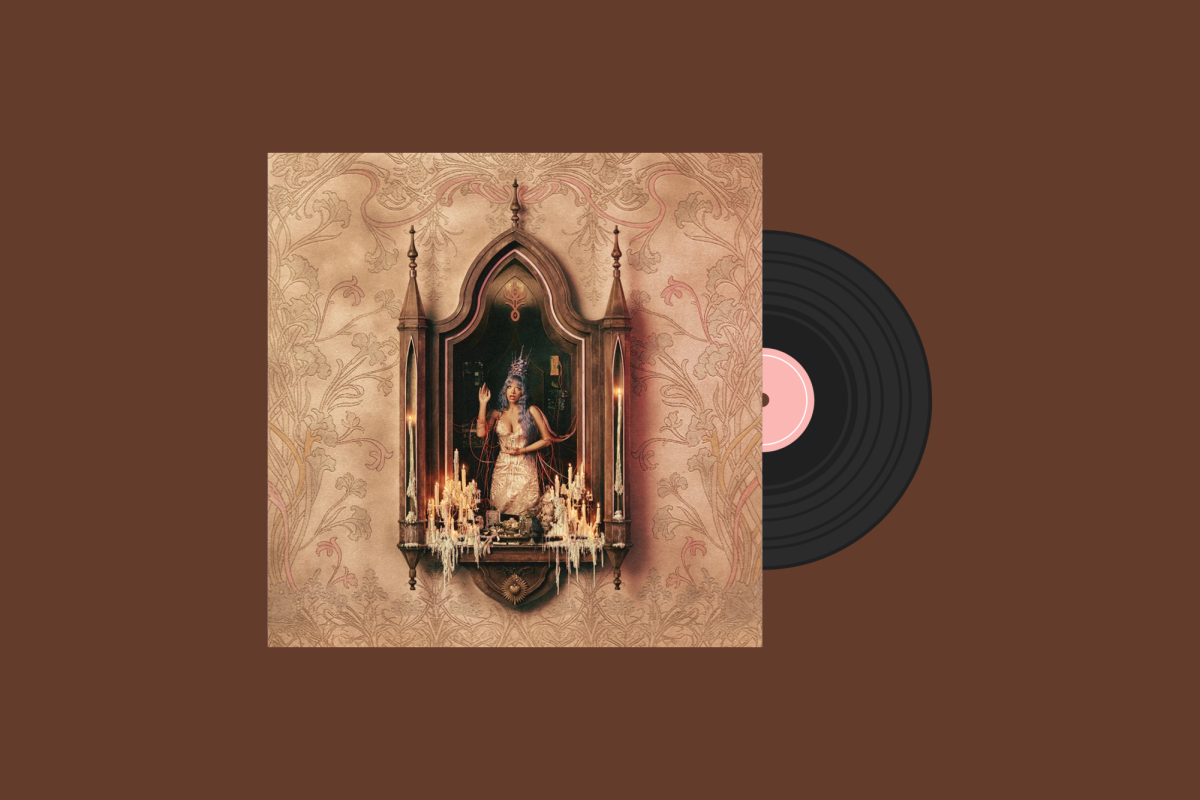
There’s no escape from the dumpster fire of a world we currently live in on “HADES,” Melanie Martinez’s fourth studio album. Released March 27, the “Dollhouse” singer doesn’t hold back from harrowing themes of corruption, misogyny and greed across the album’s 18 tracks. Despite its at-times jumbled commentary, “HADES” is a fitting soundtrack to embrace your inner apocalyptic existentialism.
After getting her start as a 17-year-old star on “The Voice” in 2012, Martinez went two times platinum with her album “Cry Baby,” the first in a trilogy that also includes 2019’s “K-12” and 2023’s “PORTALS” and follows the titular fictional character’s evolution. After her thematic death in “PORTALS,” “HADES” is Martinez’s first record that exists outside of this universe. Now, she explores a new dystopian world — not entirely unlike our own — which will come to full fruition in her next record, which she’s already teased.
“HADES,” named after the Greek god of the underworld, acknowledges all forms of evil in the world. There are several shocking moments across the album with bluntness worthy of a double take. Take “WHITE BOY WITH A GUN,” a title that speaks for itself, and features a melodic but unapologetic chorus: “You say you’rе a feminist (Ooh) / But I know that you’re lying, boy (Ooh) / You support the govеrnment / Second amendment in your drawer / You’re racist, not nuanced (Ooh) / Might as well just wear white cloth.” The song is a takedown of performative feminists and politicians who put their alleged best self forward, pretending to care about issues just to impress others. Most people would never be so vocal as to destroy people so curtly, but Martinez couldn’t care less.
Similarly, in the refrain of “GARBAGE,” Martinez sings, “Wakе up the children, devicеs are filled / With the blood of their addicted hands,” calling out society’s addiction to technology and desensitization to violence. She voices her inner thoughts against distorted vocals and gunshots, creating full-scale immersion against a progressive pop sound. Across the tracks, her audacity to bring real world issues to the forefront of modern pop music is admirable, not to mention with undeniable originality.
Her sweet, high vocals are paired with foreboding sound design straight out of a horror film. In the last 25 seconds of “DISNEY PRINCESS,” there is a reverberant, ominous sound after her chilling outro: “Suffering and pain, it’s worth it / My allowance bought me everything / Still can’t buy my innocence.” Another song, “MONOLITH,” ends with sounds of a hospital, complete with squelching and gushing. It’s brief moments like these, along with Martinez’s shrieks throughout, that show the singer’s expertise in creating an engrossing auditory experience.
Still, some songs feel remarkably similar to her past works. “WEIGHT WATCHERS” and “GUTTER” don’t just sound like one another, they also share practically the same production as “Nurse’s Office” from “K-12.” From the songs’ tempos to their rhyme schemes, the structure feels identical and offers few original sentiments. This isn’t to say these songs are bad, just that they fall flat compared to the record’s bolder tracks.
Though it had a solid start, the second half of the album feels unremarkable. From track 11, “THE PLAGUE,” until the final song of the album, “THE LAST TWO PEOPLE ON EARTH,” every track tries to say something original and meaningful about humanity, but fails to get the message across because of repetitive rhythms and flimsy lyrics. “THE PLAGUE,” for example, disjointedly compares the COVID-19 pandemic to the Black Death: “All my lovers died from this / Nuclear war will take us next / Oh, the plague, it took my breath.” It’s dark and experimental, but makes a mess of both the present and past.
If you’re trying to forget about your troubles and the world around you, “HADES” is not for you. Through this chilling musical commentary, Martinez presents a glaring reminder to everyone that the world is in the worst state that it’s probably ever been in. But, with its brutal and intense themes, “HADES” stands out as a unique perspective in a sea of cookie-cutter pop.
Contact Alessa Aluin at [email protected].