
























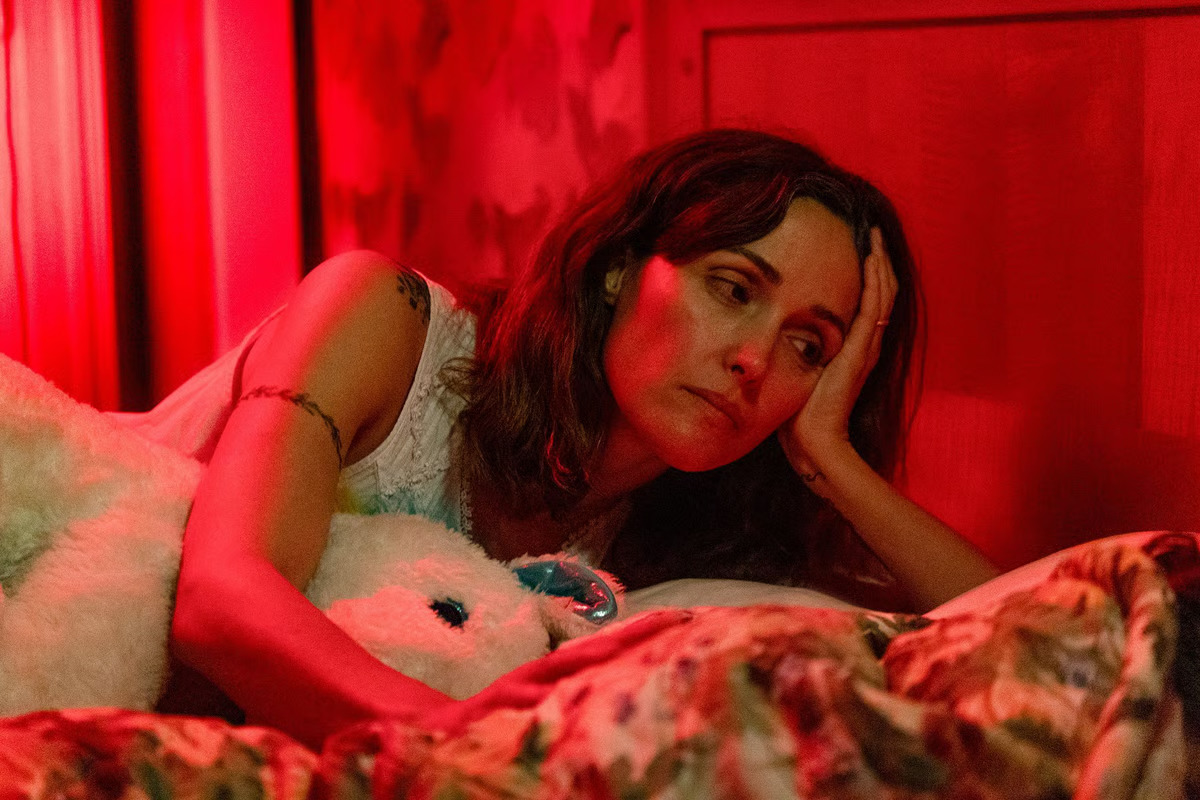
In movies, 2025 was the year of the imperfect mother. Before, maternal characters in film tend to be either purely angelic or abusive figures — but now they’re the roles of a lifetime.
These complex female characters ruled this year’s Golden Globes ceremony. Jennifer Lawrence was nominated for “Die My Love,” where she delivered an animalistic portrayal of postpartum depression. Teyana Taylor secured a best supporting actress win for playing a mother whose ultimate loyalty is to the revolution in “One Battle After Another.” Among these women was first-time winner and now Oscar nominee Rose Byrne, awarded for her powerhouse performance in the experimental dark comedy “If I Had Legs I’d Kick You.”
In the film, writer and director Mary Bronstein takes the concept of a stressed-out mom to its highest frequency. Linda’s (Byrne) woes are incredibly specific yet universally headache-inducing. Her seven-year-old daughter has an unnamed disorder that requires a feeding tube, her husband is perpetually out of town and a giant hole in her roof forces her to move into a motel. These stressors nearly break Linda as she tries to manage her job as a therapist while maintaining some semblance of sanity.
The film was only nominated in one Oscars category: best actress in a leading role. Although snubbed for its inventive screenplay, the small indie film pulling off an acting nomination is no surprise with Byrne’s performance at the helm. With a career spanning more than three decades, Byrne is no stranger to dynamic characters, but she is primarily known for blockbuster comedies like “Bridesmaids” and “Neighbors.” This film gives her the chance to show off something completely new.
“If I Had Legs I’d Kick You” is not an easy watch. The film is heart-pounding, sometimes gory, panic attack fuel. Bronstein’s choice to hide the faces of Linda’s daughter and husband means they exist solely as voices coming from off screen. They are barely personified entities, but somehow Byrne successfully acts opposite them in a way that feels like a face-to-face confrontation.
Her performance anchors the film, which can’t exist without an admittedly flawed protagonist whose frustration you sympathize with. Although the movie follows one long, emotional spiral, Byrne’s portrayal of Linda is anything but one-noted. In a film littered with closeups on her agonized face, she finds new ways to display stress, disappointment and despair compellingly.
Byrne also expands the character of Linda beyond her role as a mother in scenes with her therapy clients. Linda acts extremely vulnerable with one, feigns sympathy for another and grows thoroughly overwhelmed by a new mom struggling with extreme paranoia. By effectively displaying the many emotional levels Linda reaches in a single day, Byrne brings dimension to her character’s mania.
In one pivotal scene, Linda snaps at her peers in a group therapy session. Clearly projecting, she tells another mom that her daughter’s eating disorder is her fault, but the rebuke doesn’t seem to be directed at anyone but herself. Exasperated, Linda holds back tears and slowly backs out of the room, the guilt underlying her anger beginning to reveal itself. Byrne cleverly avoids playing this confrontation as the height of Linda’s emotional expression, but rather as a necessary release.
The current favorite for the best actress Oscar is “Hamnet” star Jessie Buckley. Byrne and Buckley both took home Golden Globes, the former in the musical or comedy category and the latter in the drama category. At the Oscars, nominations aren’t divided by genre and the competition will surely be stiffer.
Byrne is the underdog here: Her film was not adapted from a bestselling novel, it doesn’t co-star professional sad-boy heartthrob Paul Mescal and it was made with less than an eighth of “Hamnet’s” budget. On merits, Byrne delivers a nuanced performance as a mother figure we haven’t seen before, a more difficult balancing act than Buckley’s all-encompassing sadness in “Hamnet.” The academy has given flowers to tear-jerking mothers who will do anything for their children before, most recently Michelle Yeoh’s character in “Everything Everywhere All at Once.” What about one who is a little messed up?
So academy voters, please let us see Byrne’s Oscar speech. If not for her tour de force performance, at least for an update on her bearded dragon.
Contact Alice Rogers at [email protected].