





















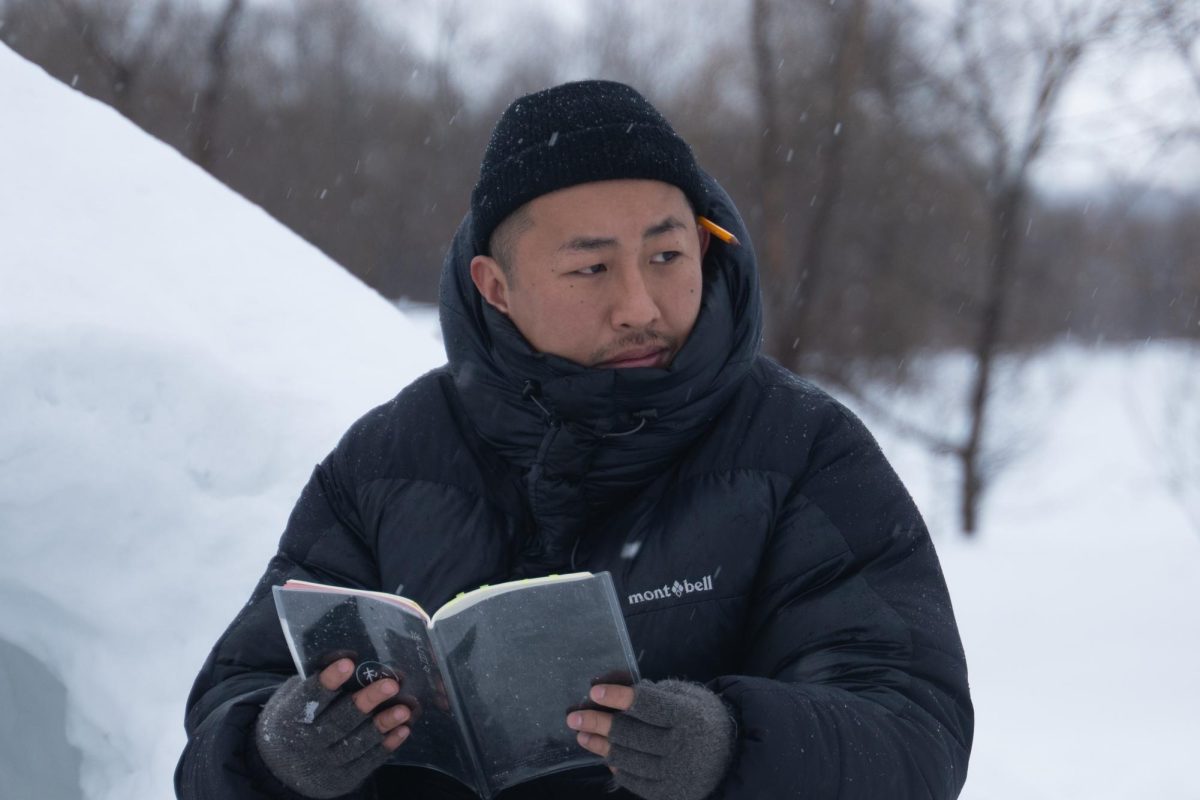
During the COVID-19 lockdown, Japanese filmmaker Sho Miyake dreamed of escaping to the beach. Around this time, a producer approached him with the idea of adapting two manga — titled “A View of the Seaside” and “Mr. Ben and His Igloo” — by Yoshiharu Tsuge, the recently deceased Japanese essayist and cartoonist, into a movie. Miyake told WSN that his longing to leave home led him to choose two vacation stories — one set in the summer, the other in the winter — as the basis for his new film “Two Seasons, Two Strangers.”
“What I’m trying to grasp is whatever it was that Tsuge had found for himself even before he started making the manga,” Miyake said. “[I’m] trying to think about the world that they were able to arrive at before they were able to put it into words.”
The 42-year-old director premiered his first feature in 2012 at the Locarno Film Festival in Switzerland. He later gained international acclaim a decade later for “Small, Slow but Steady,” which tells the story of a deaf female boxer and made its North American premiere at the New Directors/New Films festival in Manhattan. This makes “Two Seasons, Two Strangers” something of a homecoming: The film premiered at Locarno — where it won the Golden Leopard, the festival’s top prize — played at ND/NF last month and started a theatrical run at the Metrograph in Chinatown on Friday.
Miyake spoke with WSN about his contemplative adaptation, what he learned from a fellow Japanese director and advice for student filmmakers.
This interview has been edited for length and clarity. Miyake’s responses were interpreted from Japanese by Monika Uchiyama.
WSN: What drew you to the work of Yoshiharu Tsuge?
Miyake: I love the fact that it can be interpreted in many different ways depending on who reads it. Even for myself, when I first read the manga, I was 20 years old. Reading it today, I come out with a completely different interpretation of it, which is a testament to the power that the manga inherently has. When I’m making my films, I’m not trying to lead the viewer toward one single meaning, interpretation or feeling. I really want people to be able to watch it with a very open and free heart.
I’ve been visiting museums here in New York City and have encountered many artworks that are considered masterpieces. Even those pieces, if I were to encounter them again 10 years from now, I would receive them completely differently. So it’s in a sense that artworks, or all sorts of media, are unchanging, but they have a way of teaching us how we ourselves have changed.
WSN: You’re a close peer of fellow filmmaker Ryusuke Hamaguchi, director of the Academy Award-winning “Drive My Car.” What have you taken from your relationship into your films and your own life?
Miyake: He’s someone whom I respect a lot as an older peer of mine. We had run a study group together, which we started during the pandemic. So we would meet online, and at the time, I was just happy to be able to communicate or talk to my friends, so I would just be eating my snacks and enjoying our conversation. But then, when I would look at the screen, I would notice that Hamaguchi was making notes, and I asked him, ‘What are you writing?’ And he said, ‘Well, I’m taking down what all of you are talking about.’ And I realized that he’s so studious, and it made me want to take myself more seriously, too. And after that, I really think that one thing that he’s taught me is about sincerity and seriousness toward your craft.
WSN: I read that you are interested in exploring ideas or things that can’t be put into words clearly. What about the art of film allows you to do that?
Miyake: Well, it’s very hard to explain that in words! All of us have had a moment while we’re watching a movie where we are struck with this feeling that we’ve never had before. I’m sure you have, and I certainly have many times over, because it’s a feeling that you’re experiencing for the first time, you can’t yet describe it or put words to it. That’s what cinema is capable of doing: creating new experiences and new feelings. It’s not about recreating existing emotions or existing experiences in the viewer. It’s a way for us to explore the things that are ineffable, things that we can’t put words to yet.
WSN: Looking back at your time at the Film School of Tokyo, is there something you wish you knew as a student that would be useful to any NYU students now?
Miyake: There’s one thing that I tell young students quite often, so I’d like to tell you here. The presence of a professor at your school, when I was a student, it felt like they were just there for me to rebel against them. But the reality is, for a person who’s not a family member, a lover or your sibling, to give you very straightforward criticism — that will never really happen again after you leave school. Once you enter into society, it’s going to become more and more rare that you meet with people where it’s not a transactional relationship, where they’re willing to tell you very straightforwardly, whether good or bad, criticism about your work.
“Two Seasons, Two Strangers” is currently playing at the Metrograph. Tickets are available online.
Contact Ethan Li at [email protected].