





























It’s fitting that “Mother Mary,” director David Lowery’s haunting new film about a pop star and her estranged costume designer, premiered during the second weekend of Coachella. While Sabrina Carpenter sashayed across the music festival stage in sky-high stilettos, Anne Hathaway’s “Mother Mary” was vamping on the silver screen to songs from Charli xcx and FKA Twigs, sucking in her cheekbones and serving up a platter of quasi-religious pop music.
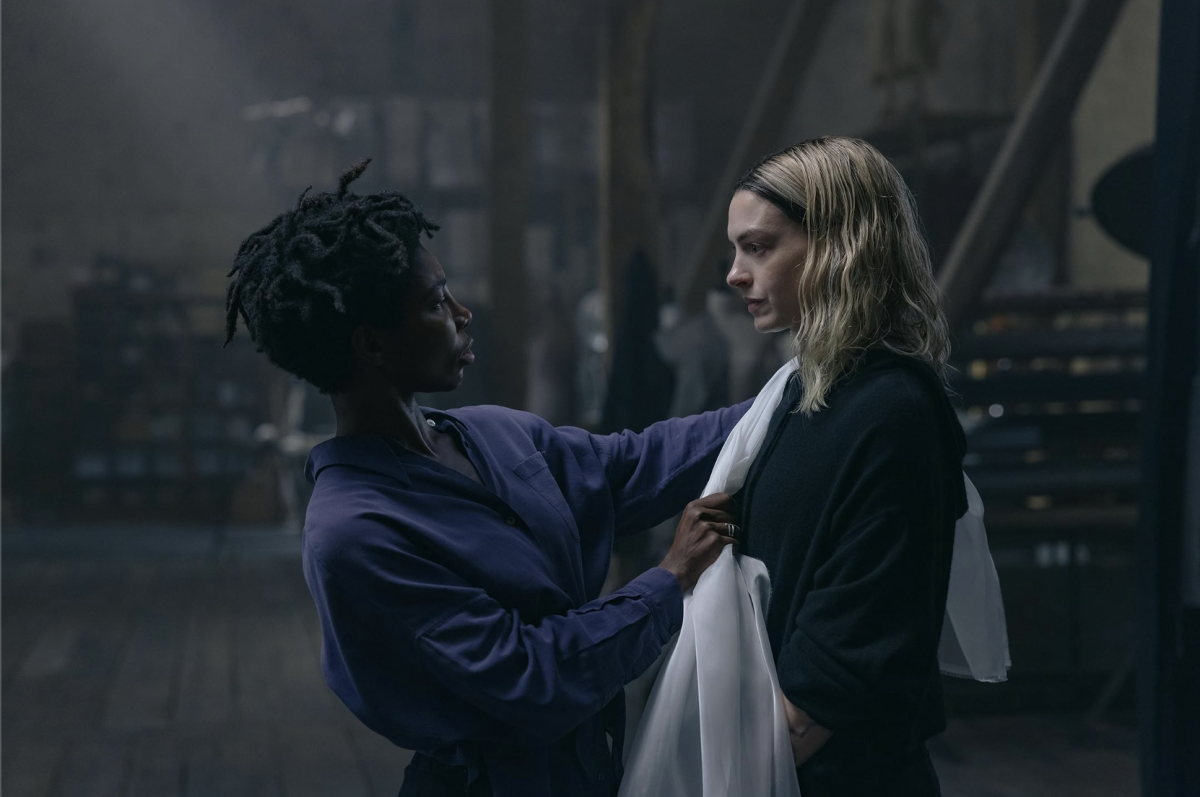
The film follows a pop icon — who is quite fond of religious allusions, hence her name — as she gears up for her comeback performance after a terrifying incident forced her out of the spotlight. She recorded the song and learned the choreography but is missing the right outfit. That’s because she parted ways with her best friend and former costume designer Sam (Michaela Coel) when she first got famous. Ever since, both Mary and Sam have had haunting visions of a bloodthirsty piece of red fabric. These visions, and the fact that Mary can’t bear to wear what her floozy flock of stylists has created, send her crawling back to Sam in a cloud of despair. Mary might be the star, but Sam is the one who can make the dress, and maybe heal their partnership with some seance-like seamstressing.
On paper, the premise of “Mother Mary” is so topical that it borders on parody. Like the rest of us, Lowery is fascinated with the high drama of the female pop star and the power she provokes. But the film is less meta than it might seem. Unlike Brady Corbet in his film “Vox Lux” or Sam Levinson in his TV show “The Idol,” Lowery doesn’t seem to care about what the world thinks of his star. Strobing lights and sycophantic managers fade into aesthetics: Here, the focus is on quieter feelings of intense isolation, tortured artistry and lost friendship. For all its pageantry, the thrust of “Mother Mary” lies in the reconnection of these two estranged friends. The result is a split tonality throughout the film, which jumps from concert to conversation to liminal scenes of Sam and Mary being haunted by the flowy fabric spirit.
The concert scenes are muscular and eye-catching in a mechanical way, as Lowery spins his camera and zooms out to a bird’s-eye view to capture the enormity of a packed stadium. Mary’s catchy music reverberates with chest-thumping intensity as Hathaway belts and dances her way into the performative excesses of pop stardom. The conversational scenes are balletic and darker, with Coel stealing the show as she bitingly dismisses Mary for breaking off their partnership and robbing her of the success she deserved. The haunting scenes are Lowery’s moment to shine. He delivers stunning, lush displays that roar with color, energy and unbridled intensity. In one particularly gorgeous sequence, a trembling Mary goes through a week of concerts, climbing up the stairs to the stage and climbing back down each night, while Lowery captures her in a fluid, unbroken panoramic long take.
These sections and both actresses are engaging in a vacuum, but “Mother Mary” can’t seem to fuse it all together. Lowery is telling a story about the tolls of artistry, when the art leaves your hands and enters the possession of an unknowable, huge audience. It’s an interesting story for him to tell, considering that he’s a clear example of Hollywood’s one for them, one for me rule — alternating his kooky brainchildren, like “The Green Knight” and “A Ghost Story,” with live-action Disney fanfare like “Peter Pan & Wendy” and “Pete’s Dragon.” But Lowery is unwilling to spell his ideas out on the page in “Mother Mary,” instead painting a loose metaphor for the dual beauty and destruction that comes with creation.
The end result isn’t an intriguing puzzle. By leaning on abstraction, “Mother Mary” feels less like a film and more like a particularly enthralling music video. The film hinges on audiences buying into the pop star fantasy and finding pleasure in cinematic exercise over narrative function. Ultimately, Lowery has a little less to say than he thinks. Maybe he simply longed to play in the pop star sandbox, elevating the central cultural figures of our time into the titanic stuff of gothic fantasy. In that case, he deserves some praise. The best music videos incomparably worm their way into your head, and “Mother Mary” has spades of spectacle that warrant your worship. It’s campy, catchy and rather nonsensical — maybe that’s why it’s pop.
Contact Shrish Bulusu at [email protected].