




























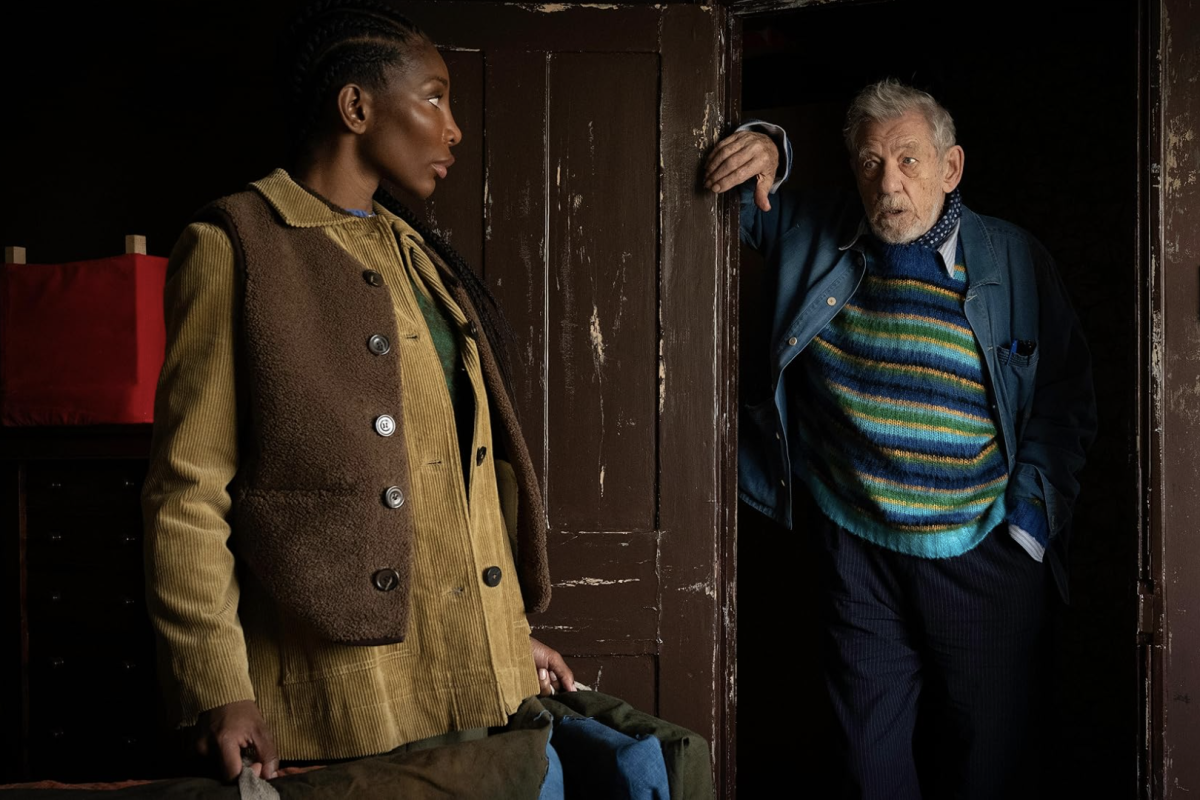
Director Steven Soderbergh’s legacy in modern American filmmaking is undeniable. Since his 1989 breakout film “Sex, Lies, and Videotape,” he has churned out hit after hit — including “Ocean’s Eleven,” “Magic Mike” and their sequels — for nearly four decades. His new film “The Christophers,” which released earlier this month and stars the legendary Ian McKellen and the inimitable Michaela Coel, is already one of the best movies of the year.
The film pits crotchety, aging artist Julian Sklar (McKellen) up against driven painter and art restorer Lori Butler (Coel). Julian, his greatest work far behind him, records personalized video messages on Cameo to make ends meet while his children Barnaby (James Corden) and Sallie (Jessica Gunning) unsuccessfully convince their mostly absent father to leave them something in his will. The two snakes hire Lori to become their father’s assistant and forge the rest of an incomplete series of paintings they can sell under his name. These works, the titular Christophers, are portraits of one of Julian’s old lovers. The existing ones have sold for millions at auctions and a posthumously uncovered set would surely set the children up for life.
Lori begrudgingly agrees — after all, she’s capable and needs the money. When she arrives at Julian’s house for an interview, the two begin an engrossing, fiery back-and-forth dynamic that graces the rest of the film. McKellen maneuvers between borderline offensive, unbearably grouchy and brilliantly funny, while Coel keeps up as a cool-faced intellectual and artistic match for the cocky old artist. They take aim at each other’s insecurities and relentlessly argue what it is to be a true creative. Even in their first meeting, they probe what exactly the meaning of art really is, anyway.
As Lori and Julian gradually become an unlikely duo, Julian pieces together his children’s involvement. We learn that they’ve already sold Lori’s Christophers to a tech bro for millions, and they switch gears to stage a brilliant comeback for Julian. As they hatch this plan, the film’s essential question arises: Do we make art for money, fame or love?
Though Soderbergh leaves these questions unanswered, he trusts that breadcrumbs will come through to viewers through McKellen and Coel’s banter. You’ll find the two are a match made in heaven, bringing screenwriter Ed Solomon’s dialogue to life by keeping a strong pace without overacting. Julian and Lori throw a zing or a philosophical blast on art and dish it off immediately, always keeping the ball in the air between them.
But as Julian and Lori continue to spar, we discover they’re much more connected than they thought. Julian is a relic of a bygone age who spent his career selling out for big bucks and popularity. Now he’s struggling to cement a legacy to leave behind. The much younger Lori, who came up in a world where selling out is what it takes to stay afloat, is used to all this. We see her turn to restoration work, work at a food truck and live in her studio. Whatever lucrative artistic glory Julian enjoyed in his prime now seems unattainable. The art world is turning, and more and more tech bros or sellout gallerists lurk around every corner.
A lesser film may have fallen into the trap of giving McKellen a brilliantly long speech about the meaning of art, which is all well and good, but does not allow or compel the audience to think. Rather than spoonfeeding answers, “The Christophers” presents us with a range of artists and consumers with extremely varied motivations. It’s up to you to choose what’s in it for you.
Contact Joe Paladino at [email protected].