




















From the insulated walls of a Manhattan high-rise, teenager Balthazar (Jaedan Martell) weeps solemnly into a phone camera. He cries about America’s persistent school shootings for a few minutes, but when the recording ends, his tearful expression instantly slips into a vacant, hollow gaze. He is the covertly egotistical protagonist of “Our Hero, Balthazar,” the poster child for privileged pseudo-activism.
Whether he’s trying to become a social media hero or impress his crush at school, it’s clear that Balthazar’s good intentions are fabricated. His anti-gun rhetoric catches the eye of the despondent Solomon (Asa Butterfield), who trolls Balthazar on Instagram by threatening to bring a gun to his Texas high school. Balthazar sees his chance to become a real hero and travels to Texas to confront him.
Quickly, this story of a wealthy high schooler becomes a rather bizarre buddy film as the two strikingly different teenagers bond over being neglected by those around them. An outlandish friendship develops between Balthazar and Solomon, where their refinement and vulgarity blend together seamlessly. Balthazar discovers that Solomon just needs a friend, and in the process of pretending to be one, he realizes that he needs one too.
We first meet Balthazar in a world of uncanny privilege and disconnect: the opening shot depicts his high-rise New York City apartment towering above rolling clouds. Using a wide-angle lens, director Oscar Boyson turns this place of luxury into something desolate. These shots isolate the audience from Balthazar and his closed-off world, emphasizing his distance from the tangible consequences of gun violence that he claims to care so much about. In fact, the only times we see him up close are when he laments performatively into a camera. Boyson trusts us to notice Balthazar’s two distinct identities of pseudo-activist and manipulator.
Conversely, Solomon appears mostly in compact settings. The wealth gap between the two teenagers is immediately clear, as Solomon scrolls through social media in a cramped trailer home littered with raunchy posters and gun paraphernalia. Boyson portrays Solomon’s proximity to social unrest by making the shots more intimate, leaving Balthazar withdrawn in comparison. But when Balthazar travels to Texas, Boyson includes both characters in one frame. This visual logic pays off; the audience feels civil turmoil through discomfort rather than it being spelled out, which is exactly what the film does best.
“Our Hero, Balthazar” takes aim at performative activism and online anonymity through its character interactions, exposing the way social media values the appearance of morality over genuine ethical responsibility. In the film, the anonymity in the online world is dangerous because it allows people to preach activism or send threats without repercussions. Before Balthazar goes to Texas, we only know Solomon through his low Southern drawl and his unidentified Instagram account. Martell regularly sheds crocodile tears, rapidly switching back to a stoic expression as soon as he gets what he wants. By juxtaposing phone screens with Balthazar’s impassive reactions to gun violence, Boyson lets the desensitizing nature of social media speak for itself.
Butterfield encapsulates the unrefined essence of an agitated teenager as Solomon. His Southern accent stands out from Martell’s enunciated English as Balthazar. Butterfield plays Solomon as juvenile and naive in scenes with his belittling father and his debilitated grandmother, using a softer and more timid cadence than Solomon does with his online peers. It’s a subtle distinction that tells you everything about who Solomon is without overperforming. All of it adds up to a character that genuinely earns sympathy, making Solomon appear less like a villain and more like a casualty of a neglectful environment.
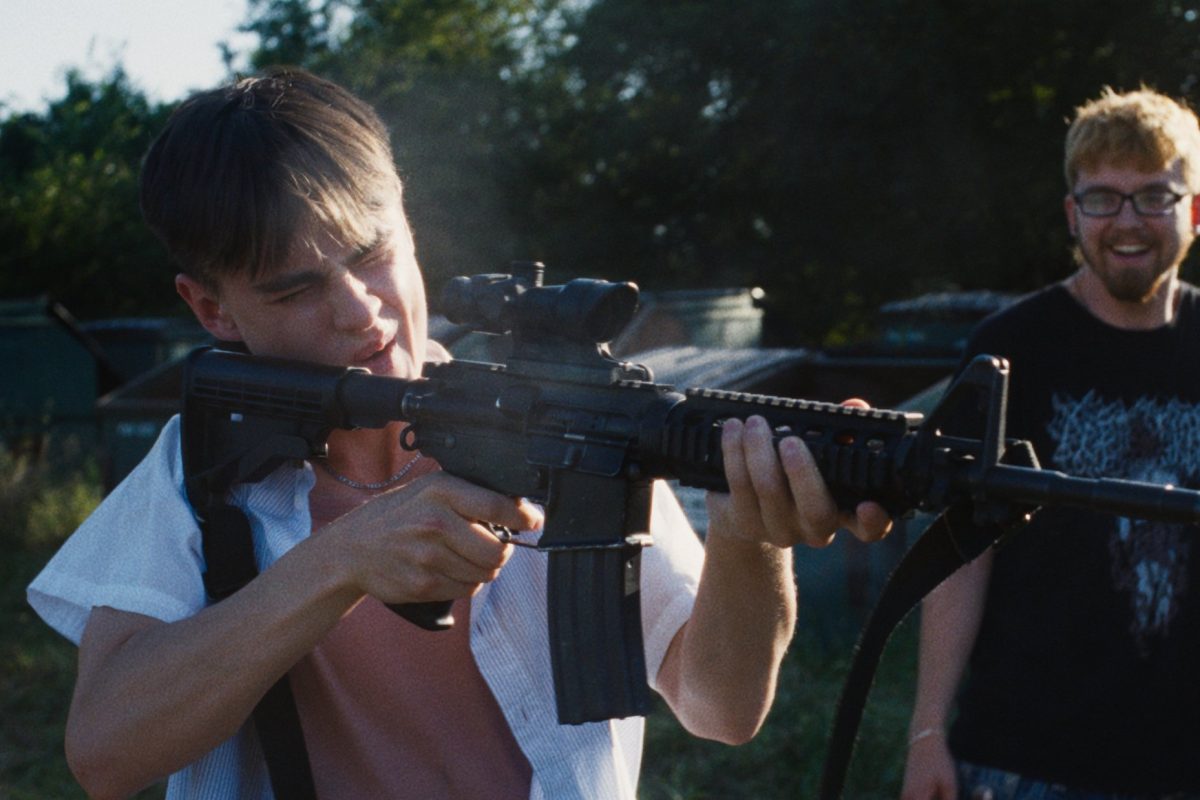
What’s most striking about Solomon is his relationship with weaponry, a familiar controversy in America due to flimsy gun control laws in Southern states. Intimate shots of Solomon taking his guns out of their cases, tending to them and shooting them with diligence highlight the systemic lack of oversight on gun control in America. The film leaves the audience to sit with this institutional failure, and it’s confident that it doesn’t need to do anything more.
“Our Hero, Balthazar” makes no explicit statements on gun violence, social media use and emotional neglect, but builds a world where these issues plague society. This approach is far more effective than telling an audience exactly how they should feel. Uncomfortable in its relevance, the film forces us to confront the disconnect between gun violence and its digital narrative.
Contact Jaclyn Macatee at [email protected]