






















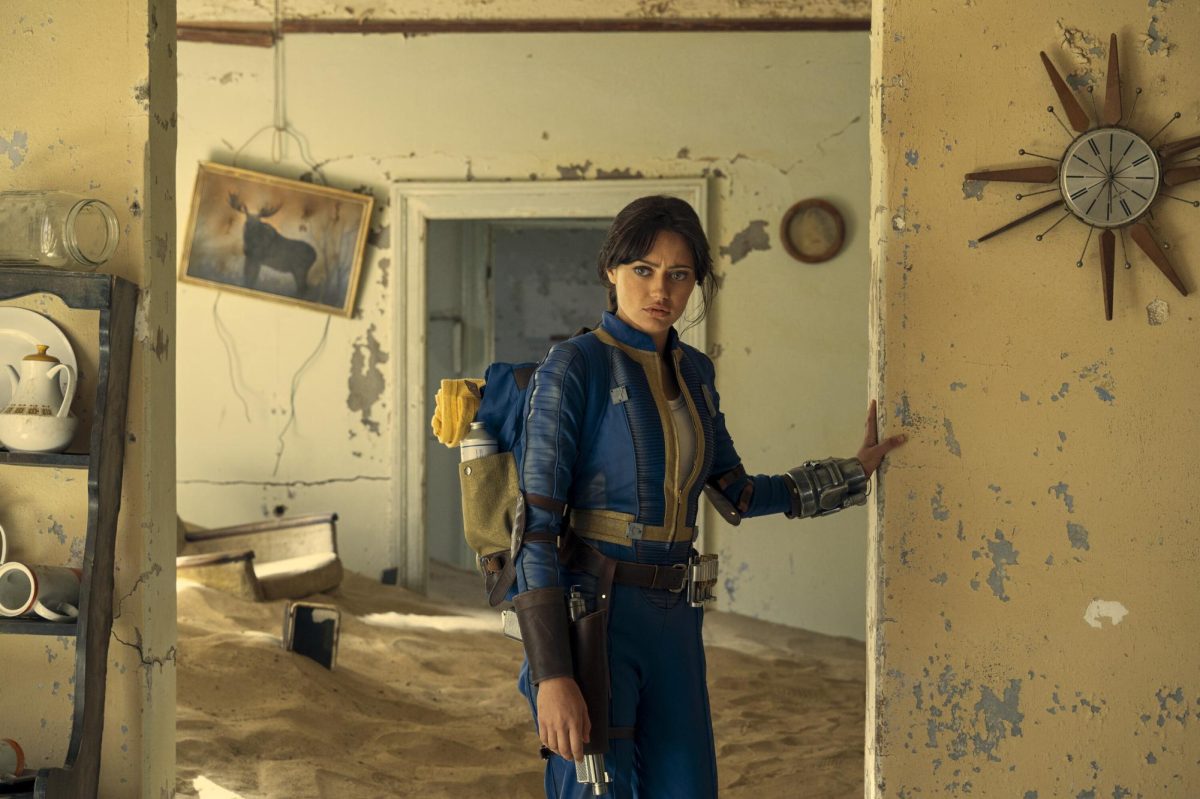
The teasers for “Fallout” season two hinted at some big changes. The sci-fi drama series’ new installment was set to take place in New Vegas, a post-apocalyptic no-man’s-land. We were excited to revisit Lucy MacLean’s (Ella Purnell) father, Hank MacLean (Kyle MacLachlan), and his role in the conspiracy to nuke the United States. We also hoped to finally learn what happened to Cooper Howard’s (Walton Goggins) family. Ultimately, the season’s Tarantino-esque stitching of an abundance of storylines and various flashbacks seemed poised to culminate in one giant explosion, but all we got was a lackluster fizzling out.
“Fallout” takes place in the year 2296, after most of humanity is wiped out by a nuclear war between the United States and China. Now a wasteland, the U.S. is populated by various irradiated, bloodthirsty creatures. Some Americans have survived in massive underground Vaults created by the malicious Vault-Tec corporation. Lucy is one of those Vaulters, having spent season one on the brutal surface. By her side are the gunslinging mutant Cooper Howard, also called the Ghoul, and Maximus, a member of the Brotherhood of Steel military faction.
Season two introduces enigmatic CEO Robert House, creator of the season’s primary conflict: mind-control chips. We also get glimpses of the New California Republic militia and the Deathclaws, monstrous genetically engineered creatures that eat anything unfortunate enough to cross their path.
With the increase in gory monster fights, Easter eggs from the original games and snapshots of the bleak surface world, too much content is crammed into eight episodes. House’s mind-control chips end up functioning as a teaser more than anything, and pose less of a threat than what viewers are initially led to believe. The show also spends a lot of time on flashbacks to the Ghoul’s previous life, in which he worked as an undercover government agent. As visually interesting as it is to see the world of 2077 contrasted with post-nuclear 2296, this unnecessary backstory steals screen time from the far more intriguing main arc.
This season has a lot of fun references to the “Fallout” video games for players, but the fan service seems to take priority over the plot. The NCR, a massive aspect of the game, is established early on as a big part of Lucy’s quest, but disappears until the last episode. On the other hand, the three warring factions of the Brotherhood were done well, revealing a childlike, humorous foil to Quintus and his cutthroat chapter. Simultaneously, the Brotherhood actually drives the plot forward as the factions’ leaders fight over the cold-fusion diode, a device that provides near-infinite nuclear energy.
Season two also builds up the Enclave, a bloodthirsty fascist collective working to establish a functioning state of supposedly pure Americans, while killing or enslaving all mutants they consider inferior. The Enclave is responsible for the Forced Evolutionary Virus, an injectable infection that rewrites the subject’s genetic code with preloaded DNA. But the show glosses over the Enclave’s involvement with the FEV, its implications and House’s control chips. With these and the diode, there are simply too many stray plot devices to keep track of. As a result, viewers are left feeling off-kilter and unable to fully grasp any concrete messaging.
The second season of “Fallout” ends up being a wild goose chase with the sole purpose of setting up the next one. The storyline feels rushed and confusing, moving impossibly quickly between scenes instead of spending time developing a small number of characters. We’re left with cliffhangers, loose ends and more annoyance than anticipation. It seems the fate of the Wasteland will continue to hang in the balance until the show returns with season three in 2027.
Contact Roshan Rao at [email protected].