




























Maggie O’Farrell’s 2020 novel “Hamnet” explores the inextricable link between art and life. The fictional story tells how the death of William Shakespeare’s son Hamnet inspired his enduring play “Hamlet.” Released at the start of the pandemic, the book’s reckonings on grief echoed across a quarantined world of strained human connection. Five years later, a film adaptation from director Chloé Zhao — and co-written by O’Farrell — turns tear-stained pages into a cinematic song of heartbreak.
“Hamnet” marks Zhao’s return to a grounded style of filmmaking after her big-budget venture with the Marvel Studios film “Eternals.” Despite that film’s overwritten and impersonal script, an undeniable truth emerged: Zhao has a singular and trademark directorial language. She roots each film in nature, capturing trees as characters and allowing natural light to guide the camera. Her stories focus on characters plagued by grief, loneliness and cognitive dissonance.
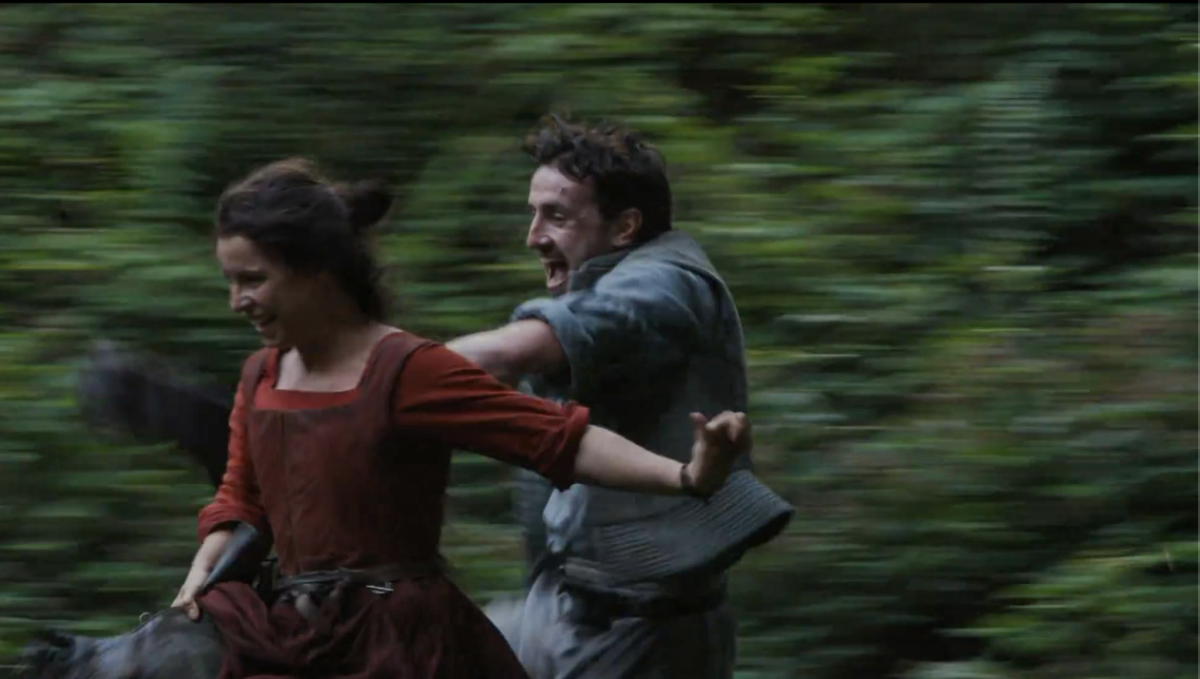
“Hamnet” centers on William Shakespeare’s (Paul Mescal) wife, Agnes (Jessie Buckley), a striking woman who seems to breathe alongside the trees as she crushes herbs and predicts the future in fragments. Will and Agnes fall in love, gaining the disapproval of their families to have three children and get married. But Will feels stifled and confined by small-town life, so Agnes suggests he travel to London, where his fervent creativity finds an outlet in the theater. In his absence, the plague penetrates their home, first infecting Hamnet’s twin, Judith, but ultimately killing Hamnet just as she recovers.
Zhao mounts tension effectively as she works towards the central tragedy at a steady pace. Her glacial direction allows empty moments to swell with so much visual subtext that their slowness feels vital.
At the beginning, cinematographer Łukasz Żal tracks storybook shots of Agnes in the forest, the camera surging and lapsing with the unknowable idiosyncrasy of the wind. After the shaking pains of Agnes’ pregnancy and childbirth, it slows down, lingering on the sky-high joys of childhood and the laughing faces of the family. The plague’s arrival brings clouds and darkness as Żal details every tear on Agnes’ face and every bead of sweat on Hamnet’s small body.
Finally, in a theatrical sequence capturing the first performance of “Hamlet,” the cinematography comes to a standstill, emphasizing the characters’ physical separation as their emotions swell.
The performances, too, are forces of nature. Buckley acts with freewheeling dynamism and emotional depth. Similar to Zhao’s direction, the script is intentionally spare at times, leaving Buckley to telegraph grief and maternal ferocity with tangible physicality. She takes it to another level, traipsing through the forest like a mythical creature and nuzzling her children like a lioness. When the grief comes, her screams and sobs shake the very core of her body, a seismic wave of emotion even Agnes cannot control. Through Buckley, “Hamnet” finds its gut-wrenching emotion, transcending time and space with the universal pains of motherhood.
Mescal matches Buckley’s excellence, though his performance operates at a low tenor better defined by contemplative intensity and a heartbroken gaze. He works in the margins, coloring in the pains of Shakespeare’s past, the joys of his love with Agnes and the stunted emotions that pull him away from his children and into the theater. As he chokes on tears seeing Agnes watch the play he created for their son, Mescal’s character finally experiences emotional catharsis.
“Hamnet” hinges on a protracted exhibition of the pain Agnes and William feel over their loss. Some have dismissed this approach as grief porn, despair for the sake of teary audience reactions. But Zhao’s direction is so well-measured that Buckley and Mescal’s performances vibrate with reality even as they mount in intensity. The climactic moment of grief feels like climbing to the top of a mountain and seeing the vastness of the world beneath. It’s all terrifying, transcendent and so intimately human that Zhao seems to be daring you not to shed a tear.
Contact Shrish Bulusu at [email protected].