

































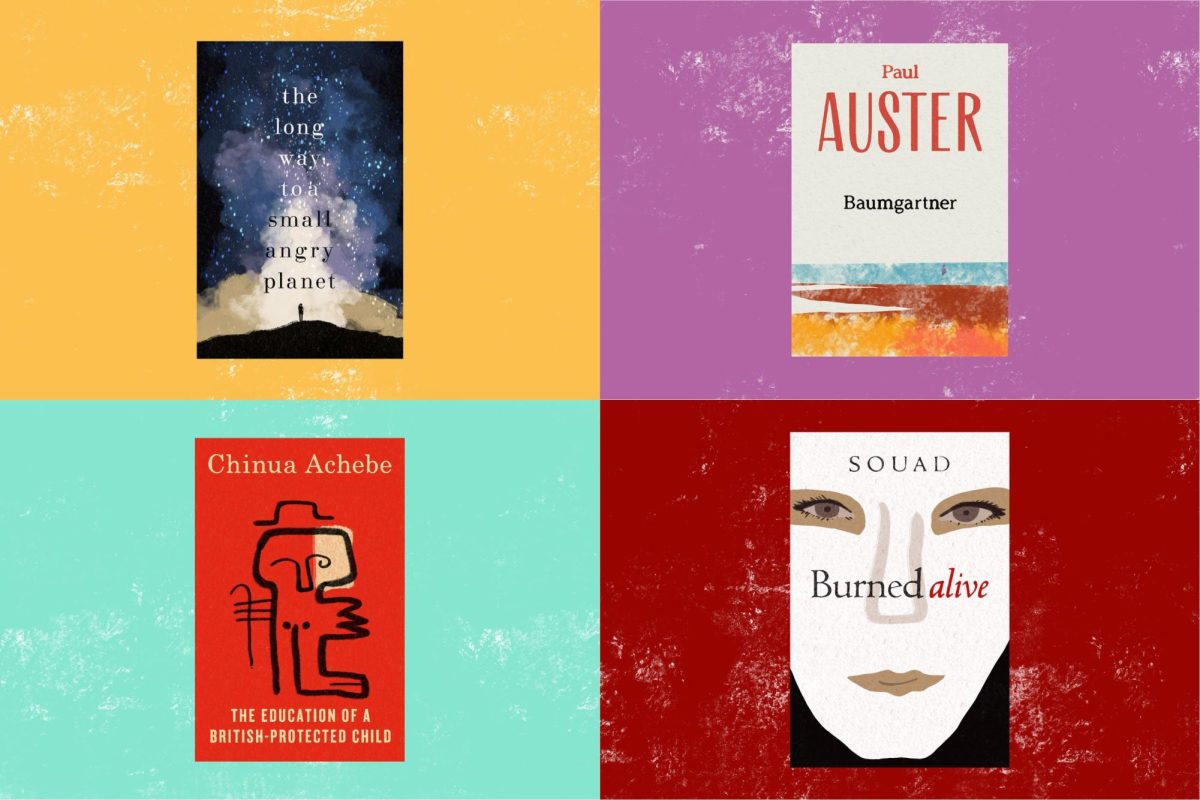
“The Education of a British-Protected Child” by Chinua Achebe

I picked up the late Chinua Achebe’s “The Education of a British-Protected Child” on an NYU Alternative Breaks trip to Accra at a local bookstore. I was looking for postcolonial African literature after noticing parallels between Ghana and my home country, India — two nations that shed British rule within a decade of each other. Achebe’s country, Nigeria, gained independence just three years after Ghana, making his 2009 book a natural next read. The autobiographical essay collection draws on nearly 80 years of life, from his childhood in colonial Nigeria to his eventual exile following a political coup. While his most recognizable work, 1958’s “Things Fall Apart,” filtered colonialism through fiction, here Achebe writes plainly and personally. He traces the psychological residue left behind by the empire in a country younger than he was.
— Krish Dev, Digital Director
“Burned Alive” by Souad

This immersive memoir tells the story of Souad, a 17-year-old Palestinian woman who survived her own brother-in-law’s attempt to kill her. Set in the 1960s, “Burned Alive” tells the devastating real-life experience of pursuing love outside of traditional expectations and being subjected to an attempted murder. Souad is a captivating writer, and it was difficult putting this book down. Vividly written accounts of her romance, fears, traditions and family dynamics bring readers deeply close to her by the end of the story. It is, however, an uncomfortable awakening to the violence against women present in her culture, so reading it with nuance rather than an ethnocentric view is key. Souad, who is still alive and omits her last name to maintain her safety, is now somewhere in Europe.
— Leena Ahmed, News Editor
“The Long Way to a Small, Angry Planet” by Becky Chambers

Becky Chambers’ debut science fiction novel emphasizes the journey over the destination. Published in 2014, “The Long Way to a Small, Angry Planet” follows the crew of the spaceship Wayfarer, made up of humans and various alien species, as they take on a dangerous but worthwhile assignment to dig wormholes across the galaxy. On their trip, readers get a firsthand view into the zany minds of the many crew members and their interpersonal dynamics. While not everyone gets along personally — with algaecist Corbin and pilot Sissix being particularly argumentative — it’s clear the crewmembers all hold a deep love for one another, often putting themselves at risk to save each other’s lives. The convoluted science terms that drag down some sci-fi novels take a backseat to what is ultimately an endearing story of a found family.
— Skylar Boilard, Arts Editor
“Baumgartner” by Paul Auster

With his 18th novel, Paul Auster demonstrates finely tuned, sophisticated prose to tell a story filled equally of love and grief. In “Baumgartner,” the titular character, now 71, wades through each day marked by loneliness after the death of his wife, Anna, in a swimming accident nine years earlier. The novel meanders between Baumgartner first meeting Anna when they were university students in 1968 and other episodes of their life, up until her tragic death. Auster details both the grand and small moments of life, all through Baumgartner’s retrospective lens. If you are searching for a novel to make your eyes well up, tear you apart and put you back together in just over 200 pages, Auster’s brilliant writing will do just that.
— Siobhán Minerva, Editor-at-Large
Contact the Arts desk at [email protected].