
































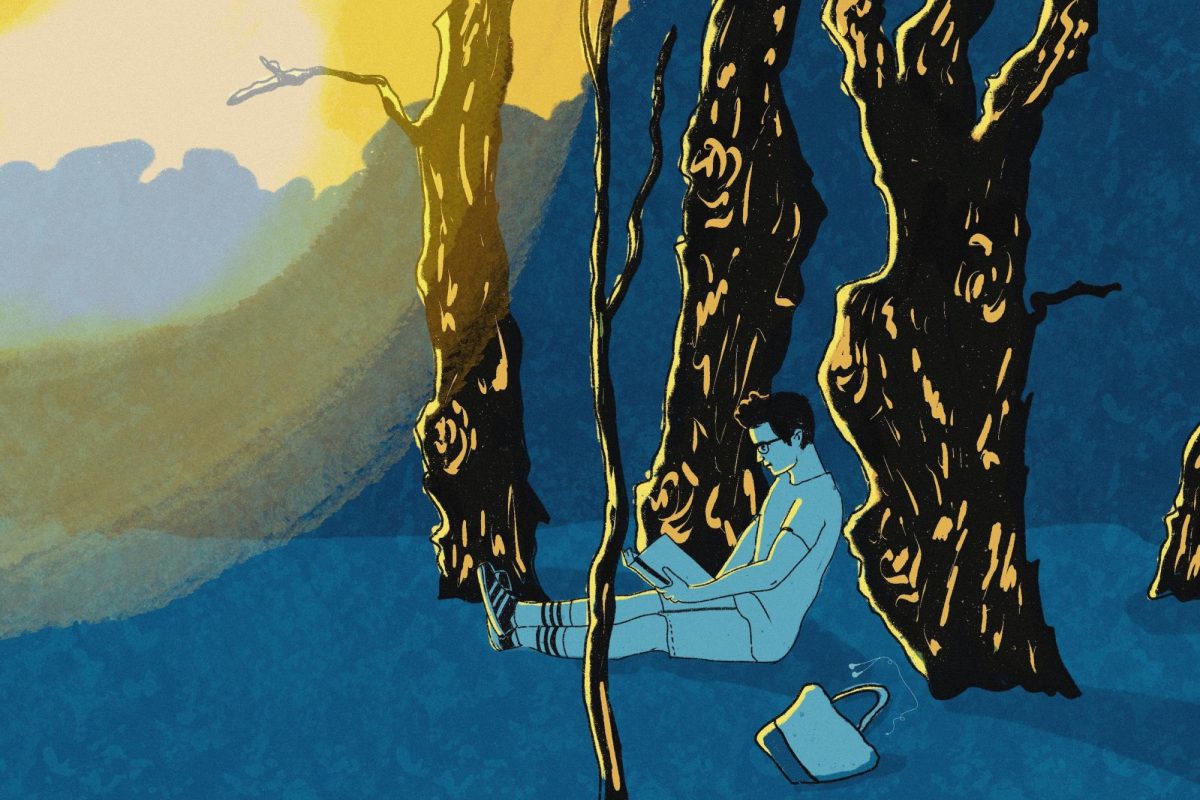
Whether it’s claiming your favorite movie is a 1960s black-and-white French film or humblebragging about your JPMorgan Chase internship on LinkedIn, we all love to perform for our audiences. It’s fun to curate yourself to fit a script — on Monday you’re the lead in a messy romance, by Friday you’re the productive worker fighting the capitalist machine. Next time you want to impress the manic pixie dream girl from your Gallatin class, try reading one of these pretentious but surprisingly grounded books. Bonus points if it’s at the Washington Square Park fountain and you have only one wired headphone in.
“The Stranger” by Albert Camus
I took The Magnetic Fields too seriously when lead singer Stephin Merritt wrote, “I could dress in black and read Camus,” because that is literally what I did in high school. For the entirety of those four years, I proudly proclaimed Albert Camus’ 1942 existentialist novella “The Stranger” to be my favorite book — and honestly, I stand by that choice. The story follows the emotionally indifferent Meursault, who goes off the rails and senselessly murders a man on a beach after his mother’s funeral. Meursault’s disillusionment with the world and refusal to conform to typical social norms is exhilarating to read, allowing readers to immerse themselves in his alienation. I don’t care if I sound pretentious, Camus really is that groundbreaking.
— Skylar Boilard, Arts Editor
“Invisible Man” by Ralph Ellison
“And my problem was that I always tried to go in everyone’s way but my own.”
The only reason I read “Invisible Man” was to impress my Advanced Placement U.S. History teacher. His fun fact on the first day of school was that it was one of his favorite novels, and being the teacher’s pet that I am, of course I had to read it. The plot centers on an unnamed narrator whose identity as a Black man exposes the racism of 1930’s America, most notably when he is forced into violent fights to please white onlookers. Ralph Ellison’s work is a gripping masterpiece on soul-searching, emphasizing that one can’t be seen until they stop living for everyone else’s gaze. It’s an anti-performative performance that will totally change how you see yourself.
— Rhea Kohli, Fine Arts Editor
“Convenience Store Woman” by Sayaka Murata
“Convenience Store Woman” is the ultimate weird girl book to name drop with your indie friends, but beneath the aesthetic is a story that’s oddly comforting. The narrative revolves around Keiko, a woman who only feels human when she is functioning as a cog in the convenience store machine. The book gets incredibly specific about the sensory details of her labor — the chimes of the doors, the scripted greetings, the exact way she’s supposed to smile — leaving readers with a grounding feeling rather than an unsettling one. While its cult classic status makes it a performative read, Sayaka Murata’s rejection of normal ambition and relationships challenges readers to wonder why we no longer value simple, quiet lives.
— Srishti Mangla, Staff Writer
“My Year of Rest and Relaxation” by Ottessa Moshfegh
“My Year of Rest and Relaxation” may be the sacred text for moody teenage girls, but that doesn’t mean it’s not worth your time. Author Ottessa Moshfegh entered the mainstream on BookTok, known for her biting satire and mocking tone. The novel, set in pre-9/11 New York City, follows an affluent, miserable and unnamed young woman who attempts to sleep for an entire year. Moshfegh details how the young woman uses drugs to bypass the hollow consumerism of her life, delivering an apathetic and nihilistic critique of capitalism and beauty culture. While the journey is cold, the final pages offer a visceral moment of awakening that make the year of slumber feel necessary.
— Abby Nye, Staff Writer
Contact the Arts desk at [email protected].