



























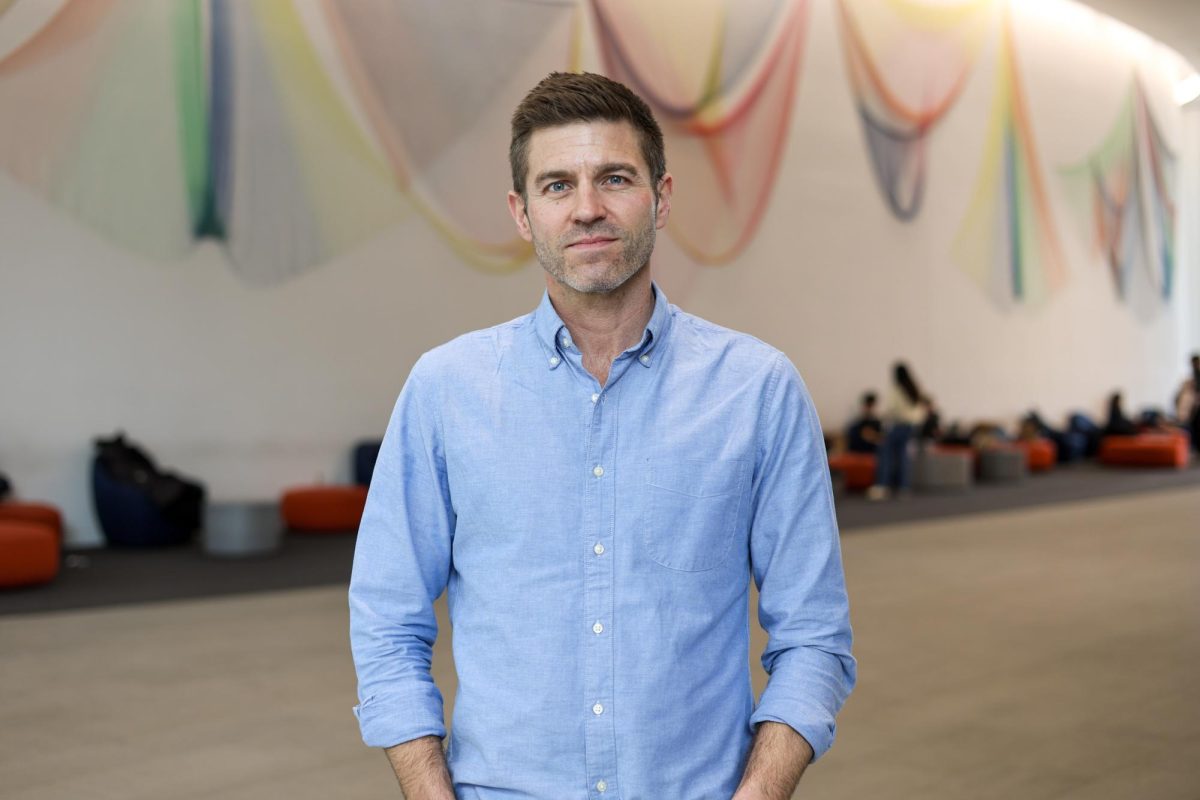
For many college students, graduation signals the beginning of a future filled with unanswered questions and the fear of the unknown becoming harder to ignore. Grant Ginder, a first-year writing professor at NYU, has built his decadeslong career around examining the emotional intricacies of growing up and exploring how relationships cultivate and crumble. After receiving his MFA in fiction from NYU in 2011, Ginder became known for novels like “The People We Hate at the Wedding” — which was adapted into a movie with Kristen Bell — and “Let’s Not Do That Again,” in which he blends his unfiltered humor and honesty to capture the messiness of adulthood.
“When you’re 22, you just think you’re gonna be 22 forever,” Ginder told WSN. “You end up making all of these choices that you don’t even know that you’re making, but you make them day in and day out, and eventually those accumulate into a life.”
Selfish decisions and growing apart take center stage in Ginder’s latest novel, “So Old, So Young.” Following its Feb. 17 release, the book — which is structured nonlinearly and with shifting perspectives — has already made USA Today’s Booklist and a New York Times weekly list of best new books. The novel follows six college friends as they move through love, careers and shifting dynamics over two decades, reconnecting at five pivotal parties that challenge their friendships. His work serves as a time capsule, reflecting the millennial reality of growing up alongside cities with changing skylines and a music scene that stretches from The Cranberries to Cardi B.
WSN spoke with Ginder, who closed out February with book talks across the country including in Brooklyn and SoHo, about navigating the pains of aging, portraying imperfect characters and teaching at NYU.
This interview has been edited for length and clarity.
WSN: When you first started writing this book, what was the thematic question you were most interested in exploring?
Ginder: The thing that I really wanted to account for in the book was how quickly time passes, and the effect that time passing and growing up can have on friendships. One of the funny things about being a professor at NYU is that I’m 43 and it still feels like yesterday I was in college. You all get older and graduate, and I’m still there, always surrounded by college students. Time is funny in that way for me.
WSN: Your characters are deeply flawed and sometimes frustrating, but also incredibly lovable. How did you go about fleshing them out, and what prompted you to create each of them the way you did?
Ginder: I’m not interested in characters that always make good decisions, because I don’t think that those are real people. I think that all of us, to a certain extent, can be selfish — those are kind of the complicated parts of us that make us human. I also think that so much of reading fiction is about feeling less alone in the world. For me, I feel less alone when I read a character that has, in some way, had a thought that I’ve had. It’s funny writing characters: They start as little bits of yourself, and then you kind of blend them with little bits of other people, you know? But then suddenly, 50 pages in, they’ve become their own people, and they take on a life of their own. It’s one of my favorite parts of the process.
WSN: New York City is almost like its own character in the book. What did New York allow you to do as a setting that another city wouldn’t?
Ginder: Part of growing up in a place is watching that place change and seeing your favorite restaurant become a store that sells $400 jeans. I moved to New York in 2008, and since then, the city has changed dramatically. I wanted characters to have that experience of being in a city that was evolving with and around them. The emotional heart of the book is transferable to a place, but I know and love New York, and I wanted these people to experience it like I have.
WSN: In your acknowledgements, you mention that you ‘almost lost your mind’ while writing this book. Outside of writing, how did you stay sane during that process?
Ginder: Teaching — and I’m not just saying this because I’m talking to an NYU newspaper. Teaching is remarkable in terms of giving structure and also being in contact with other consciousnesses. What I love about teaching so much and reading my students’ work is that I feel like I’m in this semesterlong conversation with every single one of them, and I’m able to be in their minds. And that gets me out of my own mind. I need that as a writer, because otherwise I just spend way too much time in my own mind.
I’m also an incredibly social person, so it gets me out of the house, which I need. Am I allowed to say, gin martinis? Gin martinis, just a little bit dirty, from time to time, really helped. And really long walks while listening to fellow NYU alum Maggie Rogers. Everything I could do to get out of my head, that’s what kept me sane.
WSN: As a student, something I really struggle with is knowing when a conclusion is done. What was creating the ending of this book like for you, and how did you know it was the right place to stop?
Ginder: I knew that there was always going to be a death, because I wanted this friend group to face a number of different challenges and changes. And one of the changes that you face as you grow up, unfortunately, is grief and loss. There had to be a way for them to experience that.
I honestly think there comes a point when you just have to call it. I wrote 11 drafts of this thing. I could have written 22 drafts of this and kept tinkering with it, but I think that you get to a point where you’re like, this is good enough. This is as close to true as I can get — and now I just have to release it to the world.
WSN: Do you have a favorite line from the book?
Ginder: ‘For years and years, she told herself that she was going to be different, but now she saw that what she had really meant was that she was never going to get old, which was funny in retrospect, because getting old was what she had been doing all along.’
Contact Rhea Kohli at [email protected].
Leah Block • Mar 5, 2026 at 10:01 am
I just ordered So Old, So Young from Book of the Month — I had no idea the author was an NYU professor! I can’t wait to read it!