


















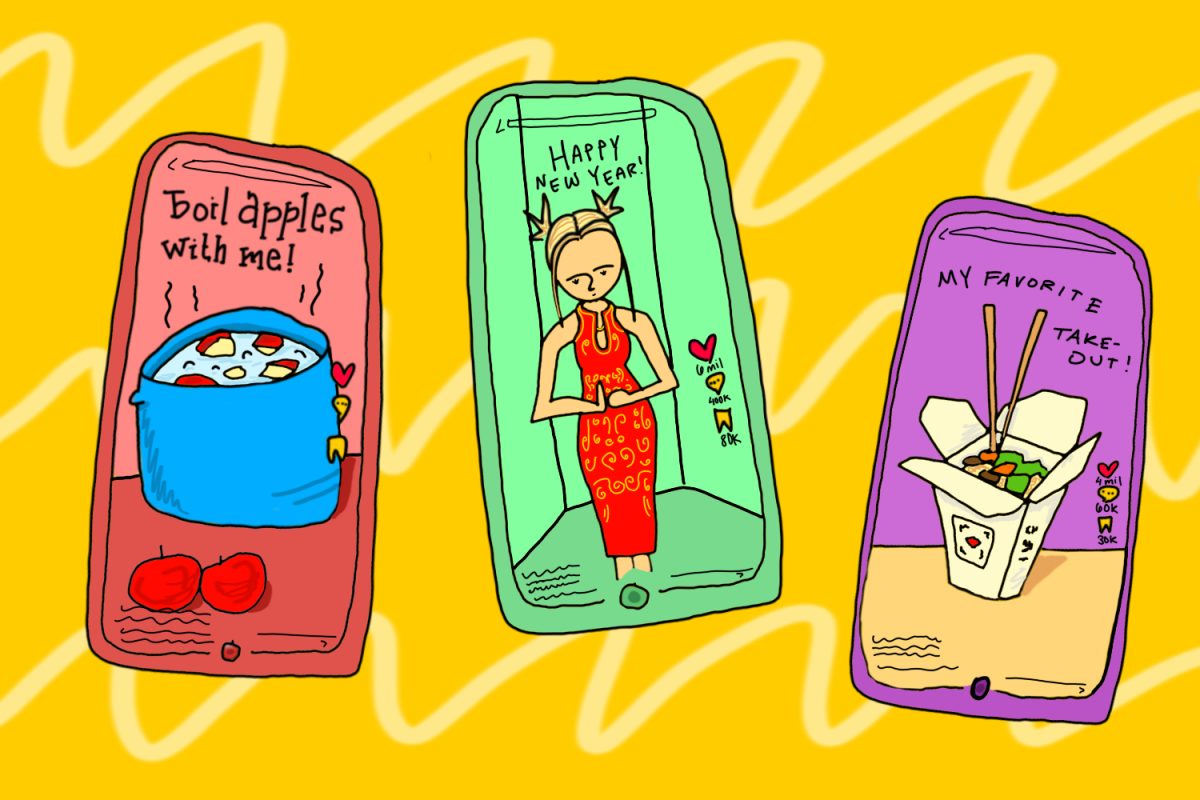
I, a second-generation American-born-Chinese, am about as out-of-touch with my culture as you can get. If you ask me what I did to celebrate Lunar New Year or the Lantern Festival, the answer is simple: absolutely nothing. Maybe I had a nice home-cooked meal with my parents, but if you asked me to explain the tradition behind it, I’d be at a loss for words. While I struggle to describe my own culture, some — who are notably less Chinese than I am — don’t struggle at all.
It’s in this same corner of social media that you see videos on making apple tea and drinking hot water, all often accompanied by some variation of “I’m at a very Chinese time in my life,” “I’m becoming Chinese” or “Chinese baddie.” These online phrases have been mostly attributed to Sherry Zhu on TikTok, an Asian-American influencer who took off after telling her followers that they were Chinese late last year. Zhu, who was riding the coattails of a growing interest in Chinese culture, created her platform through humorous skits about Chinese customs.
But the willing victims of Zhu’s preaching are consuming it out of context, as trendy lifestyle choices on social media. In real life, my family tells me to wear slippers and take herbal medicine in the same breath they tell me to “Stop playing video games” or ask “How about a more profitable major?”
In other words, it’s all less cool than you’d think.
Regardless, the concept has become so widespread that The New York Times picked up on it, writing that when it comes to this new idea of being Chinese, “Your ethnicity is beside the point.” The article, although written by an Asian reporter, interviewed no Asian American creators, pro-trend or otherwise. The article is silent about how hate crimes targeting Asians spiked just a few years ago during the pandemic. The reporter’s only mention of anti-Asian rhetoric was in a reply she left in the comments section, where she claimed she “didn’t get to include” it in the article itself.
For Gallatin first-year Ophilia Lu, a board member of Asian Heritage Month at NYU’s PR committee, ethnicity is exactly the point. Though now-viral remedies such as snow fungus soup are a real part of her family’s diet, being Chinese doesn’t just mean eating Chinese food. When things sour, it also means being a scapegoat.
“Because when another COVID hits, you guys can easily stop being Chinese,” Lu said. “You guys can turn on us with a snap of your fingers.”
Instead, through interviews with Chinese wannabes, The Times article portrays indulging in Chinese culture — making parodies of traditional Chinese music and eating congee — as a way of escaping America’s own government negligence and social upheaval. The result is a piece that smacks of tone deafness.
This trend suffers from a tendency to center the culture and not the people who actually belong to it, according to CAS junior Cynthia Han, who is Taiwanese American. She spent her fall semester at NYU Shanghai, where she grew to understand the appeal of mainland Chinese culture. Yet Han says what is happening here is not cultural appreciation but conditional consumption.
“They don’t really see AAPI people as people, in a sense,” Han said. “They see them more as guides or props — we’re just here to teach the ‘way’ of Chinese culture, we’re gonna be the mysterious Asian who talks weirdly and says ‘Chinese’ in the middle of our sentences”
While Asians are often stereotyped as quiet, the response to this trend from Asian American creators has been anything but — from satire to full-blown essays citing bell hooks and angry rants. This video even connects the trend to the recent online controversy — H Mart gate — in which an Asian American creator faced backlash for saying that she “side-eyes” white people in H Mart. Her TikTok was followed by a debate that questioned whether gatekeeping Asian grocery stores, and by extension Asian culture, from non-Asian people is justified.
And so we’re back to the age-old question: Where’s the line between insensitivity and appreciation? For CAS first-year Doris Zheng, another board member of AHM, being aware of the full picture — language, current issues and all — is key.
“Most people participating in this trend probably can’t even pronounce our last names correctly,” Zheng said. “I don’t see them organizing against rapid gentrification across the country, where Chinatowns are slowly disappearing, where Chinatowns are being priced out and people are being displaced because of selfish landlords.”
At the end of the day, trends are defined by their momentum. While we can’t change the minds of the tens of thousands of non-Chinese people who will follow Zhu to the grave, the rest of us can make the choice to be conscious of who we follow and whose posts we like.
“There’s a line between costuming around as Asian American versus genuinely trying to learn from them,” Han said. “Don’t give too much attention to the white American accounts unless they’re asking for tips, saying, ‘Hey, if I’m wrong, please let me know in the comments.’ That, I will 100% support.”
While the “I’m at a very Chinese point of my life” trend, when managed responsibly, can be a way for ABC people to reclaim and celebrate their culture, that’s something I prefer to do offline. I recently took advantage of the Manhattan Chinatown’s Lunar New Year parades to buy a doufang decoration — which you traditionally hang up on doors to welcome luck and prosperity for the new year. Because I was already late to hanging the decoration up in my dorm, I decided to deviate from the tradition even further. In a stroke of what I consider pure ABC genius, I wrote “job” on a Post-it and stuck it above the doufang’s character for prosperity, scotch-taping my masterpiece upside down on my door with gusto.
My ancestors would find this an abomination, but for me, it was a natural expression of my Asian American identity — good luck trying to find a hashtag or herbal remedy to define that.
Contact Mia Shou at [email protected].
Rhett • Mar 7, 2026 at 9:33 pm
It’s an intentionally absurd joke phrase. The last line of Fight Club (“You met me at a very strange time in my life”) being changed to “a very Chinese time…” is funny (however slightly) because being Chinese is very obviously not something that can be restricted to a specific time in your life.
Other variations poke fun at social media trends like: “I’m in my [blank] era,” or, “I’m [blank]-maxxing.”
Suggesting that a complex social identity can be affected as a developmental phase (“I’m in my Chinese era”), or optimized by adopting superficial markers (“I’m Chinamaxxing”) is deliberately silly.
Lu, Han, and Zheng fastidiously noted the lack of depth (i.e. the joke), but Han goes on to endorse giving Chinese tips while Zheng identifies language proficiency as an in-group marker. As if to say, “We’re annoyed by these half-hearted attempts at engagement with our culture, you’re not Chinamaxxing properly.”
Ultimately, the piece identifies the premise of a joke then bemoans the lack of commitment to the bit.
If there’s one person out there that sincerely thinks they can become Chinese by drinking hot water and wearing slippers, then I promise they’ll be hitched to a different trend within hours.