


















This year’s Met Gala broke the traditional standards of the skinny, hourglass figure, seeking to reclaim human bodies by building fashion that can support every person’s physique. Members of the Making Fashion Accessible project at the Tandon School of Engineering are honing in on this narrative head-first, reimagining fashion to be accessible for people with disabilities. Whether it’s using 3D printers to innovate accessible equipment, sewing costumes for disabled actors or conducting background research on accessible fashion, the nearly 20 students working on the program engineer wardrobe essentials to serve New York City’s disabled communities.
Founded after facing barriers due to a disability of their own, Daniel Johnston brought this team together after experiencing hindered motor skills in their hands as a result of arthritis — leading to an arduous and complicated journey earning their associates degree in fashion design at the Fashion Institute of Technology. Serving as a faculty supervisor for the Tandon project, Johnston is also an adjunct professor at the Tisch School of the Arts in the Interactive Telecommunications program. There, they contribute to the Ability Project, a lab researching the intersection of disability and technology functioning under Tandon, Tisch and the Steinhardt School of Culture, Education, and Human Development. For Johnston, Making Fashion Accessible was about building longevity for their love of crafting fashion pieces.
“Losing that ability to do something that you enjoy affects your mental health — and then that affects your physical health,” Johnston said. “So being able to keep up and feel that you can do the things you love to do will presumably make you happier.”
As a part of a larger, multi-year and interdisciplinary project base, the program is one of Tandon’s many Vertically Integrated Projects — one or two-credit courses that allow students to pursue hands-on research, entrepreneurship and education opportunities alongside their classes. With the project’s intent of engineering clothes to be accessible for disabled individuals, the VIP team utilizes Tandon’s MakerSpace, a workspace lab that fosters collaborative projects using technology. Tandon first-year and Making Fashion Accessible team member Olivia Matarazza emphasized the utility of the lab’s 3D printers to customize and manufacture fashion accessibility materials such as needle threading tools and Velcro buttons.
“I was very lucky to grow up in a school system where we had a really good inclusion model,” Matarrazza said. “From there, even just from an engineering perspective, it kind of gave me my why — why should I be an engineer? It made me really realize that people aren’t disabled by their impairments, but rather the barriers that surround us in everyday life.”
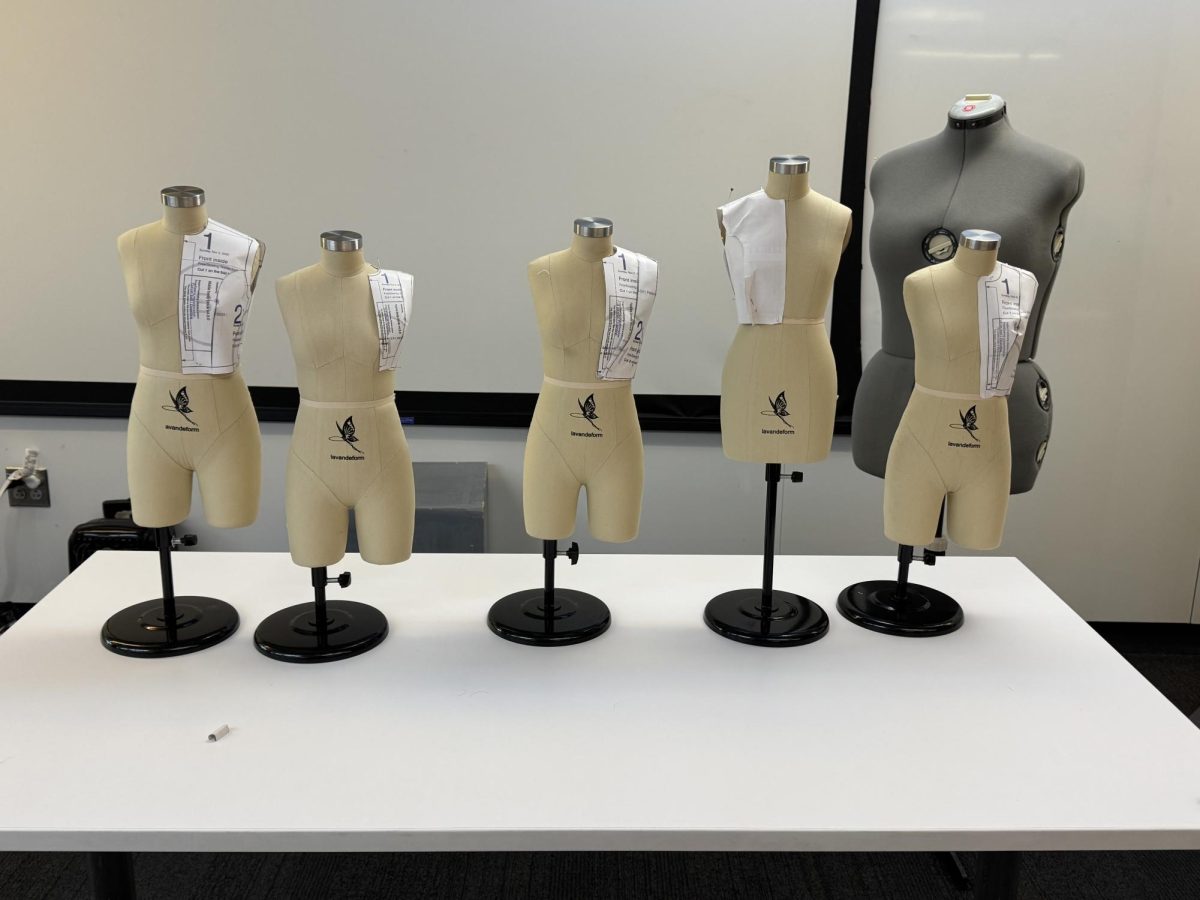
But work extends beyond the MakerSpace. As a part of their community outreach, the VIP team works directly with disabled individuals at local partner organizations. This year, the team is working with the Brooklyn-based ADAPT Community Network, which aims to connect and provide members of the disability community with housing, health, career and educational resources. Making Fashion Accessible supports ADAPT’s annual musical, cast entirely made up of disabled actors and singers by sewing costumes adapted to the individual needs of each performer. Students work with the organization to design, sew and fit the costumes, ensuring that each piece is uniquely and comfortably tailored. CAS sophomore Anaysha Khandelwal works directly with this year’s production, “Shrek the Musical” which needed four dragon dancers to be fit for costumes, two of whom were wheelchair users.
“These costumes were basically made for wheelchair users, which meant solving very complex problems,” Khandelwal said. “You have to maintain a certain length of the clothes, the fabric, headrest or magnetic closures, and everything is very differently designed for them.”
Beyond hands-on projects, Johnston has also integrated guest speakers who work to make an impact in the larger realm of disability advocacy into the VIP curriculum. Across all of its initiatives, the VIP project hopes to be an inclusive and welcoming space that advances fashion to adapt to everyone.
“Being an educator, I would love to be able to have students who feel that they may not be invited into a space know that their needs are not a burden,” Johnston said. “I would love folks to know that they could come into the MakerSpace and get the support that they need, to feel that no matter what support they need, they are welcome.”
Contact Natalie Plavec at [email protected].