














































































































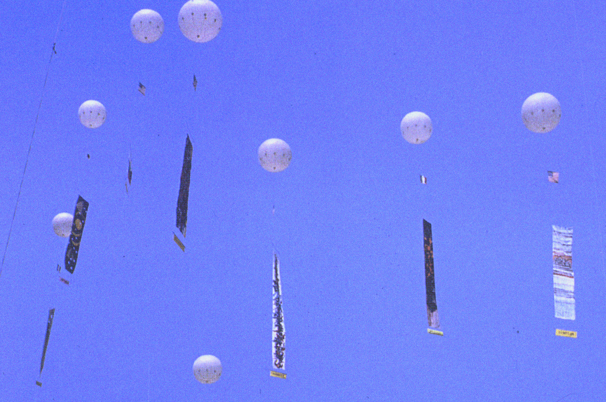
“Gutai: Splendid Playground” is the first major retrospective of the Japanese art movement in the United States since its debut at the Martha Jackson Gallery in 1958.
Upon entering the Guggenheim, one immediately witnesses a reproduction of Sadamasa Motonaga’s “Water.” The installation, made of plastic strips filled with varying colors of water, extends up the atrium, making it remarkable at all angles, Due to the atrium’s verticality, “Water” is one of the few works potentially enhanced by the museum space.
The initial exhibition was problematic because the gallery space could not accommodate the art, and it ended up harming the movement, which strove to extend art out into the real world through interactive, large-scale works.
While the Guggenheim exhibition makes gains in correcting these issues, the museum space still diminishes proper representation of Gutai. Despite such limitations, curatorial decisions have done well to make the exhibition informative to those uninitiated, something important considering the general lack of knowledge surrounding Gutai.
Nevertheless, “Water” raises a larger problem for the exhibition as a whole. It seems stagnant in a certain regard, calling into question whether the work can grasp the same effect it did originally strung up among trees at an outside “amusement park” of works set up by Gutai artists in 1956.
Gutai artists were interested in bringing art into the environment and having it directly engage the viewer. Thus, many Gutai works were originally intended for audience participation in large, open spaces — an idea that the exhibition only touches on a few times.
The best example would be Tsuruko Yamazaki’s installation “Red,” a large red cube hung a few feet off the ground. The museum viewer must bend down to enter the structure. Once inside, a surreal experience unfolds. Within the cube are bright lights that shine down upon the viewer, accentuating the red walls. The interaction is largely one founded upon experience, thus bringing it closer to what Yamasaki initially intended.
Unfortunately, there are few instances like this in the exhibition. Most works are paintings, sculpture or improper renditions of installations that fail to immerse the viewer. These reproductions feel like a fleeting effort on the museum’s part — they never feel as earnest or artful as they should.
The exhibition does, however, act as a great crash course on a lesser-known movement. “Gutai: Splendid Playground” arranges the selected works according to various ideas incorporated by the Gutai. Descriptions of Gutai concepts line the exhibition, and works following these explanations are grouped well to give examples to what has been described. Videos and photography accompanying works tell about their production.
Much like its original 1958 exhibition, “Gutai: Splendid Playground” is a mixed bag. While it is full of gaping problems, the exhibition is nevertheless enjoyable and informative.
Devon Hersch is a contributing writer. Email him at [email protected].


Critic • Feb 21, 2013 at 11:48 am
You’re 20 and work at a Japanese Steak House & Sushi Bar; what gives you the right to criticize a great museum show on the Gutai group?
Forrest • Feb 21, 2013 at 6:27 pm
hey “Critic”… y u mad bro? u jelly? i think ur jelly.
chuck • Feb 22, 2013 at 12:08 am
OMG this just sounds horrible. I was in Japan last summer and they were doing an extensive show on gutai and this article is so on point– the installations were so engaging and thought provoking! this seems completely irrelevant! The new york guggenheim has just in my impression been really sucky. The bilbao one had a lot more interesting stuff I think, like Durer and shit. I’m no critic but ugh the only thing I like about guggenheim is the shape
bdf • Feb 20, 2013 at 10:57 pm
Nice article, but I’m better than you.