



























































































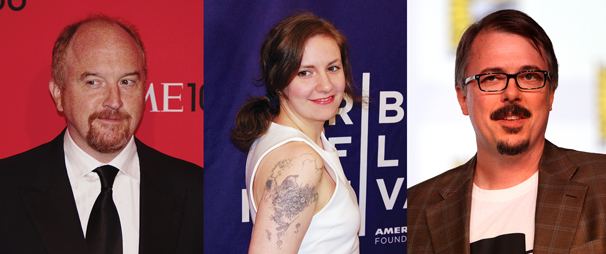
Television was initially bound by the power of censorship, ratings and producers, but as is the case with most art forms, the rules were not written in stone. Now, television is in the age of the “TV auteur,” a show runner who has complete creative control of the program.
One such auteur is Lena Dunham, Hollywood’s new “It” girl, who has received acclaim for her HBO dramedy “Girls.” In addition to frequently directing, Dunham is also the head writer and the star of the show. “Girls” has reached its current level of success because of Dunham, who disregards societal taboos and explores sex, love and drugs in more innovative manners. She enjoys creative control, which allows her to control a specific vision for the story, write it and then have the episode made exactly how she wanted.
The same can be said of Louis C.K.’s “Louie.” The FX show, starring, written and directed by C.K., has a per-episode budget of $300,000, a miniscule price compared to other programs. As part of a deal with FX, C.K.’s meager budget also grants him full control over the show. This kind of liberty is refreshing for the medium. Without any restraints, C.K., like Dunham, is given more power, which translates to a successful, entertaining and unusual show.
TV auteurism is not limited to just specific individuals but is becoming the way entire networks operate. AMC prides itself upon giving complete control to its show runners. With shows like “Mad Men,” “Breaking Bad” and “The Walking Dead,” it’s easy to see how auteurism benefits television. AMC provides an enormous amount of leeway in the production process while other networks have yet to follow the trend.
In “Breaking Bad,” for example, creator Vince Gilligan is also the producer, writer and director of some episodes. Much of the behind-the-scenes creative heavy-lifting is undertaken by Gilligan, and the amount of awards “Breaking Bad” has won since its inception is a testament to AMC’s method.
With the success of TV auteurism, it is clear that we have launched ourselves into a new era, one in which creativity triumphs over network limitations and where the voice of one person is not only acknowledged but placed at the forefront of the production process.
So why is this trend happening now?
The answer to this lies in film, which started as a substitute for theater and quickly became a cheaper source of good entertainment. Soon, filmmakers became more concerned with crafting the best and even the most controversial films.
In a way, television is an extension of film, representing an even cheaper and more accessible outlet. Initially, censorship and ratings limited TV, but now, with pay cable, many shows are freed from those weights.
With cable networks less concerned with ratings, show runners have pushed television’s boundaries and encouraged more risk taking. Television auteurism has yet to fully experience its renaissance, but, with the public’s growing fascination with edgier programming and proven successes, its arrival is only a matter of time.
Rotem Eitan is a contributing writer. Email her at [email protected].


Rena Moretti • Feb 13, 2013 at 8:30 pm
Lena Dunham an “auteur”?!!!!!!
What a joke.
She’s a rich, well-connected, talentless hack who keeps being shoved down our collective throats with the complicity of the press.
Lena Dunham can’t act, write or produce… How does that qualify her to be an “auteur”? Oh wait, I forgot her PR budget this article reflects.
Sadly we do not live in an era of TV auteurs, we live in an era of executives dictating nonsense and rich heiresses being hailed as something special.
Sad.